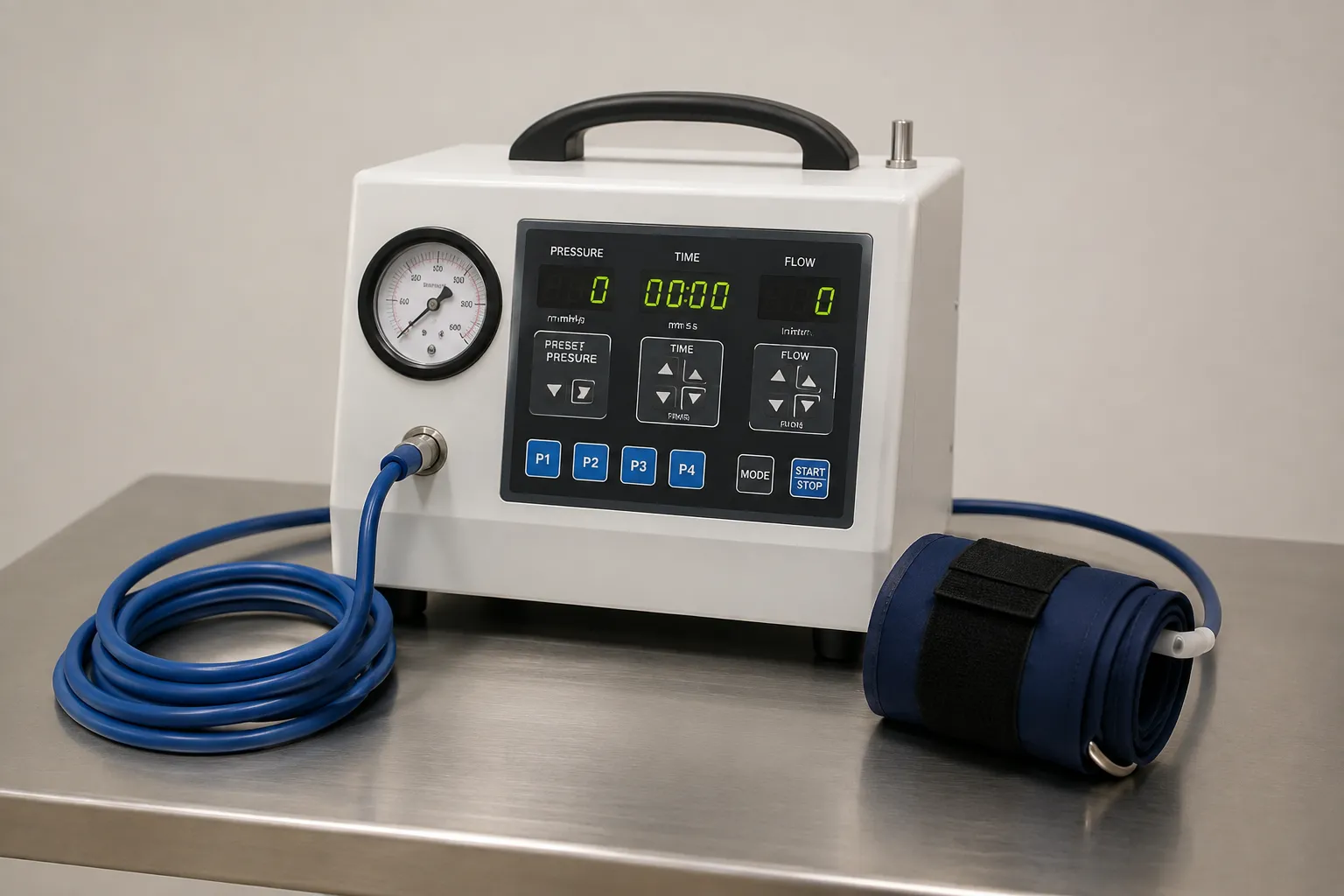
A pneumatic tourniquet is a powered instrument that inflates a cuff around a limb to a controlled pressure, squeezing the underlying arteries closed so a surgeon can work in a bloodless field. Unlike a simple elastic band or a manual strap, the pneumatic system regulates the pressure electronically, holds it steady for the whole case, and shuts off when set limits are reached. It is standard kit for orthopaedic, hand, foot and plastic surgery on the arms and legs.
For a theatre buyer, the device consists of a small console, cuffs, and connecting tubing. Still, the specification details carry details. Cuff fit, pressure accuracy, and time management are directly tied to patient safety, so the choices you make at purchase shape how safely the kit performs for years. This guide sets out how the system works and what to check before you commit.
How automatic pressure regulation works
Inside the console are a pump, a pressure sensor and a microprocessor that together form a closed feedback loop. The operator sets a target pressure; the pump inflates the cuff until the sensor reads that value, then the processor trims the continuously inflating and bleeding pump and bleed valve. Limb tissue is not rigid, so pressure drifts as muscle relaxes and the limb settles under the cuff. Automatic regulation corrects that drift without anyone touching a dial, which is the decisive advance over a mechanical gauge that shows a reading but does nothing to maintain it. A capable machine holds the set value within a few millimetres of mercury and displays the live pressure throughout the case.
Limb occlusion pressure and why it matters
Inflating a cuff higher than needed bruises muscle and can compress nerves; setting it too low lets blood seep back into the field. Modern practice has moved away from fixed textbook numbers toward limb occlusion pressure (LOP) — the lowest pressure that stops arterial inflow to that particular limb, measured for that patient on the day. Many consoles measure LOP automatically using a distal sensor and then add a defined safety margin. Because occlusion pressure depends on limb girth, the patient's blood pressure, and cuff width, measuring LOP allows the team to use the lower allowable value rather than a blanket 250 or 300 mmHg. Automatic LOP measurement is increasingly expected, so ask whether a console offers it.
Single-cuff versus dual-cuff systems
A single-channel console inflates one cuff and suits most limb surgeries. A dual-channel console drives two independent bladders, supplied either as two separate cuffs or as a double-bladder cuff on one sleeve. The twin arrangement matters most for intravenous regional anaesthesia, but it is also useful when a surgeon wants a spare channel ready. Independent timers and pressure readouts for each channel are the mark of a true dual system rather than not
Intravenous regional anaesthesia (Bier block)
In a Bier block, local anaesthetic is injected into a vein of an exsanguinated limb while the tourniquet keeps that anaesthetic out of the general circulation. A dual-cuff sleeve makes this practical: the proximal cuff is inflated first over unanaesthetised skin, and once the block has taken effect, the distal cuff is inflated over now-effectively numb tissue while the proximal cuff is deflated, easing the cuff-site discomfort that patients otherwise feel. This sequence needs a console with two independent channels, separate timers, and a safety interlock that prevents both cuffs def esfrom deflating simultaneously because pre-inflation flushes anaesthetic into the circulation. If your unit performs Bier blocks, a dual-cuff machine is not optional.
Cuff sizing and selection
Cuff width relative to limb circumference sets the occlusion pressure: a wider cuff occludes at a lower pressure and spreads the load over more tissue. Buyers should stock a range of widths and lengths, from paediatric arms to bariatric thighs, and consider contoured cuffs shaped for the cone of a large thigh, which seal better than straight cuffs and reduce the pressure needed. Decide early between reusable cuffs, which are cleaned between patients, and single-use cuffs, which remove reprocessing but add a per-case cost. Check that cuff connectors match the console; proprietary quick-connect fittings vary between makers and a mismatch renders otherwise good cuffs useless.
Pressure-sensor calibration and alarms
The sensor that governs the feedback loop must stay accurate, so consoles are verified against a reference gauge on a defined schedule, typically annually, as part of planned biomedical maintenance. A drifting sensor is dangerous precisely because the display looks normal. Alongside calibration, the alarm set is a core safety feature: expect audible and visual alerts for over-pressure, under-pressure, failure to reach the set pressure within a time window (which flags a leak or loose cuff), and low battery. Confirm that alarms cannot be silenced permanently and that the console fails to a safe state if power is lost mid-case.
Tourniquet time and safe use
Duration is the single biggest safety variable in tourniquet use, because prolonged ischaemia risks nerve and muscle injury. A pneumatic console runs an automatic, time-based inflation cycle at set intervals, allowing the team to plan and enabling perfusion. The clock, the live pressure and the elapsed time should all be visible at a glance. Good documentation of set pressure, LOP and total inflation time supports both audit and any later incident review, so a console that logs or prints these values earns its place in busy theatres.
Standards, regulation and decontamination
A pneumatic tourniquet is a medical device and must carry valid UKCA or CE marking, with instructions for use that state the intended purpose and the validated cleaning method for reusable cuffs and tubing. The console is mains- or battery-powered and falls under the general medical electrical safety standard IEC 60601-1, with electromagnetic compatibility requirements for theatre use. Reusable cuffs are cleaned strictly to the manufacturer's validated method between patients, and single-use cuffs are discarded after one case and never reprocessed. The MHRA regulates medical devices in the UK and is the route for reporting adverse incidents. At the same time, broader safety-at-work duties regarding equipment can help match consoles and cuff ranges to your case mix — register as a buyer or use the contact page.
Procurement checklist
-
Confirm the console holds set pressure accurately and displays it live throughout.
-
Check for automatic limb-occlusion measurement and adjust to a stable safety margin.
-
Decide single- or dual-channel, and specify dual-cuff if you perform Bier blocks.
-
Match cuff widths, lengths and contoured options to your patient range, and verify connector compatibility.
-
Confirm the alarm set: over-pressure, under-pressure, leak detection and low battery.
-
Establish the calibration interval and biomedical support for the pressure sensor.
-
Check automatically the lapsed-time display and any,loggingorr printout. printoutsPrintouts: CE documentation, IEC 60601-1 compliance and validated cuff cleaning instructions.
Conclusion
A pneumatic tourniquet earns its keep through control: it holds the set pressure, measures the lowest safe occlusion pressure, tracks time and warns the team when limits are reached. Buying well means matching channels and cuffs to the surgery you do, insisting on accurate regulation and a calibration set, and planning calibration and cuff decontamination from day one. Confirm the UKCA or CE paperwork and IEC 60601-1 compliance before you commit. MediGear can help theatres compare tourniquet systems so limb surgery is supported by a kit that is safe, reliable, and easy to service.
Disclaimer
This article is for informational purposes only. It is published by MediGear (medigear.uk) for general information and procurement guidance, and is not cli. It is not diagnostic, treatment, technical, engineering, legal or regulatory advice, nor a product endorsement, guarantee or substitute for professional assessment. MediGear does not provide medical consultations. Buyers should consult their clinical, biomedical, estates and regulatory contacts, and the manufacturer's documentation, and independently verify all specifications, certifications, compatibility and suitability before purchase. Specifications, certifications and availability are correct at the time of publication and may change without notice. MediGear is a medical-equipment distributor and does not sell medicines or pharmaceutical products.