What a tilt table is and how it tests orthostatic tolerance
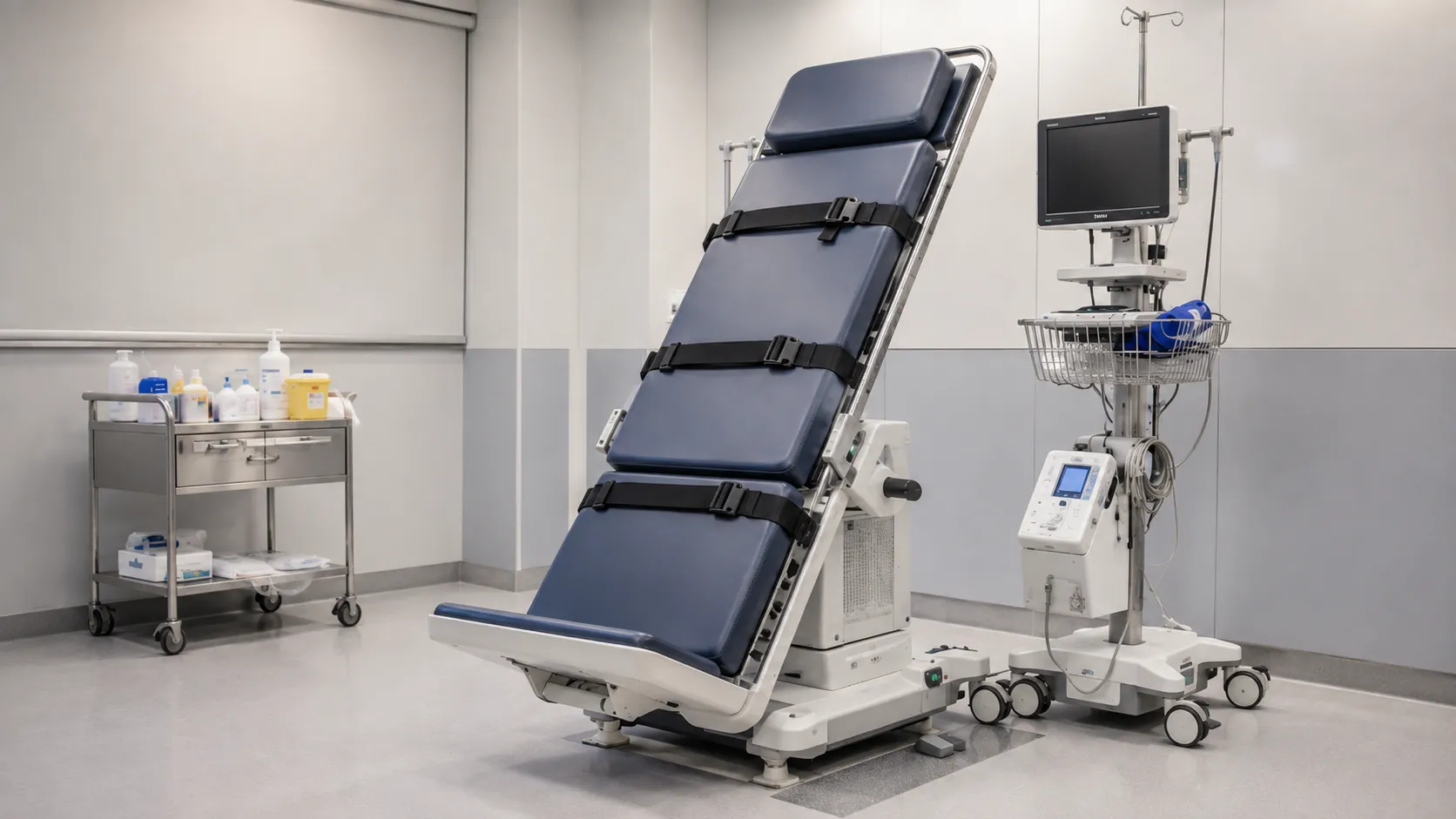
A tilt table is a powered treatment table that moves a patient from lying flat to an upright position in graded stages, allowing a clinical team to test and build orthostatic tolerance – the body's ability to maintain blood pressure and consciousness against gravity when moving toward standing. The patient lies supine, is secured with straps at the chest, pelvis and knees, and rests against a footplate; the powered mechanism then tilts the surface through a controlled angle while the team observes the cardiovascular response. It is used both diagnostically, to investigate unexplained syncope and orthostatic intolerance, and therapeutically, to reintroduce weight bearing and upright posture after prolonged bed rest, spinal injury or neurological illness.
For a procurement lead, the defining features are the powered, angle-graduated tilt, the secure strapping and footplate, and the need to pause at any angle while monitoring. That combination sets a tilt table apart from every other rehabilitation surface in the department.
Tilt table, standing frame and Bobath table: keep the roles distinct
These are separate purchases with separate jobs. A tilt table starts with the patient fully reclined. It rotates them slowly toward vertical, making it the tool for grading orthostatic challenge from lying – ideal where blood-pressure response must be closely monitored. A standing frame brings an already partly upright, non-ambulant patient into supported standing for sustained weight-bearing. Still, it does not start from full supine or offer the same fine angular gradation. A Bobath table is a wide, low platform for hands-on neuro facilitation and does not tilt toward vertical at all. Specifying a standing frame when the clinical need is graded orthostatic testing, or vice versa, leaves the service unable to do the job safely.
The angle range and why graduation matters
The heart of a tilt table is controlled, incremental angle change. Tables typically move from the supine position to around 80–90 degrees, and the clinical value lies in stopping and holding at intermediate angles – for example, a partial tilt – while the patient's tolerance is assessed before progressing. Look at whether the angle is displayed clearly, whether it can be held precisely, and the speed of tilt, since a slow, smooth motion is essential when reintroducing upright posture. Emergency return-to-flat is a key safety feature: if a patient shows a pre-syncopal response, the team must be able to lower them rapidly and in a controlled manner.
Powered versus manual and the drive mechanism
Most clinical tilt tables are electrically driven, giving smooth, repeatable motion and freeing staff to monitor the patient. Some manual and hydraulic versions exist, but battery-powered operation with a battery backup or fail-safe lowering is preferred when a patient must be returned to flat without delay. Because the powered tilt is a medical electrical function, it is designed and assessed against BS EN 60601-1 for basic safety and essential performance, and mains-powered units should include appropriate protective earthing and a control that operates reliably at any angle. Ask about the drive type, the behaviour on power failure and whether a hand control and foot control are both provided.
Reading the angle and repeating the protocol
Head-up tilt testing depends on doing the same thing the same way each time, so the angle indicator is more than a convenience. A clear, legible scale – and, on some tables, a digital readout – lets the team return to a defined test angle precisely, which matters when a protocol calls for a set position held for a fixed period. Ask whether the displayed angle can be trusted over the life of the table or should be checked periodically against a known reference, because a table used for diagnostic testing benefits from a documented way to verify it.
The drive's duty cycle is the detail buyers most often miss. A tilt table may hold a patient at a set angle for many minutes at a time, repeated through a clinic list, so confirm the actuator and control unit are rated for that pattern of sustained holding rather than occasional movement. A motor sized only for brief, intermittent travel can overheat or wear early under repeated testing loads.
Footplate, straps and patient support
Because the patient bears increasing weight through the feet as the table rises, the footplate is a load-bearing component and should be adjustable to the patient's height and stated to a clear safe working load. Secure, well-padded strapping at the chest, pelvis and knees prevents sliding and stabilises the patient through the tilt. In shared units, quick-adjust straps and a footplate that repositions without tools speed up patient turnover. Check the padding material for durability and for compatibility with your infection-prevention team's disinfectants, and confirm that the surface tolerates repeated wipe-down. Side-arm supports, or handgrips, are a useful option, giving the patient something to hold and adding reassurance during the first tilts after a long period of bed rest.
Monitoring context and clinical environment
A tilt table is rarely used in isolation; the orthostatic response is assessed alongside blood pressure and heart rate monitoring, so the table needs to be within reach of monitoring equipment and, when used for syncope investigation, close to resuscitation support. When specifying, think about the surrounding environment: clear access on both sides for staff, room to bring a monitor and, for a mobile table, lockable castors so it stays stable once positioned. The table is one part of a monitored assessment set-up, and siting it well is part of specifying it well.
Standards, UKCA marking and the MHRA
A powered tilt table placed on the GB market is an active medical device and should be UKCA (or recognised CE) marked, with the manufacturer registered with the MHRA; the powered mechanism is assessed to BS EN 60601-1. For the clinical context in which tilt-table testing sits – investigation of syncope and orthostatic intolerance – national clinical guidance from NICE is the appropriate reference for services designing their protocols. This buyer's overview is drawn from manufacturer specifications and current UK device rules and is written for NHS and private rehabilitation and cardiology-linked buyers; MediGear's part is to help facilities compare verified suppliers on the specifications that matter, not to advise on clinical protocols.
Where tilt tables are used
Tilt tables are used in rehabilitation gyms to reintroduce upright posture after critical illness or spinal injury, in neuro-rehabilitation services, and in cardiology or falls/syncope clinics for head-up tilt testing. The intended use shapes the specification: a rehabilitation service progressing weight-bearing may prioritise a low-loading platform, a smooth, graded tilt, and an adjustable footplate, while a syncope-testing service will prioritise rapid emergency return-to-flat, precise angle-holding, and proximity to highly sensitive monitoring. Define the primary use before comparing models, because the emphasis shifts markedly between a testing clinic and a weight-bearing rehabilitation gym.
Specifying a tilt table for your service
- Confirm the full angle range and the ability to hold precisely at intermediate angles.
- Check tilt speed and, critically, the emergency return-to-flat function and power-failure behaviour.
- Verify the footplate is adjustable and rated to a clear safe working load.
- Review strap positions, padding and quick-adjust features for your patient turnover.
- Require UKCA/CE marking, MHRA registration and BS EN 60601-1 assessment for the powered drive.
- Confirm access for monitoring equipment and, if mobile, lockable castors and a stable footprint.
- Ask about the drive type, battery backup and both hand and foot controls.
- Clarify warranty, actuator/motor service intervals and spare-part availability.
Beyond the purchase price
As with any powered table, the actuators, control unit, and battery backup are the components that determine long-term uptime, so a serviceable design with readily available spares is worth paying for. Upholstery and straps are wear items to budget for over the equipment's life. Delivery and siting of a heavy powered table, plus installation and a first service, should be confirmed up front. A robust drive and a durable, well-padded surface generally cost less across a decade than repeated repairs on a lighter unit. To weigh options, our team can help you compare tilt tables from verified UK suppliers or connect you through the enquiries desk.
The bottom line on choosing a tilt table
A tilt table succeeds when its graded angle control, secure support, and safety features match how your service tests orthostatic tolerance or rebuilds upright posture. Decide the primary clinical use first, then judge angle graduation, emergency return, footplate loading and servicing. Explore powered rehabilitation tables and reach vetted UK suppliers through MediGear's buyer network to specify a table that fits your protocol and your patients.
Disclaimer
This article is for informational purposes only. It is published by MediGear (medigear.uk) for general information and procurement guidance. It is not clinical, diagnostic, treatment, technical, engineering, legal, or regulatory advice, nor a product endorsement, guarantee, or substitute for professional assessment. MediGear does not provide medical consultations. Buyers should consult their clinical, biomedical, estates and regulatory contacts, and the manufacturer's documentation, and independently verify all specifications, certifications, compatibility and suitability before purchase. Specifications, certifications and availability are correct at the time of publication and may change without notice. MediGear is a medical-equipment distributor and does not sell medicines or pharmaceutical products.