Standing frames explained: supported weight-bearing for rehabilitation.
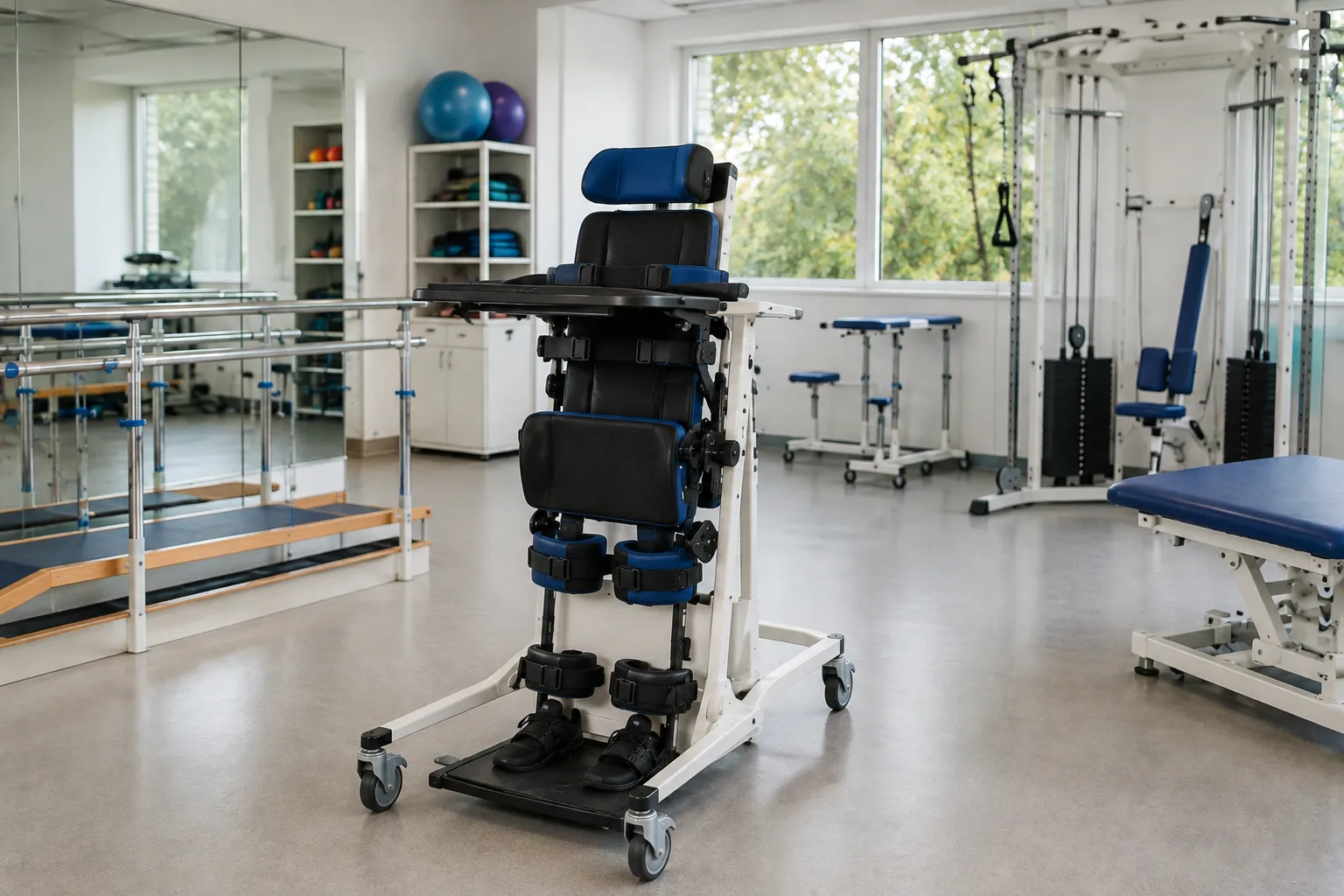
A standing frame is a rehabilitation device that holds a person in a supported upright position so they can bear weight through the legs when they cannot stand independently. It is used with patients who have limited or no standing ability – after spinal cord injury, in neurological conditions, cerebral palsy, or advanced neuromuscular disease – to load the skeleton, maintain range of motion at the hips, knees, and ankles, and support circulatory and bowel function through regular upright time. Straps, pads and a work surface hold the trunk, pelvis, knees and feet in alignment while the frame does the lifting and holding.
For a procurement lead, the device is best understood by its job: it delivers controlled, supported standing to people who are not yet ambulant. That single purpose distinguishes it from tables and bars used elsewhere in a rehabilitation service, and it drives every subsequent specification decision.
Standing frame versus tilt table and parallel bars
The same service often buys these items, so keep the distinctions clear. A standing frame brings a patient into a supported vertical position for sustained weight-bearing, typically strapped at the knees, pelvis, and trunk, with a tray in front. A tilt table achieves standing by rotating a fully reclined, strapped patient toward vertical on a powered bed-like surface – it is the tool of choice where orthostatic tolerance must be graded slowly from lying. Parallel bars, by contrast, support an already-standing patient during gait training. A standing frame occupies the middle ground: the patient is upright and loading the legs, but held securely rather than walking. Choosing the wrong one leaves a non-ambulant patient without a safe route into standing.
Prone, supine and sit-to-stand frames
Standing frames are not a single design. The main variants suit different levels of head and trunk control.
Prone standers
The patient is supported from the front and tilted slightly forward onto chest and pelvic supports, which encourage head and trunk extension. These suit users with some upper-body control who benefit from an active head-up posture and a tray for hand activities.
Supine standers
Support comes from behind, and the frame is brought up from a reclined start. This suits users with limited head or trunk control because the backboard supports the posture, and the angle can be gradually graded toward vertical.
Sit-to-stand and mobile standers
Some frames raise the user from a seated position using a powered or gas-assisted mechanism, reducing manual transfers. Mobile standers add castors so a user can self-propel or be moved while standing. Each added function changes the transfer method, footprint,t and price.
Strapping, supports and the angle of standing.
The clinical value of a frame lies in its support system. Look at the range and adjustability of knee blocks, pelvic and thoracic supports, foot plates, and the chest pad, and whether they can be adjusted without tools between users in a shared setting. Angle adjustment matters: the ability to grade the degree of upright loading – from a partial lean to full vertical – allows a service to progress a patient safely and accommodate those who cannot yet tolerate full standing. A well-padded, fully adjustable frame accommodates a wider range of cases than a fixed-geometry model. Foot-plate design also matters: adjustable, angled plates help maintain ankle position and even weight distribution through the feet, which is central to the loading the frame is meant to deliver.
Elevation mechanism and pressure care
On sit-to-stand and adjustable frames, how the user is raised is a specification in its own right. Gas-spring assistance is simple, quiet and needs no power, but the effort and rise speed depend on the strut rating and the user's weight. A powered actuator gives controlled, repeatable elevation at the press of a button and suits users who need slow, staged raising or a member of staff working single-handed. Weigh the two against your setting: a school or home may prefer the simplicity of gas assist, while a unit standing many users a day often values powered control and a consistent rise.
Pressure care deserves attention wherever a frame loads soft tissue. Knee blocks, a chest pad, and a pelvic support concentrate force on small areas, so look closely at pad size, contouring, and padding quality, and at how precisely each contact point can be positioned to spread the load. For users with reduced sensation or fragile skin, the ability to quickly adjust and check these pointy matters as much as the standing angle itself.
Sizing, safe working load and fit
Fit is a safety issue, not a comfort preference. Frames are made in paediatric, adolescent and adult sizes, and each has a defined user height and weight range plus a stated safe working load. In a shared rehabilitation gym, the adjustment range across a single frame matters as much as its nominal size, because it determines how many patients one unit can serve. Confirm the maximum user weight, the minimum and maximum user height, and the pad and strap adjustment ranges before you commit. An ill-fitting frame either cannot be used safely or leaves the patient poorly aligned.
Manual handling and how the patient gets in
Getting a non-ambulant patient into the frame is where injuries and delays happen. Consider the transfer method carefully: some frames require a hoist transfer, others raise the user from a sitting position, and mobile sit-to-stand designs reduce the handling burden on staff. These handling risks fall squarely under workplace duties enforced by the HSE, so the transfer method is a genuine procurement criterion, not an afterthought. Match the frame's entry method to your ward or gym's hoisting and staffing reality.
Standards, conformity and the MHRA
A standing frame supplied for therapeutic use in the UK is a medical device and should be UKCA (or recognised CE) marked, with the manufacturer registered with the MHRA. Assistive products of this kind are designed in accordance with the general requirements for assistive products for persons with disabilities set out in BS EN 12182, and any powered lifting element brings the relevant electrical safety requirements into play. This overview is assembled from manufacturer-standard documentation and current UK device rules to help NHS, community and special-school buyers specify sensibly; MediGear does not test devices but connects facilities with verified suppliers so that specifications can be compared like for like. Clinical decisions on standing programmes remain with the treating team.
Where standing frames are used
Frames appear across spinal injury units, neuro-rehabilitation and community physiotherapy, special schools and children's services, and increasingly in domiciliary settings where a home programme is prescribed. The setting shapes the specification: a school may prioritise a size-adjustable frame with a tray for classroom activities, a spinal unit may need a robust adult frame with a hoist-compatible transfer, and a home user needs a footprint and controls suited to a domestic space. Match the frame to the environment, not just the diagnosis.
Before you buy a standing frame
- Confirm the user height and weight ranges and the stated safe working load against your caseload.
- Decide prone, supine or sit-to-stand based on the users' head and trunk control.
- Check pad, strap and knee-block adjustability – ideally tool-free in shared settings.
- Verify the angle-of-standing range so upright loading can be graded safely.
- Match the transfer method (hoist, sit-to-stand, mobile) to your staffing and handling policy.
- Require UKCA/CE marking, MHRA registration and BS EN 12182 alignment.
- Confirm the footprint and, for mobile frames, lockable castors rated for the loaded weight.
- Clarify warranty, spare pads and strap availability, and any powered-component service interval.
Running costs and lifetime value
Pads, straps and harnesses are wear items on a frame in daily use, so factor replacement supports into the budget rather than treating the purchase as a one-off. Powered sit-to-stand mechanisms add a serviceable component that benefits from a maintenance plan and obtainable spares. A frame with a wide adjustment range and durable, replaceable supports serves more patients for longer and usually justifies a higher initial spend than a narrow, fixed-fit model that is quickly outgrown. If you are equipping a service, our team can help you compare standing frames from verified UK suppliers or discuss options via the enquiries desk.
Making the right call for your service
The best standing frame is the one that fits your users, matches your transfer capability and grades the standing angle safely – and keeps doing so as supports wear and caseloads change. Settle the frame type and fit range first, then weigh up the transfer method, standards, and running costs. Explore supported-standing equipment and reach vetted suppliers through MediGear's buyer network to specify with confidence.
Disclaimer
This article is for informational purposes only. It is published by MediGear (medigear.uk) for general information and procurement guidance. It is not clinical, diagnostic, treatment, technical, engineering, legal or regulatory advice, nor a product endorsement, guarantee or substitute for professional assessment. MediGear does not provide medical consultations. Buyers should consult their clinical, biomedical, estates and regulatory contacts, and the manufacturer's documentation, and independently verify all specifications, certifications, compatibility and suitability before purchase. Specifications, certifications and availability are correct at the time of publication and may change without notice. MediGear is a medical-equipment distributor and does not sell medicines or pharmaceutical products.