Parallel bars in gait training: what a rehabilitation centre is buying
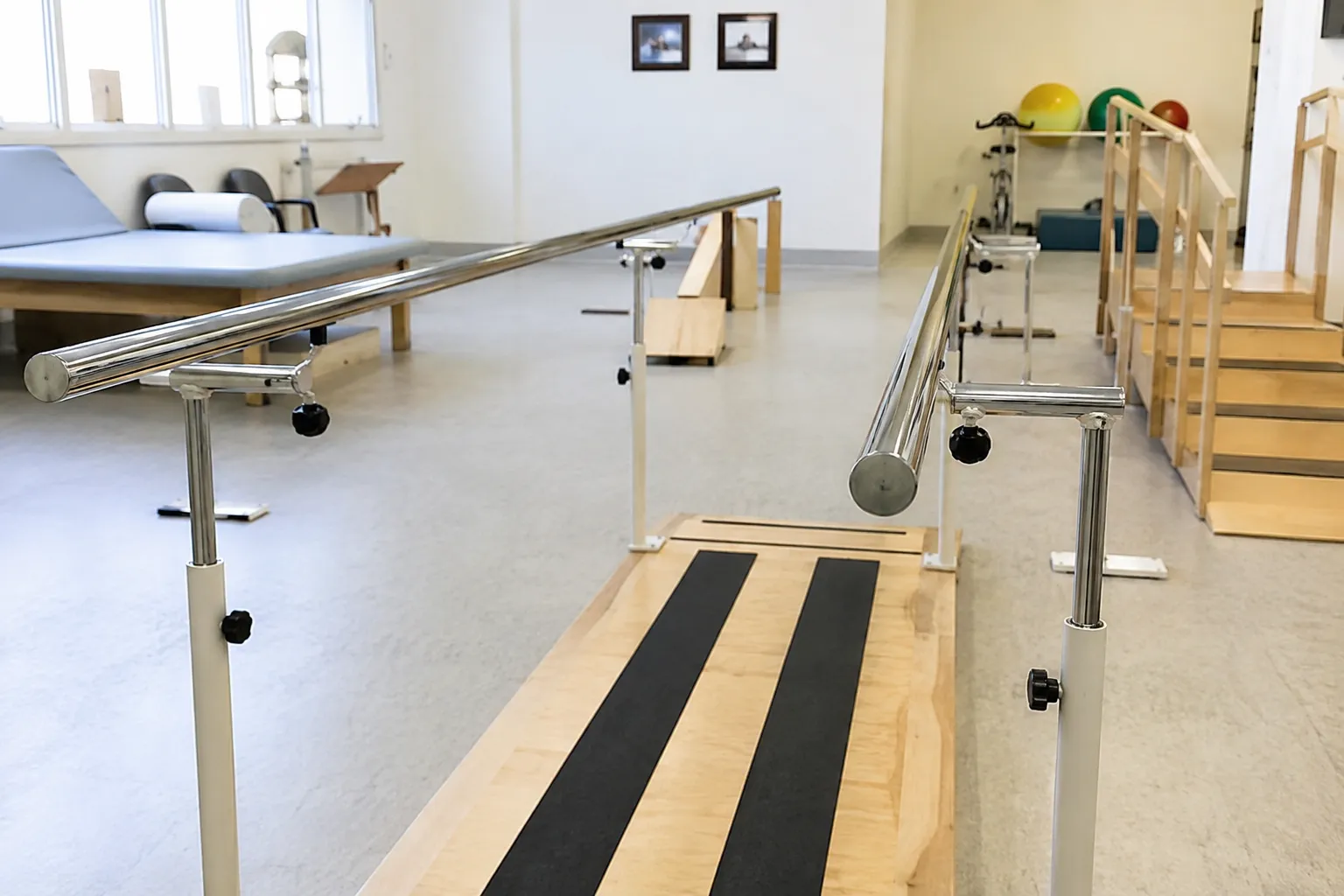
Parallel bars are a pair of fixed or adjustable horizontal rails, set at hip height on either side of a walkway, that give a patient secure two-handed support while relearning to walk. In gait training, they provide a stable frame within which a physiotherapist can progress standing balance, weight transfer, and stepping after stroke, amputation, joint surgery, spinal injury, or any condition that has disrupted walking. The patient grips both rails and takes controlled steps along the walkway while the therapist guides, corrects and safeguards. For a rehabilitation centre, parallel bars are among the most heavily used and longest-lived pieces of equipment in the gym, so specifying them well pays off for years to come.
The core job is straightforward: a rigid, dependable support on both sides during early gait re-education. Everything a buyer needs to weigh – adjustability, mounting, length and stability – follows from that.
How parallel bars differ from frames and standing aids
Keep the lane clear when specifying a gym. Parallel bars support an upright patient who is actively walking, offering fixed bilateral handholds along a set walkway. A standing frame, by contrast, holds a non-ambulant patient in supported standing for weight bearing and does not involve stepping. A tilt table reintroduces upright posture after lying down. Parallel bars are specifically the gait-training tool: the patient is on their feet and moving, using the rails for balance and support rather than being held. A centre building a walking-rehabilitation pathway needs the bars; they are not interchangeable with supported-standing equipment.
Height and width adjustment
The two adjustments that determine clinical usefulness are bar height and bar width.
Height adjustment
Bars should be set to roughly the patient's wrist or hip height, with the elbow slightly flexed for effective push-through. Adjustable-height models – often via a crank, gas assist, or motor – let a single installation serve patients of very different statures, from a tall adult to a child, which matters in a shared department.
Width adjustment
The gap between the rails must suit the patient's body width and mobility aid. Width-adjustable bars accommodate broader patients, those using a frame within the bars, and paediatric users. Fixed-width bars are cheaper but limit who can use them, so match the adjustment to your caseload breadth.
Floor-mounted, freestanding and folding designs
The mounting method is a major procurement decision with cost, stability and estates implications.
Floor-mounted (fixed) bars
Bolted to the floor, these are the most rigid and stable, ideal for a dedicated gait area and heavier or less predictable patients. They require an estates installation and a suitable sub-floor, and they are permanent.
Freestanding bars
Mounted on a solid base plate or platform, freestanding bars need no floor fixing and can be repositioned, which suits leased premises or multi-use rooms. They rely on the base for stability, so the platform must be substantial and the safe working load clearly stated.
Folding and platform-mounted variants
Some models fold or sit on a shared platform to save space; a platform base can also integrate a walking surface. Each variant trades a little rigidity or footprint against flexibility, so weigh what your room and caseload demand.
Length, walkway and progression features
Standard bars run in the region of 2 to 4 metres; a longer walkway lets a patient take more consecutive steps and build endurance, while a shorter run suits a compact room and early practice. Some systems add progression features – an integrated set of steps, a small ramp at one end, or an adjustable-height platform – so a patient can advance from level walking to negotiating a kerb or a stair within the same station. If graded progression matters to your service, confirm whether steps and ramps are included or bolt-on accessories.
Forearm platforms and the walking surface
Not every patient can grip a rail. For those with hand weakness, painful wrists, or a recent upper-limb operation, forearm support platforms that clamp onto the bars allow patients to bear weight through the forearms rather than the hands, widening the range of patients the station can treat. If your caseload includes rheumatology, hand-injured, or frail users, ask whether such attachments fit the model and adjust independently of the rails in height.
The surface underfoot is part of the specification too. A platform-mounted set brings its own walking surface, which should be firm, level and non-slip, and sit flush enough that a shuffling or high-stepping patient does not catch a toe on an edge. Floor-mounted bars instead rely on your existing floor, so check the finish grips reliably when clean and when footwear is damp, and that any threshold onto a platform is gentle. A predictable, even surface reduces the very trip risk the bars exist to guard against.
Stability, safe working load and materials
Because a patient may suddenly load one rail hard to save a stumble, rigidity and safe working load are central safety criteria, not niceties. Ask for the stated SWL and confirm it covers your heaviest anticipated patient plus the dynamic force of a near-fall. Rails are typically stainless steel or coated tube with a comfortable diameter and a warm, secure grip; the frame should not flex or creak under sideways load. For freestanding units, the base weight and footprint determine tip resistance. A set of bars that feels solid under a hard grab is doing its most important job.
Conformity, workplace safety and where the standards sit
In the UK, parallel bars used for therapy are supplied as rehabilitation equipment and treated as medical devices. They should carry the appropriate UKCA (or recognised CE) mark and have the manufacturer registered with the MHRA. Assistive products of this type are designed in accordance with the general requirements of BS EN 12182. Because the bars are a fixed piece of gym equipment that staff and patients rely on structurally, the workplace and equipment duties overseen by the HSE apply to their installation and inspection. The guidance here is compiled from manufacturer specifications and UK conformity requirements for a buyer audience; MediGear operates as a distributor, connecting facilities with verified suppliers, so specifications and safe working loads can be compared directly rather than assumed.
Where parallel bars are used
Bars are core kit in stroke and neuro-rehabilitation gyms, orthopaedic and amputee rehabilitation, spinal units, community and outpatient physiotherapy, and paediatric services. The setting steers the choice: a busy shared department benefits from height- and width-adjustable bars that serve many patients; an amputee service may want a longer walkway with steps for progression; and a space-constrained clinic may prefer a freestanding or folding set. Match length, adjustment and mounting to the room and the caseload.
Parallel bars buying checklist
-
Confirm both height and width adjustment ranges suit your full patient range, including paediatric or bariatric needs.
-
Decide on floor-mounted, freestanding, or folding based on your estate, tenancy, and space.
-
Check the safe working load covers your heaviest patient plus dynamic near-fall loading.
-
Choose a walkway length that fits the room while allowing enough consecutive steps.
-
Assess the rail material, diameter, and grip, and confirm that the frame does not flex under sideways load.
-
Decide whether integrated steps, ramps or a platform for progression are required.
-
Verify UKCA/CE marking, MHRA registration and BS EN 12182 alignment, plus installation to HSE-compliant standards.
-
Clarify the warranty and, for adjustable models, the mechanism type and spare-part availability.
Cost over the life of the bars.
Parallel bars are among the lower-maintenance items in a gym, but the total cost still reaches beyond the purchase. Floor-mounted bars essentially increase a state's installation cost and the required sub-floor space; adjustable models add a crank, gas, or powered mechanism that requires occasional servicing. Grips and any moving parts are the components most likely to need replacement over a long service life. A well-built, rigid set with a generous safe working load rarely needs replacing and is safer, which usually justifies choosing quality over the cheapest option. To compare options, our team can help you source parallel bars from verified UK suppliers or talk it through via the enquiries desk.
Choosing well for your gait-training service
The right parallel bars are rigid enough to trust during a hard grab, adjustable enough to fit your whole caseload, and mounted where your building and tenancy allow. Settle adjustability, mounting and safe working load first, then weigh length, progression features and servicing. Browse gait-training and rehabilitation equipment and reach vetted UK suppliers through MediGear's buyer network to equip your gym with confidence.
Disclaimer
This article is for informational purposes only. It is published by MediGear (medigear.uk) for general information and procurement guidance. It is not clinical, diagnostic, treatment, technical, engineering, legal, or regulatory advice, nor a product endorsement, guarantee, or substitute for professional assessment. MediGear does not provide medical consultations. Buyers should consult their clinical, biomedical, estates and regulatory contacts, and the manufacturer's documentation, and independently verify all specifications, certifications, compatibility and suitability before purchase. Specifications, certifications and availability are correct at the time of publication and may change without notice. MediGear is a medical-equipment distributor and does not sell medicines or pharmaceutical products.