Optical biometry measures the eye's dimensions with light so the correct intraocular lens power can be chosen before cataract surgery. It captures axial length, corneal curvature, and other distances, then feeds them into a calculation formula that predicts the lens power needed for the patient's target vision. For a procurement lead buying a biometer, the questions are the measurement technology, the range of eyes it can measure, the formulas and connectivity it offers, and the cost of keeping it current.
The measurement principle
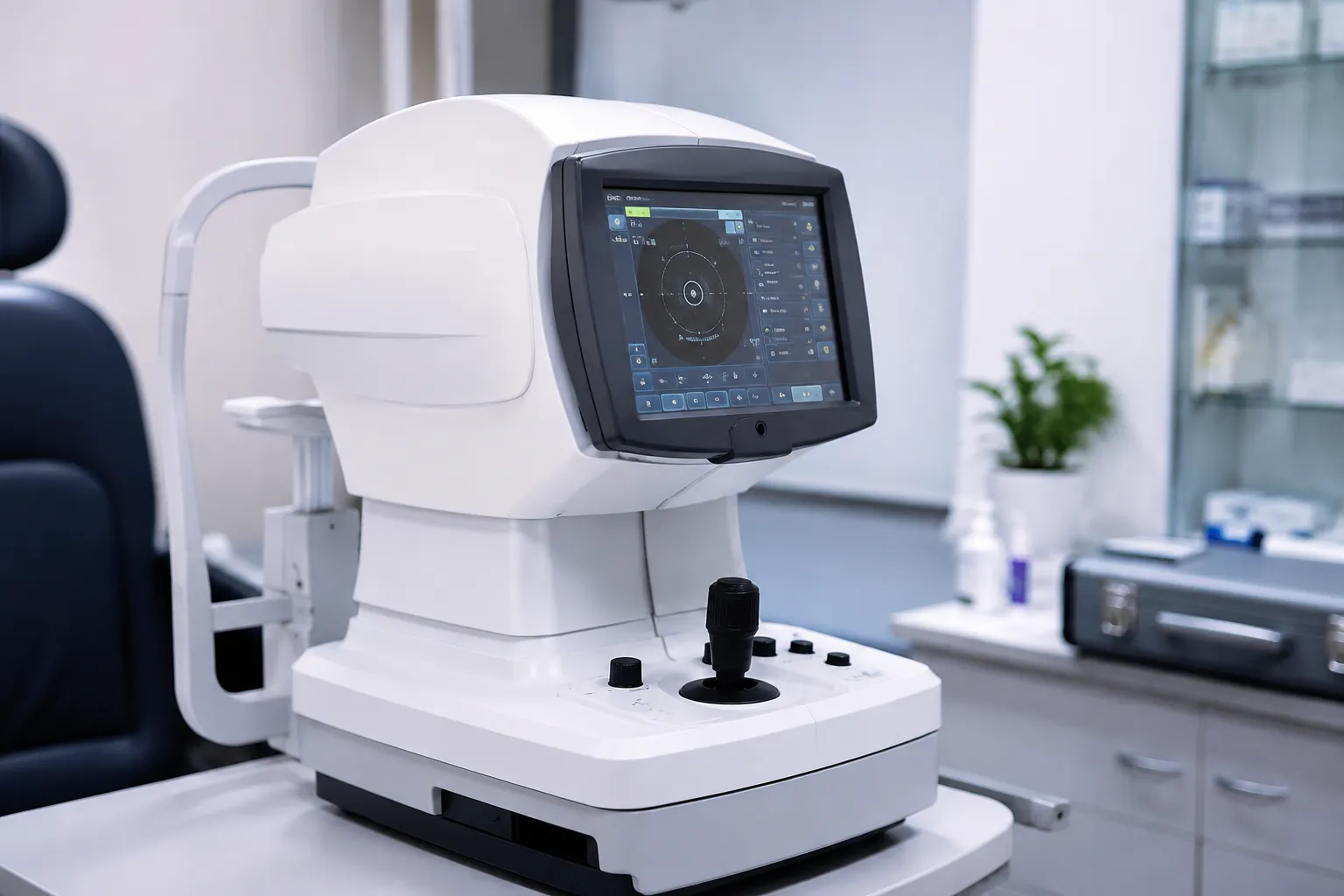
Optical biometers send low-coherence infrared light into the eye and detect reflections from each optical interface, from the tear film through to the retina. By analysing the interference between reflected beams, the device measures distances along the visual axis with high precision, most importantly the axial length from cornea to retina. It also measures corneal curvature by projecting rings or points onto the cornea and reading their reflection, and derives anterior chamber depth, lens thickness and white-to-white corneal diameter. Because the light is aimed along the line the patient is fixating, optical biometry measures the visual axis directly, which is one reason it has largely replaced older contact ultrasound methods for routine cases.
How lens power is set
The measured values are entered into an intraocular lens power formula. Modern formulas combine axial length, corneal power and other biometric inputs, sometimes with ray-tracing or large-dataset methods, to predict where the lens should sit and what power will achieve the desired refractive result. The surgeon selects a target, often emmetropia or a chosen degree of myopia, and the formula returns the lens power for the specific lens model, using constants supplied for that lens. Accurate biometry matters enormously here: a small error in axial length translates into a noticeable refractive surprise, which is why measurement precision and the choice of formula are central to good outcomes.
Sub-types and how they compare
Optical low-coherence interferometry and swept-source
Early optical biometers used partial-coherence or low-coherence interferometry. Newer swept-source instruments scan a range of wavelengths and penetrate dense cataracts and hazy media more reliably, measuring more eyes on the first attempt and often capturing posterior segment detail.
Ultrasound biometry
Contact and immersion ultrasound remains the fallback for eyes too dense for light to pass, such as very mature cataracts. It touches the eye, needs anaesthetic and depends more on operator technique, but it measures where optics cannot.
Combined and topography-integrated units
Some biometers add corneal topography, keratometry mapping or toric lens planning, which helps when astigmatism must be corrected. Decide whether you need these integrated or already have them elsewhere before paying for a combined unit.
Key specifications a buyer must check
Confirm the light source and whether the device is swept-source, since that affects how many dense cataracts it measures without resorting to ultrasound. Check the axial-length range and the measurement reproducibility, the keratometry method and range, and whether it measures anterior chamber depth, lens thickness and corneal diameter, all of which feed newer formulas. Review the formula library and whether you can add lens constants and updated formulas, because formulas evolve. Consider lens planning, the insertion speed, ease of fixation for older patients, and how the device handles poor fixation or media opacity. Autofocus, an intuitive display and a clear signal-quality indicator all affect throughput in a busy pre-assessment clinic.
Standards and UK regulation
An optical biometer is an electrical medical device using a light source, so it should meet IEC 60601-1 for general safety, IEC 60601-1-2 for electromagnetic compatibility and the light-safety requirements for ophthalmic instruments, with the relevant particular standard for ophthalmic measuring equipment. Any device on the UK market needs appropriate UKCA or CE conformity marking, where required. Manufacturer registration: Ask for the declaration of conformity and confirm light-exposure limits. The MHRA is the UK reference for device safety and field-safety notices, and NICE guidance informs the cataract pathways the equipment supports.
Calibration and routine maintenance
Optical biometers typically run an internal self-check and are verified against a supplied model eye or test piece; follow the manufacturer's schedule and keep records for audit and clinical governance. Keep the optics clean, because dust or fingerprints on the objective degrade signal quality. Software is a live part of maintenance: formula updates, new lens constants and outcome-tracking tools arrive through updates, so a device that is easy to keep current holds its clinical value longer. Track your refractive outcomes and refine lens constants over time, which improves accuracy independent of the hardware. This audit loop, sometimes built into the device, is part of good cataract governance and lets a service demonstrate its outcomes against national benchmarks. A biometer that exports outcome data cleanly makes that continual refinement far less laborious for the team.
Decontamination and single-use considerations
Optical biometry is non-contact, which is a real advantage: nothing touches the eye, so there is no probe to reprocess and minimal cross-infection risk. Clean the chin rest and forehead band between patients with an agreed disinfectant. Where ultrasound biometry is used as a fallback, contact probes need a validated cleaning routine or single-use covers, so factor that into the workflow for the minority of eyes that need it. Agree both routines with your infection-control lead.
Care settings and connectivity
Biometry sits in ophthalmic outpatient and pre-assessment clinics, day-surgery units and cataract high-volume lists, in the NHS and independent sector alike. Connectivity is central because the measurements must reach the surgical planning system and the patient record without transcription errors. Confirm networked export, integration with your electronic patient record and theatre systems, and whether toric and lens-selection data transfer cleanly to the operating microscope or planning software. A device that shares data openly reduces manual entry, which is itself a source of refractive error. If you run several sites, matching models simplifies training and lets you pool outcome data.
Total cost of ownership, warranty and servicing
Beyond the purchase price, budget for software and formula updates, service contracts, calibration, staff training and any per-measurement or planning licence. Optical biometry has specific consumables, but service and software support can be significant, so read the contract carefully. Ask suppliers for warranty length, what's included, repair turnaround, loan-unit availability, and the cost of major spares such as the optical engine. Because a working biometer is essential to a cataract list, downtime cover matters. The MediGear buyers team can compare options, or contact us for current availability and support.
Procurement checklist
-
Confirm the technology and whether swept-source improves measurement of dense cataracts.
-
Check axial-length range, reproducibility and which biometric values are captured.
-
Review the formula library and whether constants and formulas can be updated.
-
Confirm toric lens planning and export to surgical planning systems.
-
Verify UKCA/CE marking, IEC 60601 compliance and light-safety limits.
-
Check calibration against a model eye and the software update route.
-
Confirm patient-record and theatre-system integration to avoid transcription.
-
Get warranty, update inclusions, repair turnaround and downtime cover in writing.
Conclusion
Optical biometry sets the lens power that determines a cataract patient's vision, so measurement precision, an up-to-date formula library and clean data transfer are what a buyer should weigh most heavily. Match the technology to your caseload, keep aor the deeyes that need ultrasound, and confirm software support and servicing in writing. Comparing verified specifications through MediGear helps your ophthalmic service invest in a biometer that supports accurate outcomes, list after list.
Disclaimer
This article is for informational purposes only. MediGear (medigear.uk) publishes it for general information and procurement guidance. It is not clinical, diagnostic, treatment, technical, engineering, legal, regulatory, or a product endorsement, guarantee, or substitute for professional assessment. MediGear does not provide medical consultations. Buyers should consult their clinical, biomedical, and regulatory teams, review the manufacturer's documentation, and independently verify all specifications, certifications, compatibility, and suitability before purchase. Specifications, certifications and availability are correct at the time of publication and may change without notice. MediGear is a medical-equipment distributor and does not sell medicines or pharmaceutical products.