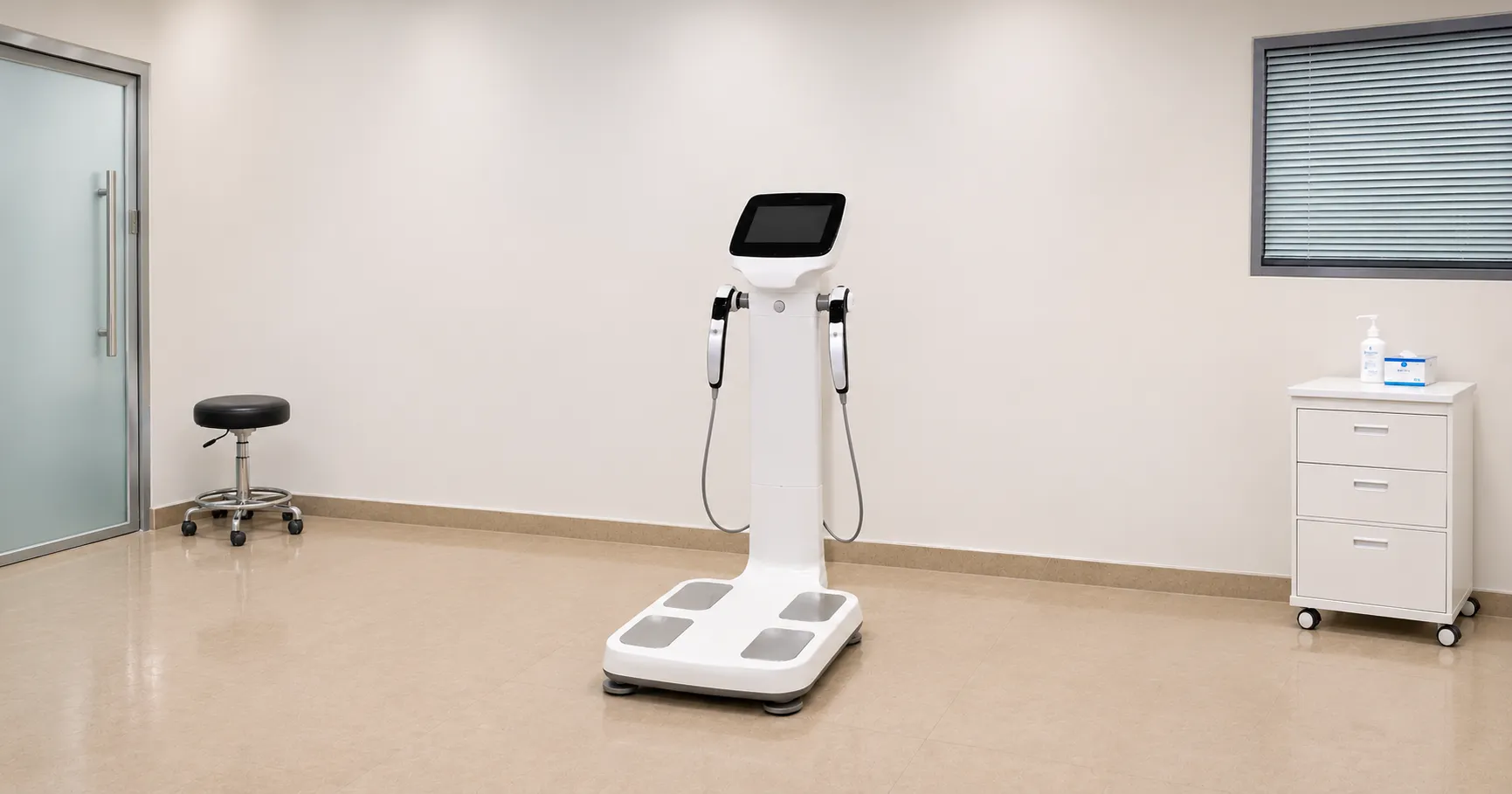
A bioimpedance analyser estimates body composition, the proportions of fat, muscle and water, by passing a tiny, safe electrical current through the body and measuring the resistance it meets. Tissues that hold a lot of water and electrolytes, such as muscle, conduct easily; fat and bone resist. From that resistance, together with height, weight, age and sex, the device calculates a body profile. For a procurement lead, the useful questions are the frequency range, the electrode configuration, the validity of the built-in equations, hygiene and consumables, connectivity, and how well the readings hold up as a comparable measure over time.
The measurement principle
Bioelectrical impedance analysis, or BIA, sends a small alternating current, typically well below the threshold of sensation, between electrodes and measures two things: resistance, the opposition to current flow through body fluids, and reactance, the capacitance effect of cell membranes. Together these give impedance and the phase angle. Because lean tissue is roughly three-quarters water and conducts well, while fat conducts poorly, the impedance value reflects the amount of conductive tissue. The device then applies a prediction equation, derived from reference populations, to estimate total body water, fat-free mass and fat mass. The key point for a buyer is that BIA predicts composition from impedance rather than measuring fat directly, so the quality of the equations and the consistency of measurement conditions determine how meaningful the numbers are.
Single-frequency, multi-frequency and bioimpedance spectroscopy
Single-frequency analysers
These use one frequency, commonly 50 kHz, at which current passes through both inside and around cells to varying degrees. They are simple and inexpensive but cannot separate intracellular from extracellular water reliably, limiting their use to broad composition estimates.
Multi-frequency analysers
These use several frequencies. Low frequencies pass mainly around cells through extracellular fluid, while high frequencies penetrate cell membranes. This lets the device distinguish extracellular and intracellular water, giving more useful data for hydration and clinical monitoring.
Bioimpedance spectroscopy
Spectroscopy sweeps many frequencies and fits the data to a physical model rather than a fixed population equation. It is the most rigorous approach for fluid assessment and is used where hydration status matters, though it costs more.
Electrode configuration and body segments
How the electrodes contact the body shapes what is measured. Hand-to-hand devices pass current across the upper body only; foot-to-foot scales measure the lower body; hand-to-foot and eight-electrode segmental analysers measure the whole body and break it into arms, legs and trunk. Segmental analysers give a fuller picture and localise fluid or muscle differences between limbs, which matters in rehabilitation and lymphoedema work. Wet gel electrodes on the wrist and ankle, the classic tetrapolar arrangement, remain the reference method in clinical studies. For buyers, the electrode design drives both the depth of data and the hygiene routine, so it is a core specification, not a detail.
Key specifications a buyer must check
Confirm the frequency range and whether the device is single- or multi-frequency, because that sets whether it can assess hydration or only broad composition. Check the electrode type, gel electrodes, stainless steel plates or hand grips, and whether measurement is segmental. Review the outputs: fat mass, fat-free mass, total body water, extracellular and intracellular water, phase angle, skeletal muscle mass and any visceral estimate. Ask about the validation population behind the equations and whether paediatric, athletic or clinical modes exist, because an equation derived for healthy adults may not suit children or dialysis patients. Weight capacity, measurement time, repeatability and the display or software reporting all affect daily use.
Standards and UK regulation
Where a bioimpedance analyser is marketed for a medical purpose, such as monitoring hydration in kidney or heart patients, it is a medical device and needs appropriate UKCA or CE conformity marking with manufacturer registration where required. It must meet the IEC 60601-1 general safety standard, which for a device that applies current to the patient includes strict limits on patient auxiliary current, and IEC 60601-1-2 for electromagnetic compatibility. Devices sold purely for fitness or wellbeing may not carry medical marking, so a buyer procuring for clinical use should confirm the intended-purpose statement and the declaration of conformity. The MHRA publishes device safety information, and clinical use should follow professional guidance rather than manufacturer marketing claims.
Phase angle, accuracy and limitations
Beyond fat and water estimates, many analysers report the phase angle, a raw measure derived from resistance and reactance that reflects cell-membrane integrity and is used as a general marker of cellular health and nutritional status. Because it is measured rather than predicted from an equation, some clinicians value it as a more direct output than the calculated composition figures. A buyer should also understand the limits of the method: BIA assumes normal hydration, so oedema, dehydration, recent exercise or a full bladder can distort results, and readings are not directly comparable between devices that use different frequencies, electrode arrangements or equations. This is why the method suits tracking change within one patient on one device far better than one-off comparison against a population norm, and why standardising on a single device across a service protects the value of the data.
Calibration, maintenance and decontamination
Bioimpedance analysers are largely solid-state and need little routine calibration, but many manufacturers supply a check resistor or calibration routine to confirm the measurement circuit, and electrical-safety testing applies as to any device that contacts the patient. The real determinant of reliable trends is measurement consistency: hydration, recent food, exercise, skin temperature and electrode placement all shift readings, so a written standard operating procedure matters more than the hardware. Decontamination depends on the electrodes: gel electrodes are single-use and discarded, while stainless-steel plates and hand grips are wiped between users with a compatible disinfectant. In shared clinical settings, confirm the plates tolerate your cleaning agents without corrosion.
Care settings, consumables and total cost of ownership
Bioimpedance analysers appear in dietetics and nutrition clinics, weight-management and metabolic services, renal units monitoring fluid status, cardiology, sports and rehabilitation, and community health checks. Handheld and scale-type units also serve fitness and occupational health. The purchase cost varies widely, from inexpensive foot-to-foot scales to research-grade spectroscopy systems, so match the tier to the clinical question. Consumables are modest, mainly disposable gel electrodes for tetrapolar devices, plus cleaning materials; plate-electrode devices avoid electrode cost but need durable hygiene. Software licences, data management and integration with the patient record can add ongoing cost. Ask suppliers about warranty, calibration support, software updates and repair turnaround. The MediGear buyers team can help compare devices across tiers, or you can contact us to check availability and support.
Procurement checklist
-
Decide whether you need single-frequency, multi-frequency or spectroscopy for your use.
-
Confirm electrode type and whether segmental, limb-level data is required.
-
Check the validation population and availability of clinical or paediatric modes.
-
For clinical use, verify UKCA or CE marking, intended purpose and IEC 60601 compliance.
-
Agree a standard measurement procedure to keep readings comparable over time.
-
Confirm electrode consumables and a compatible cleaning method for plate electrodes.
-
Check software, patient-record integration, warranty and repair turnaround.
Conclusion
A bioimpedance analyser estimates a body profile from how the body resists a small electrical current, and the value of that profile depends on the frequency range, the electrode configuration and the equations behind the numbers. Match the technology tier to your clinical question, standardise measurement conditions so trends mean something, and confirm medical marking and safety standards for clinical use. Comparing verified specifications through MediGear helps a service choose a body-composition tool it can rely on rather than one whose readings drift with every use.
Disclaimer
This article is for informational purposes only. It is published by MediGear (medigear.uk) for general information and procurement guidance, and is not clinical, diagnostic, treatment, technical, engineering, legal or regulatory advice, nor a product endorsement, guarantee or substitute for professional assessment. MediGear does not provide medical consultations. Buyers should consult their clinical, biomedical, estates and regulatory contacts, and the manufacturer's documentation, and independently verify all specifications, certifications, compatibility and suitability before purchase. Specifications, certifications and availability are correct at the time of publication and may change without notice. MediGear is a medical-equipment distributor and does not sell medicines or pharmaceutical products.