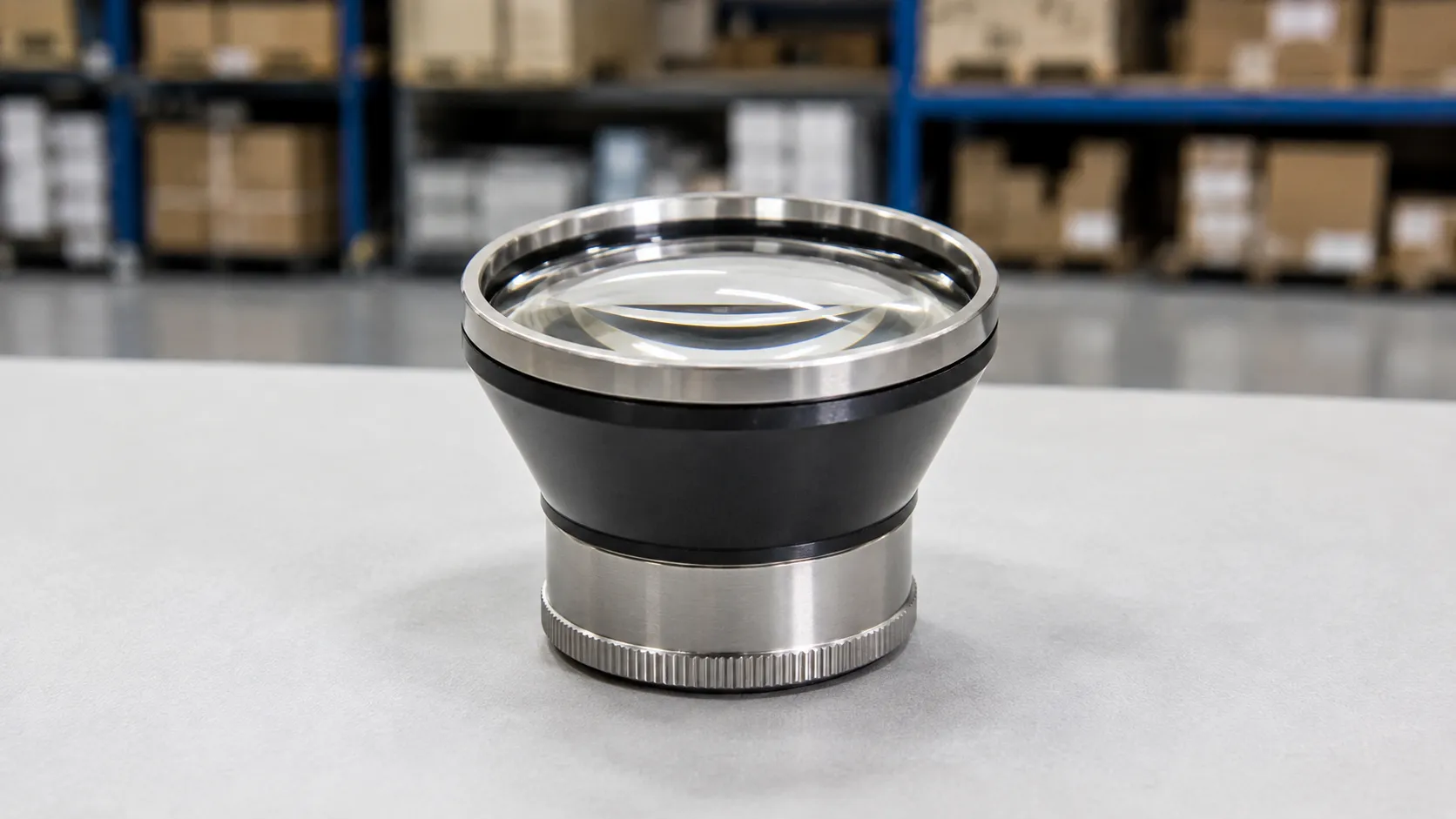
A gonioscopy lens is a contact lens fitted with angled mirrors or a steeply curved front that lets a clinician view the iridocorneal angle. In this drainage region, the iris meets the peripheral cornea. That angle cannot be seen directly at the slit lamp because light leaving it is trapped by total internal reflection inside the cornea. The lens defeats that reflection and brings the angle into view.
For a procurement lead, the buying decision narrows to a handful of things: whether the lens is direct or indirect, how many mirrors it carries, whether it needs a coupling fluid, how it will be decontaminated between patients, and what it will cost to run over a year of clinics. Settle those and the rest of the specification falls into place.
The measurement principle in detail
The cornea and its tear film sit against air, and the large difference in refractive index means light from the angle reflects internally rather than reaching the observer. The same physics makes a swimming pool look mirrored from below. A gonioscopy lens replaces that cornea-to-air boundary with a lens-to-eye contact, either through a viscous coupling gel or directly against the tear film. Once that boundary is neutralised, mirrors set at fixed angles redirect the image of the angle back through the slit lamp. Hence, the examiner sees a structure that is otherwise hidden; what the clinician grades — the visibility of the trabecular meshwork, scleral spur and ciliary body band — depends entirely on the optical quality of that contact and the geometry of the mirrors.
Direct versus indirect designs
Direct lenses
Direct, dome-shaped lenses of the Koeppe pattern give a real, non-reversed panoramic view of the whole angle at once. They are used with the patient lying flat, typically in theatre or under anaesthetic, and pair with a separate hand-held microscope and light source rather than a slit lamp. They suit examination under anaesthesia, paediatric assessment and surgical planning.
Indirect lenses
Indirect lenses are the workhorses of routine clinics. They present a mirror image of the opposite angle and are used with the patient upright at the slit lamp. The Goldmann-style lens and the four-mirror lens both fall into this group and cover most day-to-day examinations. Because they mount against a standard slit lamp, they slot into existing clinic layouts without extra furniture.
Mirror configurations and variants
Mirror count specifies indirect lenses. A single-mirror lens is simple but must be rotated to survey the full circumference. Three-mirror Goldmann lenses combine an angle mirror with mirrors for the peripheral and central retina, so one lens serves several purposes in a general clinic. Four-mirror lenses show all four quadrants without rotation and allow indentation gonioscopy, where gentle pressure on the cornea forces aqueous into the angle to distinguish appositional from synechial closure. Decide which examinations your clinicians perform most often before settling on a pattern, because a lens that doesn't fit the workflow sits in a drawer.
Coupling fluid or tear film
The Goldmann-style lens has a front curve steeper than the cornea, so it needs a drop of viscous coupling gel to bridge the gap. That gel gives a stable, high-quality view but blurs any subsequent fundus photography or OCT and must be rinsed away. Four-mirror lenses have a flatter contact face that couples through the patient's own tear film, so they are quicker between eyes and leave the cornea clear for imaging. If your clinic images and grades angles in the same visit, the tear-film-coupled lens saves a rinse step; if it grades angles alone, the gel-coupled view is often steadier.
Key specifications a buyer must check
Beyond lens type and mirror count, look at the contact-face diameter and base curve, which must suit both adult and paediatric corneas if your caseload spans ages. Check the field of view and magnification the mirror geometry delivers, the anti-reflective coatings, and the scratch resistance of the contact surface. Confirm the mount and flange are compatible with the specific slit lamps already installed, and that any handle or stabilising ring fits your clinicians' technique. A lens that seats poorly on your slit lamp will frustrate every user, no matter how good its optics.
Standards, regulation and documentation
A gonioscopy lens is a medical device and must carry valid UKCA or CE marking, with instructions for use that specify cleaning, disinfection and intended purpose. Ask the supplier for the declaration of conformity and confirm the device is registered appropriately for the Great Britain market. The MHRA is the UK regulator for medical devices, and safety reporting and broader device guidance sit on GOV.UK. Keep the instructions for use on file, because they define the only validated reprocessing method for that particular lens.
Decontamination and single-use options
Most gonioscopy lenses are not autoclavable; heat damages the coatings and cement. Reprocessing usually means manual cleaning followed by a chemical disinfectant named in the instructions for use, with strict rinse and dry steps and a controlled contact time. Reusable glass lenses offer excellent optics and a long service life, but demand a validated decontamination cycle between every patient. Single-use lenses remove the reprocessing burden and the associated infection-control risk, at a higher per-examination cost. Many clinics keep both: reusable lenses for scheduled clinics and disposables for isolation, screening days or high throughput.
What to check before you buy
-
Confirm the lens type — direct or indirect — matches how and where your clinicians examine.
-
Match the contact-face diameter and base curve to your slit lamp and to paediatric and adult patients.
-
Check whether a coupling gel is required and budget the consumable and rinse step.
-
Verify the manufacturer's validated cleaning and disinfection method, and whether the lens can withstand repeated use.
-
Ask whether the design supports indentation gonioscopy if your team needs it.
-
Confirm anti-reflective coatings and scratch resistance for optical longevity.
-
Request the UKCA or CE documentation and instructions for use before committing.
Total cost of ownership and servicing
Look past the headline price. A reusable lens carries recurring costs for disinfectant, staff time and eventual replacement when coatings degrade or the surface scratches; a single-use lens shifts that to a predictable per-patient figure. Coupling gel, storage cases and the occasional dropped lens all add up over a year. Lenses are largely passive optics, so there is little to service, but plan for replacement cycles and keep a spare so a damaged lens never cancels a clinic. Our team can help you model the options for your caseload — register as a buyer or contact us to compare specifications.
Use across care settings.
In a hospital eye service, you may want three-mirror lenses for combined angle and retinal work, four-mirror lenses for glaucoma clinics, and Koeppe lenses for examination under anaesthesia. A community optometry practice screening for angle closure may prefer a single robust four-mirror lens per slit lamp. Paediatric and theatre settings tend to favour direct lenses. Matching the mix to the setting avoids buying optics that never leave the cabinet.
Conclusion
Choosing a gonioscopy lens is less about brand and more about fit: the right lens type, mirror count, coupling method and decontamination route for the clinics you actually run. Weigh reusable optics against single-use convenience, confirm the paperwork, and cost the consumables honestly. MediGear can line up suitable options, so you buy the lens your clinicians will reach for, not the one that gathers dust in a drawer.
Disclaimer
This article is for informational purposes only. MediGear (medigear.uk) publishes it for general information and procurement guidance. It is not clinical, diagnostic, treatment, technical, engineering, legal, or regulatory advice, nor a product endorsement, guarantee, or substitute for professional assessment. MediGear does not provide medical consultations. Buyers should consult their clinical, biomedical, estate, and regulatory contacts and the manufacturer's documentation, and independently verify all specifications, certifications, and compatibility/suitability before purchase. Specifications, certifications and availability are correct at the time of publication and may change without notice. MediGear is a medical-equipment distributor and does not sell medicines or pharmaceutical products.