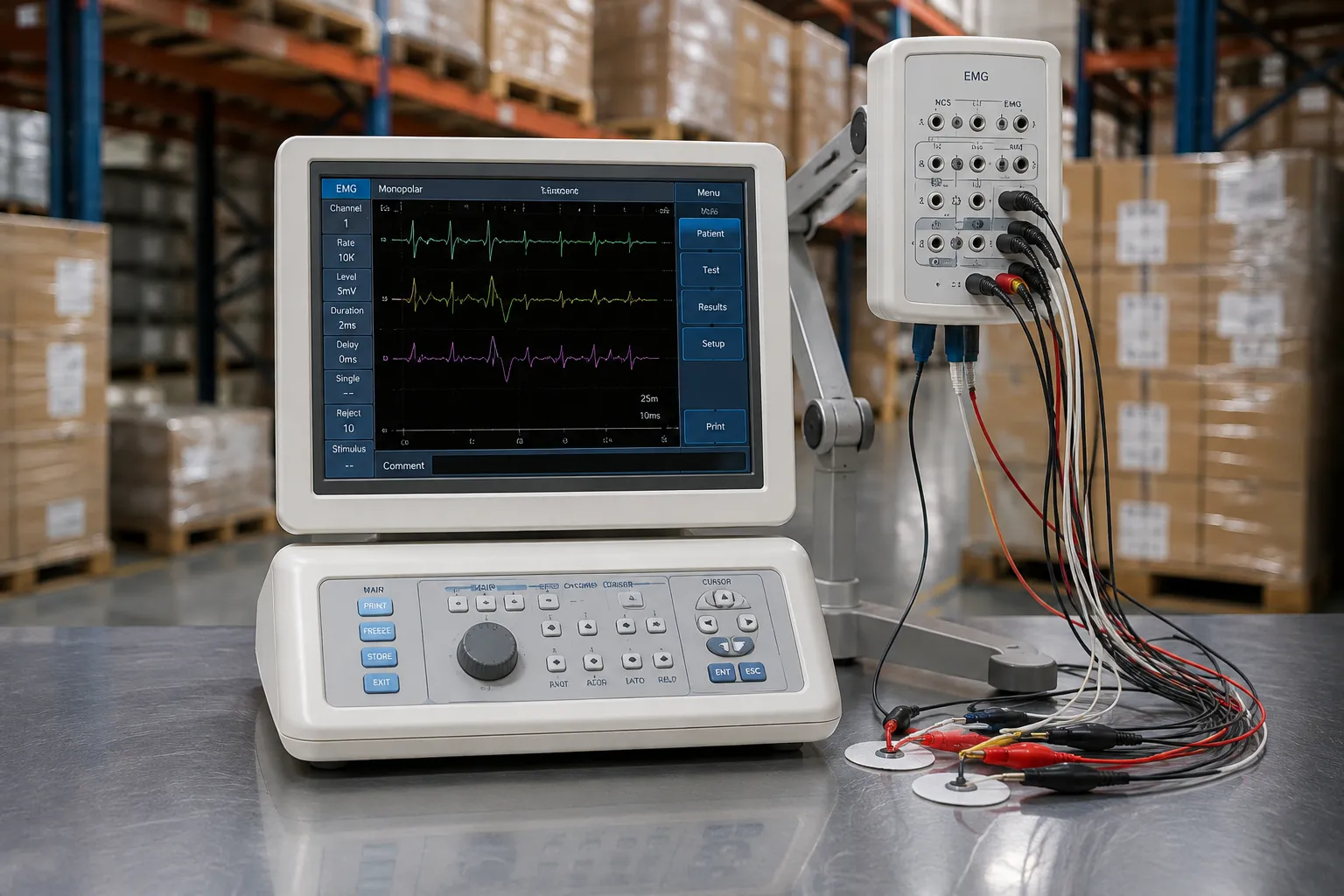
Electromyography (EMG) records the electrical activity that muscle fibres produce when they are activated. A neurophysiologist uses it to determine whether weakness, wasting, or cramping comes from the muscle itself, the nerve supplying it, or the junction between them. In practice EMG is almost always run alongside nerve conduction studies (NCS) on the same instrument, so the two together map where along the motor and sensory pathway a problem actually sits.
For a buyer, the core question is not what EMG proves clinically but what a capable, safe, serviceable system needs: clean amplification, the right electrodes, patient-safe isolation to IEC 60601, and a supplier who will keep it calibrated. This guide walks through the principle and the procurement detail. Measurement principle
A resting, healthy muscle is electrically silent. When a motor neurone fires, it triggers all the muscle fibres it supplies — a motor unit — to contract together, producing a motor unit action potential in the microvolt to millivolt range. EMG picks up these tiny potentials, amplifies them hundreds or thousands of times, filters out interference, and displays them as a waveform on screen and through a loudspeaker. The clinician judges the size, shape and firing pattern of the potentials, both at rest and during graded voluntary effort. Because the signals are so small, the amplifier quality and the rejection of mains and movement noise determine whether the trace is readable or useless.
Needle EMG versus surface EMG
Needle EMG
Concentric or monopolar needle electrodes are inserted into the muscle to record from a small number of motor units at a time. This gives the detailed diagnostic information used to separate neurogenic from myopathic patterns. Needles are single-use, sterile consumables and represent a recurring cost.
Surface EMG
Adhesive surface electrodes sit on the skin over the muscle and record the summed activity of many units. Surface recording is non-invasive and suits kinesiology, biofeedback, rehabilitation and screening, but lacks the resolution of needle work. Most diagnostic laboratories need both modes.
Nerve conduction studies on the same platform
A clinical EMG system almost always includes a stimulator for nerve conduction studies. A brief, controlled electrical pulse is delivered over a nerve, and the response is recorded downstream, giving conduction velocity, latency, and amplitude. Buy the two capabilities together: look for a constant-current stimulator with adjustable pulse width, clear intensity control and safety limits, because current delivered to a patient is where isolation and standards compliance matter most.
Key specifications a buyer must check
Concentrate on the front end. Check the number of recording channels — two channels suit routine work, more support intraoperative or evoked-potential expansion. Look for a high input impedance, a common-mode rejection ratio well above 100 dB to suppress mains interference, low input noise quoted in microvolts, and a wide, adjustable filter and gain range. A responsive stimulator, a quality loudspeaker for the audio feedback clinicians rely on, and reporting software with a normative reference database all matter. Confirm storage and export formats, and whether results integrate with your patient record system.
Reporting software and connectivity
The acquisition hardware is only half the system; the software decides how efficiently a clinic runs. Look for guided protocols for common nerve conduction and EMG studies, automatic marker placement with easy manual correction, and a normative database appropriate to your patient population. Good reporting generates a clear, structured summary a referring clinician can read at a glance, and exports it into the electronic patient record without re-keying. Check whether the workstation runs on standard, supported operating systems, how data is backed up, and whether remote review or second-opinion sharing is possible. Poor software quietly costs staff time on every patient, so weigh it as heavily as the amplifier.
Electrodes and consumables
Electrodes drive the running cost. Disposable concentric needle electrodes, surface electrodes, ground straps, ring electrodes for sensory studies and conductive gel are all consumed continuously. Reusable bar electrodes need cleaning and disinfection between patients to a validated method. When comparing systems, price the consumables over a year at your expected caseload, not just the hardware, and confirm the electrode connectors are an open standard rather than a proprietary lock-in that inflates future prices.
Electrical safety and standards
Because EMG both records from and delivers current to patients, electrical safety is central. Look for compliance with the IEC 60601-1 general standard for medical electrical equipment and the relevant collateral and particular standards covering electromyographs and evoked-response equipment, together with IEC 60601-1-2 for electromagnetic compatibility. Applied parts should carry the appropriate type classification and patient isolation. The device must hold valid UKCA or CE marking; the MHRA regulates medical devices in the UK and receives safety reports, and general guidance is on GOV.UK. Ask for the declaration of conformity and the electrical safety test certificate at handover.
Calibration, maintenance and servicing
An EMG system needs periodic electrical safety testing and verification that gain, filters and stimulator output remain within tolerance. Agree a maintenance schedule with the supplier, ideally an annual service combined with portable-appliance and medical electrical safety testing by a competent biomedical engineer. Clarify software update terms, the availability of loan units during repair, calibration certificates, and the warranty length. A five-figure instrument that sits idle waiting for a part is a false economy, so confirm spares availability and typical turnaround before you sign.
Infection control and single-use policy
Needle electrodes are single-use and must be disposed of as sharps. Surface electrodes are generally single-patient. Any reusable electrode, stimulator probe or ground strap must be cleaned and disinfected per the instructions for use and your local infection-control policy. Confirm the recording leads and stimulator can be wiped down with your standard disinfectant without degrading the insulation, and that the manufacturer specifies a validated method.
Procurement checklist
-
Confirm the system supports both needle and surface EMG plus nerve conduction studies if you need them.
-
Check channel count, amplifier noise, input impedance and common-mode rejection ratio.
-
Verify a constant-current stimulator with adjustable pulse width and safety limits.
-
Request evidence of IEC 60601-1 compliance, EMC testing and UKCA or CE marking.
-
Price needle and surface electrode consumables over a year at your caseload.
-
Agree calibration, annual electrical safety testing, warranty and loan-unit cover.
-
Confirm reporting software, normative database and export into your patient record.
Use across care settings.
Regional neurophysiology departments run high-throughput diagnostic EMG and NCS and need multi-channel systems with full reporting. Rehabilitation and sports-medicine services may want surface EMG for biofeedback and gait work rather than needle diagnostics. Some intraoperative monitoring builds on the same platform with extra channels and evoked-potential modules. Match the configuration to the service so you neither overspend on channels you will not use nor buy a unit that cannot grow with the department.
Conclusion
An EMG purchase rewards attention to the unglamorous detail: amplifier quality, stimulator safety, electrode running costs and a service contract that keeps the machine calibrated and available. Decide which modes your clinicians actually use, insist on documented IEC 60601 compliance, and cost the consumables honestly. MediGear can help you compare configurations and line up servicing so the system earns its place in the clinic. Register as a buyer or contact our team to get started.
Disclaimer
This article is for informational purposes only. MediGear (medigear.uk) publishes it for general information and procurement guidance. It is not clinical, diagnostic, treatment, technical, engineering, legal, or regulatory advice, nor a product endorsement, guarantee, or substitute for professional assessment. MediGear does not provide medical consultations. Buyers should consult their clinical, biomedical, estate, and regulatory contacts and the manufacturer's documentation, and independently verify all specifications, certifications, compatibility, and suitability before purchase. Specifications, certifications and availability are correct at the time of publication and may change without notice. MediGear is a medical-equipment distributor and does not sell medicines or pharmaceutical products.