A pupillometer measures pupil size and light response, turning a check done with a torch and a clinician's judgement into an objective, repeatable number. In neurological assessment, it quantifies the pupillary light reflex, tracking constriction size, speed and latency so change can be trusted between observers and over time. For a buyer, the decision rests on the measurement method, the metrics reported, hygiene, connectivity and the cost of consumables across the device's life.
The measurement principle
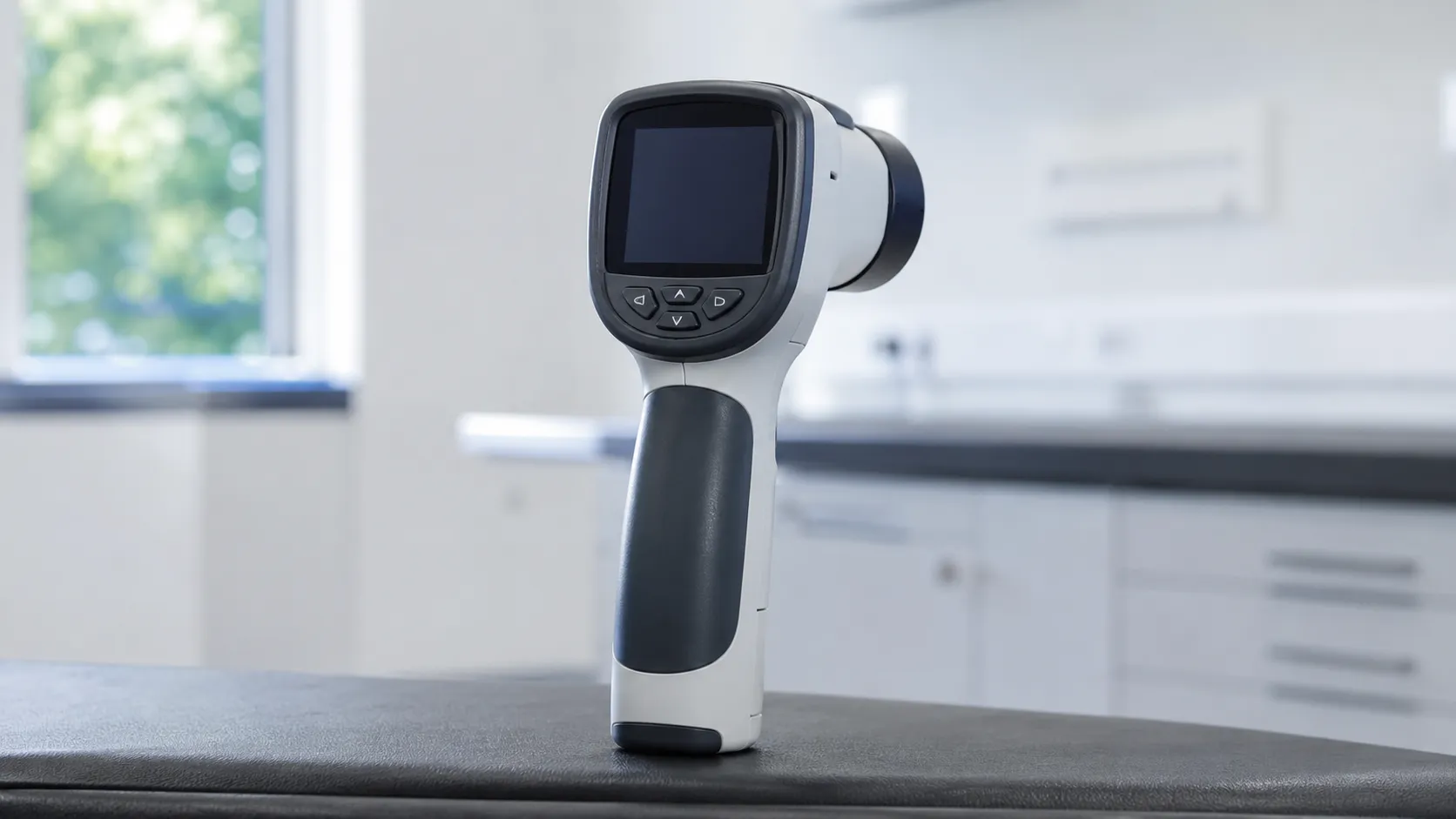
A handheld automated pupillometer illuminates the eye with infrared light, which the pupil does not respond to, and captures the pupil with an infrared-sensitive camera. Because infrared makes the pupil margin stand out sharply regardless of iris colour, the device can outline the pupil precisely. It then delivers a controlled, calibrated flash of visible light and films the constriction. Image analysis measures the resting and minimum diameters, the percentage change, the latency before constriction begins, and the speed of constriction and re-dilation. Delivering a fixed light stimulus each time makes the reading objective, removing variation in torch brightness and observer estimation that limits a manual check.
What the metrics mean
Automated pupillometry reports several values. Pupil diameter and the percentage constriction describe the size change. Latency is the delay before the pupil starts to react. Constriction and dilation velocities describe how briskly it moves. Many devices combine these into a single scalar index that summarises reactivity on a simple scale, which supports consistent trend monitoring on a ward. The clinician interprets these figures in context; the device's job is to produce them reliably and identically whoever holds it.
Sub-types and how they compare
Handheld automated pupillometers
These are the mainstay for bedside neurological observation. Battery-powered and portable, they give a reading in seconds and store results against a patient identifier. They suit intensive care, neurosurgery and emergency settings where serial measurements matter.
Binocular and desktop systems
Some devices measure both eyes at once or sit on a bench for ophthalmic and research use, offering controlled ambient light and more detailed dynamic analysis. These trade portability for depth and depth-of-field and research pupillometers
Specialist units use coloured stimuli to probe different retinal pathways. This is research and specialist ophthalmology territory; a general neurological service rarely needs it, so avoid paying for capability the ward will not use.
Where the readings are used
In neurological assessment, serial pupillometry supports monitoring of patients with brain injury, after neurosurgery and in intensive care, where a change in reactivity can be an early sign warranting review. It brings consistency to handovers because the number does not depend on who took it. It is also used in emergency departments and, with different emphasis, in ophthalmology and optometry. Match the device to the setting: a ward wants speed, identity tagging and trend display, while a clinic may value detailed dynamic curves.
Key specifications a buyer must check
Confirm which metrics the device reports and whether it provides a summarised reactivity index for trend monitoring. Check measurement resolution and repeatability, the range of pupil sizes it handles, and how it performs in bright and dark rooms, since ambient light affects results. Look at how quickly a reading is taken and how the result is tagged to the patient, because barcode or manual identification prevents mix-ups on a busy ward. Review the display clarity, whether it shows the constriction curve, and how many records it stores. For infection control, the eyepiece design and the use of a single-use eye-cup are important. Battery life and charging method decide how well a shared device survives a shift.
Standards and UK regulation
A pupillometer is an electrical medical device and should meet IEC 60601-1 for general safety and IEC 60601-1-2 for electromagnetic compatibility, along with the light-safety requirements relevant to an ophthalmic instrument that flashes light into the eye. Any device on the UK market needs appropriate UKCA or CE conformity marking and, where required, manufacturer registration. Ask for the declaration of conformity and confirm the light output is within recognised safety limits. The MHRA is the UK reference for device safety and field-safety notices, and gov.uk hosts the current marking and registration guidance.
Calibration, maintenance and decontamination
Because the light stimulus must be consistent, follow the manufacturer's guidance on calibration and any self-check the device performs at start-up, and keep records for governance. Maintenance is usually light: keep the lens and camera window clean and the battery healthy. Decontamination matters more, because the device is shared between patients and rests near the eye. Many systems use a single-use eye-cup that both blocks ambient light and provides a clean barrier; budget these as an ongoing consumable. Wipe the body between patients with an agreed disinfectant compatible with the housing, confirmed with infection control.
Care settings and connectivity
Pupillometers are used in neurosurgical and general intensive care, emergency departments, high-dependency and neurology wards, in recovery after anaesthesia, and in ophthalmology clinics. Their value on a ward depends on getting the number into the record, so check connectivity: docking stations that sync readings, wireless transfer, and integration with the electronic patient record or observation charts. A device that stores serial readings and displays a trend supports the handover better than one that shows only the latest value. Consistency between observers is the core benefit: the same threshold means the same thing for whoever is on shift, which strengthens escalation protocols. If several wards share devices, a common model and charging setup simplifies training and support, and a shared docking point keeps every device charged and its readings synced without staff having to think about it.
Total cost of ownership, warranty and servicing
The purchase price is joined by single-use eye-cups, replacement batteries, docking or charging hardware, software updates and any per-reading smart-card or licence the vendor uses. Ask suppliers for warranty length, whether consumables are proprietary and how they are priced, typical repair turnaround, loan-unit availability and the cost of a replacement device, since handhelds are dropped and damaged in use. Proprietary consumables can dominate the five-year cost, so price them explicitly against your expected reading volume before you compare purchase prices. A device with open or cheaper consumables may cost more up front yet less over its life. Confirm too how battery health is managed, because a fleet of ageing batteries that no longer hold charge quietly undermines a shared device. The MediGear buyers team can compare options, or contact us for current availability and support.
Procurement checklist
-
Confirm the metrics reported and whether a summarised reactivity index is provided.
-
Check repeatability, pupil-size range and performance across ambient light levels.
-
Review patient identification, on-screen curves and stored-record capacity.
-
Verify UKCA/CE marking, IEC 60601 compliance and light-safety limits.
-
Confirm single-use eye-cup use and body decontamination with infection control.
-
Check docking, wireless transfer and patient-record integration.
-
Price proprietary consumables and any per-reading licence over five years.
-
Get warranty, repair turnaround and replacement-unit cost in writing.
Conclusion
A pupillometer replaces a subjective torch check with an objective, repeatable measurement, which is exactly what serial neurological observation needs. Choose a device whose metrics, hygiene and connectivity suit your wards, price the proprietary consumables honestly, and confirm safety standards and servicing in writing. Comparing verified specifications through MediGear helps your critical-care and neurology teams buy a device they can rely on at every bedside.
Disclaimer
This article is for informational purposes only. It is published by MediGear (medigear.uk) for general information and procurement guidance and is not clinical, diagnostic, treatment, technical, engineering, legal, or regulatory advice, nor a product endorsement, guarantee, or substitute for professional assessment. MediGear does not provide medical consultations. Buyers should consult their clinical, biomedical, estates and regulatory contacts, and the manufacturer's documentation, and independently verify all specifications, certifications, compatibility and suitability before purchase. Specifications, certifications and availability are correct at the time of publication and may change without notice. MediGear is a medical-equipment distributor and does not sell medicines or pharmaceutical products.