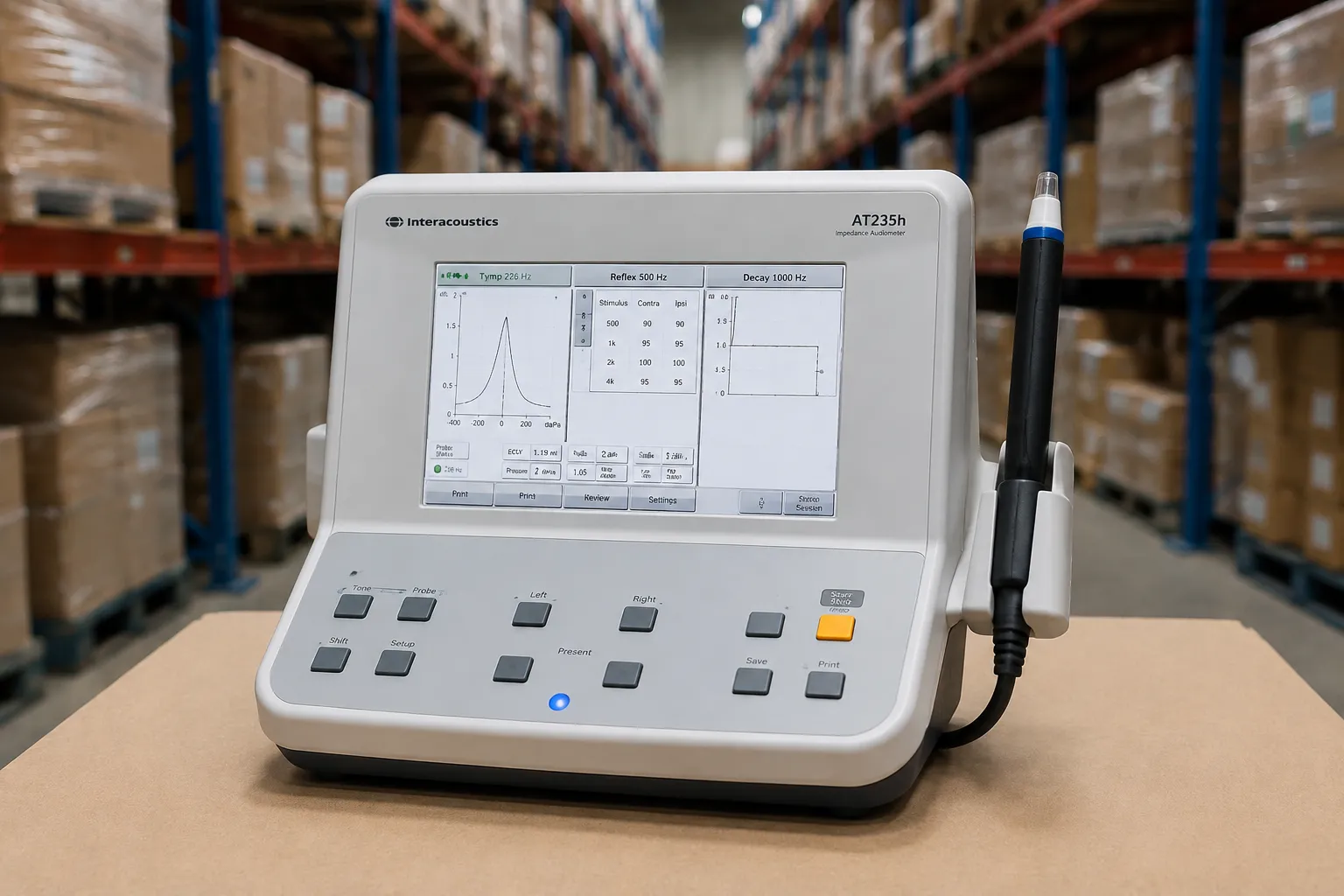
An impedance audiometer, often called a middle-ear analyser, measures how the eardrum and middle ear respond to sound and pressure. Its core test, tympanometry, charts the mobility of the tympanic membrane as air pressure in the ear canal is varied, producing a tympanogram that helps identify fluid, perforations, pressure problems and ossicular issues. For a buyer, the choice hinges on the test suite, probe design, calibration demands, connectivity and lifetime running cost.
The measurement principle
The instrument seals a small probe in the ear canal. The probe delivers a continuous probe tone, usually around 226 Hz for adults, while a pump sweeps the canal pressure across a range either side of atmospheric. A microphone in the probe measures how much of the probe tone is reflected. When the middle-ear system is most mobile, more sound is admitted and less reflected; the device records this as acoustic admittance, or its inverse, impedance. Plotting admittance against pressure produces the tympanogram, whose peak position and shape reveal how the middle ear is behaving. Because the reading depends on a sealed, known volume, probe fit and canal-volume measurement are central to a valid result.
What the tests reveal
Tympanometry distinguishes a normal, mobile middle ear from one with fluid, negative pressure, a perforation or an unusually stiff or flaccid membrane. Ear-canal volume helps confirm a perforation or a patent grommet. Acoustic reflex testing measures the reflex contraction of the middle-ear muscles in response to loud sound, providing information about the reflex pathway. Reflex decay and Eustachian tube function tests add more detail. Together these results support screening and diagnosis, though interpretation stays with the clinician.
Sub-types and how they compare
Screening tympanometers
Compact, often handheld, screening units run a quick tympanogram and sometimes a basic reflex. They suit GP surgeries, community paediatric clinics and school screening where throughput and portability matter more than a full diagnostic suite.
Diagnostic impedance audiometers
Bench units add multiple probe-tone frequencies, ipsilateral and contralateral reflexes, reflex decay and Eustachian tube tests. Audiology departments choose these for their fuller test range and detailed reporting.
Multi-frequency and high-frequency probe tones
Higher probe-tone frequencies, such as 1000 Hz, give more reliable results in young infants whose ear canals behave differently. If you assess neonates or babies, confirm the device offers a 1000 Hz probe tone, because a standard 226 Hz test can mislead in that age group.
Key specifications a buyer must check
Start with the available probe-tone frequencies and whether 1000 Hz is included for infant testing. Check the pressure range and pump speed, since a faster sweep saves time but must remain within the standard. Confirm which reflex tests are supported, ipsilateral and contralateral, and the range of stimulus frequencies and levels. Review probe design and the fit of the ear-tip range supplied, because a poor seal is the most common cause of a failed test. Review the display, automatic test sequencing, and whether the device classifies tympanograms to a recognised scheme. Finally, weigh integration: printing, export to audiology software and patient-record links.
Standards and UK regulation
Impedance audiometers are calibrated and built to recognised acoustic standards; the relevant instrument standard is the IEC 60645 series, specifically the part covering aural acoustic-impedance instruments, and general electrical safety follows IEC 60601-1 with IEC 60601-1-2 for electromagnetic compatibility. Any device placed on the UK market needs appropriate UKCA or CE conformity marking and, where required, manufacturer registration. Ask for the declaration of conformity and the calibration certificate. The MHRA handles device safety and field-safety notices in the UK, while the NHS newborn hearing and audiology programmes set the clinical protocols the equipment must support.
Calibration and routine maintenance
Acoustic instruments drift, so annual calibration by an accredited laboratory is the norm, alongside daily or per-session checks the operator performs against a test cavity to confirm the probe reads a known volume correctly. Keep calibration certificates for audit and quality assurance. Day to day, the probe tip and tubing must stay clear; blocked probes are a frequent fault, so keep a cleaning kit and spare probe tips on hand. Budget the annual calibration cost into the running total, because it is unavoidable and recurring.
Decontamination and single-use considerations
The ear-tips that seal the probe in the canal contact the patient, so most services use single-use disposable tips and discard them after each ear. This removes reprocessing and cross-infection risk but recurs as a consumable in several sizes. Reusable probe components need a validated cleaning routine between patients, agreed with infection control. Stock a realistic range of tip sizes, because paediatric and adult canals differ and a missing size stalls a clinic.
Care settings and connectivity
Impedance audiometry runs in hospital audiology, ENT clinics, GP surgeries, community and school paediatric screening, and increasingly in mobile hearing services. Handheld screeners travel well; bench diagnostic units stay in a sound-managed room. Confirm how results leave the device: a built-in printer suits screening, while diagnostic departments need export to audiology data systems and the patient record. If you assess children under the newborn and school programmes, check the device supports the required test protocols and reporting formats before you buy. Consider the room too: tympanometry tolerates ambient noise better than pure-tone audiometry, but a quiet space still helps reflex testing, and a stable surface matters for a bench unit. Many services pair the impedance audiometer with a pure-tone audiometer, so ask whether both share a platform, a database and a single calibration visit, which reduces cost and simplifies training across the department.
Total cost of ownership, warranty and servicing
Beyond purchase price, recurring costs include disposable ear-tips, probe tips and tubing, thermal paper for printing, annual calibration, and the occasional probe replacement. Ask suppliers for warranty length, whether the first calibration is included, typical repair turnaround, loan-unit availability during service and the cost of a replacement probe assembly, which is the part most likely to fail. A probe that blocks or a pump that drifts can stop a whole clinic, so a fast repair route and an available loan unit protect your screening throughput. Standardising models across a service simplifies training, calibration logistics and consumable stock, and lets one calibration visit cover several units. The MediGear buyers team can compare options, or contact us to check current availability and support.
Procurement checklist
-
Confirm probe-tone frequencies, including 1000 Hz if you test infants.
-
Check the reflex tests supported, the pressure range, and pump speeds.
-
Review the supplied ear-tip sizes and how easily replacements are sourced.
-
Verify UKCA/CE marking, IEC 60645 and IEC 60601 compliance and certificates.
-
Confirm the annual calibration route, cost and daily cavity-check method.
-
Agree single-use tip consumables and probe decontamination with infection control.
-
Check printing, export to audiology software and patient-record integration.
-
Get warranty, probe replacement cost and repair turnaround in writing.
Conclusion
An impedance audiometer answers a focused clinical question about middle-ear function, and its reliability rests on probe fit, calibration and the right test suite for your patients. Match the frequency range and reflex tests to your caseload, plan for disposable tips and annual calibration, and confirm standards and servicing in writing. Comparing verified specifications through MediGear helps your audiology or ENT service buy an instrument that performs reliably in clinic after clinic.
Disclaimer
This article is for informational purposes only. It is published by MediGear (medigear.uk) for general information and procurement guidance and is not clinical, diagnostic, treatment, technical, engineering, legal, or regulatory advice, nor a product endorsement, guarantee, or substitute for professional assessment. MediGear does not provide medical consultations. Buyers should consult their clinical, biomedical, estates and regulatory contacts, and the manufacturer's documentation, and independently verify all specifications, certifications, compatibility and suitability before purchase. Specifications, certifications and availability are correct at the time of publication and may change without notice. MediGear is a medical-equipment distributor and does not sell medicines or pharmaceutical products.