
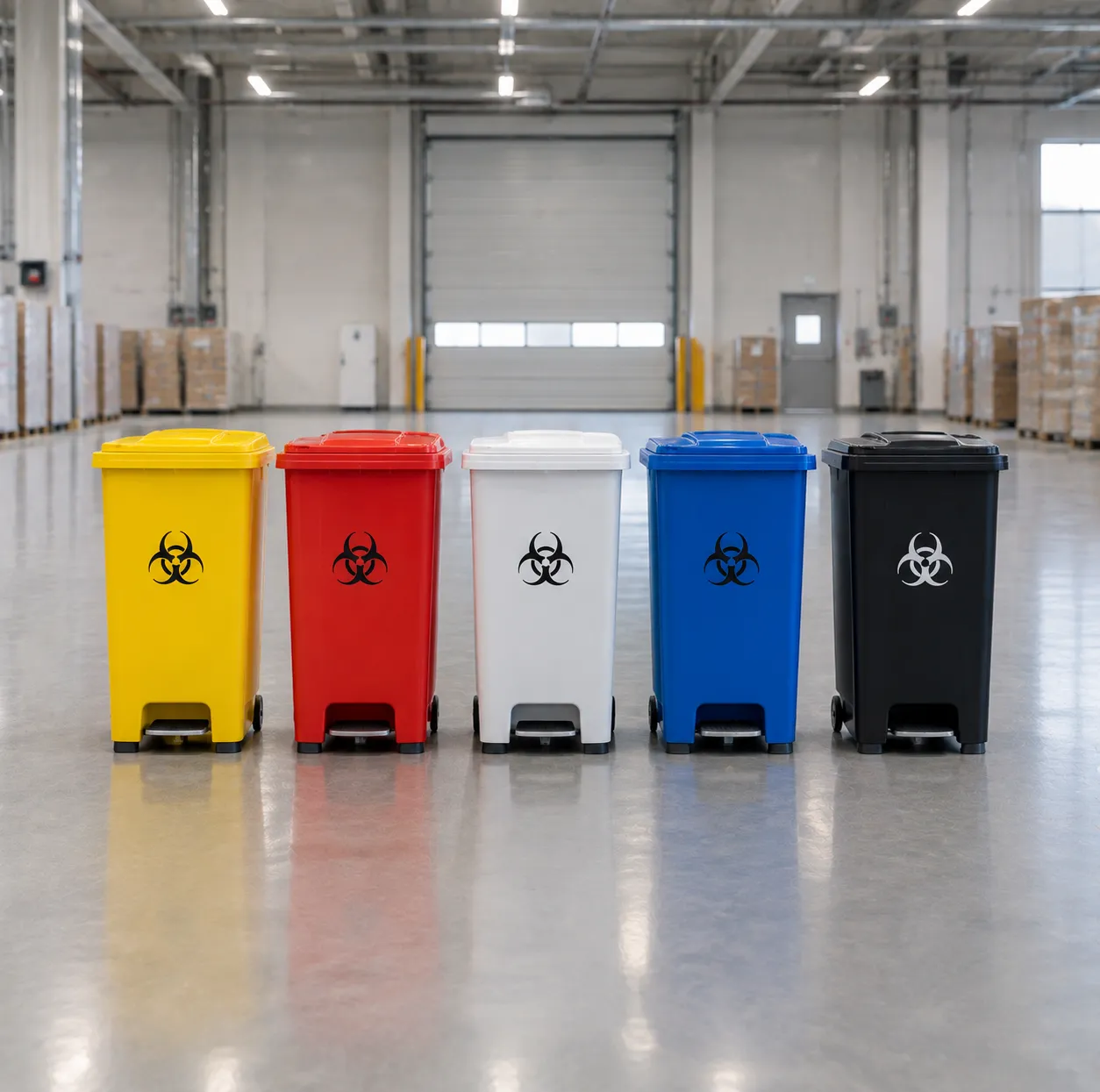
Clinical waste segregation is the practice of separating healthcare waste into defined streams at the point of production, using a national colour code. Hence, each type of waste follows the correct disposal route. In the UK, Health Technical Memorandum HTM 07-01 sets that code, assigning a colour to every bag, lid, and container so staff can tell infectious waste from offensive waste, medicines, and domestic rubbish at a glance. Getting the choice right at the bin is what keeps hazardous waste out of the wrong route and controls both cost and risk.
For a procurement lead or estates manager, segregation is as much a purchasing task as a clinical one: you specify the bags, bins, wall brackets, labels, and signage that make the colour code work in every clinical area. This guide explains what each colour means, the legal duty of care behind it, and what to check before you buy.
Why waste is separated where it is made
Segregation only works if it happens at the point of use — the moment an item becomes waste, it goes into the correctly coloured receptacle beside the clinician. Once streams are mixed, they cannot be economically separated again, so a single infectious item dropped into a domestic bag can force the whole bag up to incineration. In contrast,e a domestic item in an infectious bag wastes the most expensive route. The colour code exists so that decision is made once, correctly, at the bedside, treatment chair or sluice, without anyone having to sort waste later.
The HTM 07-01 colour code, stream by stream
The code covers the full range of healthcare waste, each colour tied to a disposal route and, for hazardous streams, a European Waste Catalogue code:
-
Yellow: infectious waste that must be disposed of by incineration, including waste also contaminated with chemicals or medicines (EWC 18 01 03*).
-
Orange: infectious waste that may be rendered safe by alternative treatment such as autoclaving before final disposal.
-
Purple: cytotoxic and cytostatic waste from chemotherapy and related medicines, for high-temperature incineration (EWC 18 01 08*).
-
Yellow with a black stripe (tiger): offensive or hygiene waste that is non-infectious, such as incontinence pads and nappies.
-
Blue: medicinal waste — out-of-date or part-used non-hazardous medicines destined for incineration.
-
Red: anatomical waste and identifiable body parts, for incineration.
-
Black or clear: domestic, non-clinical waste following the municipal route (EWC 20 03 01).
-
White: dental amalgam waste, captured for mercury recovery rather than disposal.
Yellow versus orange: the line that decides the bill
The most consequential distinction in the whole code is between yellow and orange. Both are infectious, but yellow waste must go to incineration — the highest-cost route — because it also carries a chemical or pharmaceutical hazard, whereas orange waste can be treated by autoclave or an equivalent process and then disposed of far more cheaply. Accurate segregation, rather than sending everything to yellow to be safe, determines a hospital's waste cost, and it depends entirely on staff reading the code and estates providing both colours in every clinical area.
Offensive waste and the stream people get wrong.
Tiger-striped offensive waste is the most commonly mis-segregated stream. Non-infectious hygiene waste — pads, nappies, stoma and catheter bags from patients with no known infection — does not need infectious-waste treatment. Yet, it is routinely thrown into orange or yellow, inflating disposal cost with no safety benefit. Providing a clearly labelled tiger stream, and training staff on when it applies, legitimately moves large volumes of waste off the expensive routes.
Where sharps and medicines fit the code
The colour code extends to rigid containers as well as bags, and the same discipline applies. Sharps bins follow the identical logic: an orange lid for infectious sharps not contaminated with medicines, a yellow lid for sharps contaminated with medicinal products, and a purple lid for cytotoxic and cytostatic sharps. Medicinal waste splits the same way — non-hazardous medicines to the blue stream, cytotoxic and cytostatic medicines to purple. The point of segregation is that the lid colour, not the container's shape, tells staff and carriers which route the waste takes, so a consistent colour across bags and rigid containers keeps the whole scheme coherent. A mismatched lid is as much a segregation failure as the wrong bag, and it undermines every downstream step in the disposal chain.
Duty of care and the waste hierarchy
Segregation sits inside a legal duty of care under the Environmental Protection Act 1990 and, for hazardous streams, the Hazardous Waste Regulations. The producer must describe each stream accurately, store it securely, consign it to a registered carrier, and keep the consignment and transfer notes that prove where it went — the cradle-to-grave audit trail. Hazardous streams cannot be mixed with non-hazardous ones without reclassifying the whole load upward so that a single mis-segregation can turn a cheap consignment into an expensive one. National guidance on managing healthcare waste is published through GOV.UK, and the occupational risks of handling it fall under the Health and Safety Executive. The waste hierarchy — reduce, reuse, recycle, recover, then dispose — applies across every stream.
Making the colour code work on the ward
A colour code is only as good as its physical implementation. Each clinical area needs the right waste segregation bins in the right colours, held in hands-free, foot-operated, or wall-mounted holders and sited appropriately to keep the correct receptacle within reach for every task. Clear pictorial signage above each bin, colour-matched bags and ties, and consistent placement across wards stop staff hesitating or guessing. The aim is simple: make the correct choice the easy choice.
Specifying a clinical waste segregation system
-
Confirm the full HTM 07-01 colour range is available — yellow, orange, purple, tiger, blue, red, black and white as needed.
-
Match bag colour, tie and bin lid to each stream, with clear pictorial signage above every disposal point.
-
Check bag specifications and weight ratings so sacks do not fail when lifted, and confirm UN approval where required.
-
Provide hands-free, foot-operated or wall-mounted holders positioned at the point of use.
-
Include labelling space for producer, department and date to support the audit trail.
-
Confirm a registered carrier and consignment paperwork cover every hazardous stream.
-
Standardise signage and bin layout across all wards so segregation stays consistent.
What compliant segregation costs to run
The running cost of segregation is dominated not by the bags and bins but by the disposal route each stream takes — incineration for yellow, purple and red, treatment for orange, deep-route disposal for tiger and municipal collection for black. Because the hazardous routes cost several times more than the cheap ones, accurate segregation is the single biggest lever on a healthcare waste budget. Investing in clear signage, adequate bin provision and staff training pays back by keeping waste in its lowest legitimate stream. A distributor stocking the full colour-coded range keeps every ward reliably supplied.
The bottom line on clinical waste segregation
Clinical waste segregation turns a national colour code into daily practice: the right bag, in the right holder, chosen at the point of use, with the paperwork to prove where each stream went. Get the yellow-orange split and the offensive stream right, ht and you control infection risk and disposal cost at the same time. To specify a compliant HTM 07-01 colour-coded segregation system across your site, contact the MediGear buyers' team.
Disclaimer
This article is for informational purposes only. It is published by MediGear (medigear.uk) for general information and procurement guidance. It is not clinical, diagnostic, treatment, technical, engineering, legal or regulatory advice, nor a product endorsement, guarantee or substitute for professional assessment. MediGear does not provide medical consultations. Buyers should consult their clinical, biomedical, estates and regulatory contacts, and the manufacturer's documentation, and independently verify all specifications, certifications, compatibility and suitability before purchase. Specifications, certifications and availability are correct at the time of publication and may change without notice. MediGear is a medical-equipment distributor and does not sell medicines or pharmaceutical products.