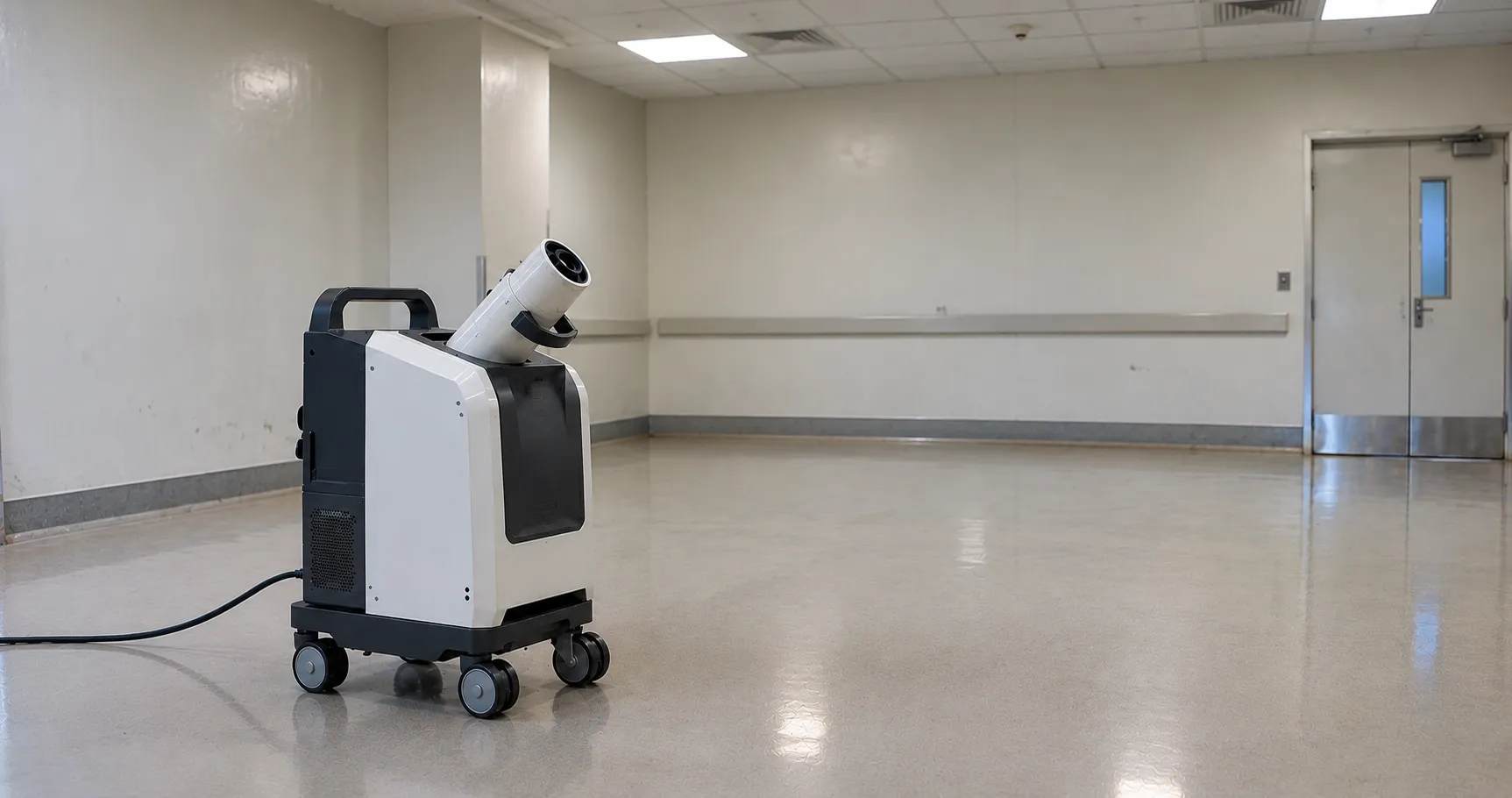
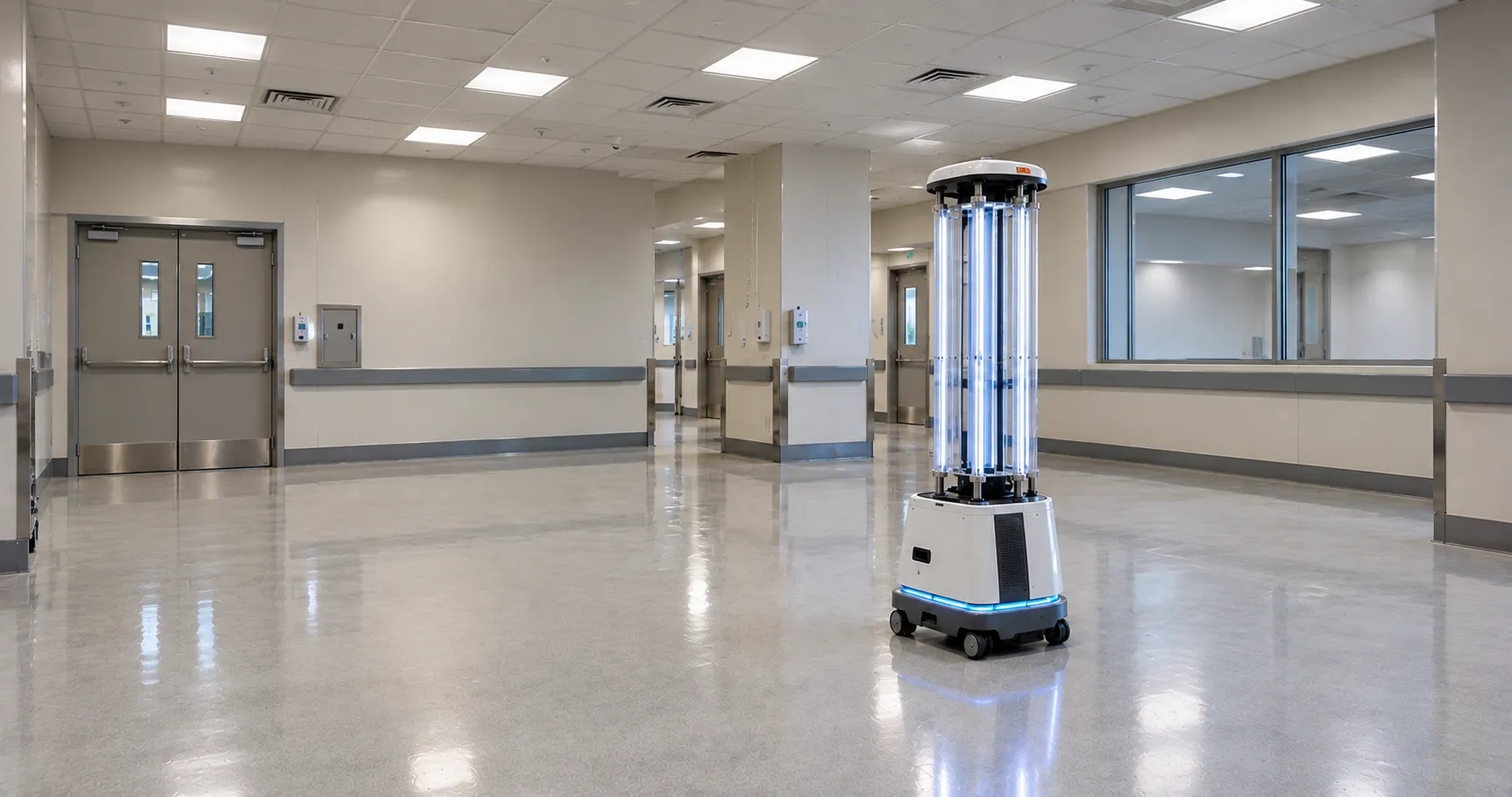
A UV disinfection robot is a mobile, no-touch machine that floods an empty room with ultraviolet-C light to inactivate bacteria, viruses and spores on exposed surfaces after the room has been manually cleaned. Wheeled into place and run from outside, it delivers a measured dose of germicidal UV that damages the genetic material of any organism the light reaches, giving a fast, chemical-free terminal disinfection step for high-risk spaces such as isolation rooms, operating theatres and intensive care bays.
This article covers UV-C robots specifically — how the light works, dose, the line-of-sight limit and room turnaround — as one of two main no-touch modalities, distinct from hydrogen peroxide vapour, which fills a sealed room with gas.
How UV-C light inactivates pathogens
Germicidal ultraviolet sits in the UV-C band, with peak effect around 254 nanometres. At that wavelength, the light is absorbed by the nucleic acids in bacteria, viruses and fungal spores, forming molecular bonds that scramble the DNA or RNA so the organism cannot replicate. The hospital also uses radiation in a related way, where a blood irradiator uses ionising radiation to disable donor lymphocytes and prevent transfusion complications. It is a purely physical mechanism — no chemistry, no residue, nothing to aerate — and the surface is safe to touch as soon as the cycle ends. Because it acts only where the light lands, UV-C is a surface-and-air treatment for line-of-sight areas rather than a way to reach inside drawers, under equipment, or around corners.
Dose, distance and the line-of-sight limit
The defining variable is dose — the UV energy delivered to a surface, measured in millijoules per square centimetre (mJ/cm²). Dose is intensity multiplied by exposure time, and intensity falls sharply with distance following an inverse-square relationship. Hence, a surface close to the lamp receives far more energy than one across the room. The practical consequences are twofold: exposed surfaces facing the device are disinfected quickly, while surfaces in shadow — the far side of a bed, the underside of a table, inside a cupboard — receive little or no dose. This is UV's fundamental limitation. Many robots are therefore run from two or more positions in the room, or use reflective-wall algorithms and sensors that measure delivered dose and adjust cycle time so a target dose is actually reached rather than assumed. The principle of a precisely measured dose recurs across clinical equipment, from this UV cycle to the metered dose inhaler that meters each puff of drug.
Continuous mercury UV versus pulsed xenon
Two lamp technologies dominate. Continuous low-pressure mercury lamps emit a steady, near-monochromatic 254 nm output and are efficient and well understood. Pulsed xenon systems fire brief, intense broad-spectrum flashes that include UV-C, claiming faster cycles because of their high peak intensity. Both aim to deliver a germicidal dose; they differ in cycle time, lamp life and cost. When comparing, look past the technology label to the delivered dose and the validated cycle for your room size, because a shorter advertised cycle is only meaningful if it still reaches an effective dose on the surfaces that matter. Ozone-free lamp designs avoid generating ozone that would itself require ventilation.
Cycle time and room turnaround
UV robots are chosen partly for speed. A cycle is commonly in the range of several minutes to around fifteen or twenty per position, so a small room turnaround from a single position can be turned around quickly, while a large theatre run from multiple positions takes longer. That is still far faster than gaseous decontamination, and it needs no room sealing or aeration, which is UV's main operational advantage over vapour methods. Turnaround planning must include time to remove or reposition the device between placements, and to move shadowed items so more surfaces face the lamp. The device does not replace manual cleaning — visible soil blocks the light — it follows it.
Safety interlocks and operator protection
UV-C is harmful to skin and eyes, causing painful photokeratitis and skin erythema on direct exposure, so that no one may be in the room during a cycle. Robots include layered safeguards: passive infrared motion sensors that halt the lamp instantly if someone enters, door-mounted interlocks, remote start from outside the room, and audible and visible warnings. Operator training and clear signage on the door are part of safe use. The relevant safety framework is photobiological — lamp and product safety is assessed against the IEC 62471 approach to optical radiation hazards — and workplace duties around the exposure risk sit under general health-and-safety law overseen by the Health and Safety Executive.
Where UV robots fit in the cleaning protocol
A UV robot is an adjunct, not a replacement, for cleaning. Effective use follows a strict order: staff carry out the normal manual clean to remove visible soil and reduce the bioburden, then the room is vacated, and the UV cycle delivers a measured terminal dose to the exposed surfaces the manual clean may have missed. It suits terminal disinfection after a patient with a significant organism, theatre turnovers and outbreak response. It is weakest where geometry is complex, and shadowing is unavoidable, which is exactly where a gaseous method has the edge. Infection-prevention decisions about when to deploy such technology draw on NICE guidance and local policy. No-touch and automated approaches now run through infection prevention more broadly, from these robots to automated dispensing systems that track hand-sanitiser use at the bedside.
Room size, surface reflectivity and dose mapping
How well a UV robot performs in a given room depends as much on the room as on the machine. Wall, floor and ceiling finishes that reflect UV-C help bounce light into partial shadow and raise the delivered dose, whereas dark or matt surfaces absorb it and leave colder zones. Room size sets how many positions a cycle needs: a small side room may be covered from one placement, while a theatre or a four-bed bay needs several, each adding cycle and handling time. Some systems map the room with sensors and report the dose achieved at defined points, turning an assumed cycle into a verified one and giving audit evidence. When trialling a unit, test it in your actual worst-case rooms rather than an empty demonstration space, because clutter, bed frames and equipment are exactly what create the shadows that limit real coverage.
Lamp life and running costs
UV robots are relatively simple to run but not free. The main consumable is the lamp: mercury and xenon sources have rated lifetimes in the low thousands of hours and lose output as they age, so a lamp near end of life may not deliver the validated dose even though it still lights. A quality unit monitors lamp hours and flags when to replace it. Budget for periodic lamp changes, sensor calibration and any service contract, and weigh battery-powered mobility against the convenience of mains operation. Because the device avoids chemicals entirely, its per-cycle cost is low, but the honest comparison is cost per validated cycle across the lamp's life, not the sticker price.
Specifying a UV-C disinfection robot
Before investing in a UV robot, compare units on the things that decide real-world performance:
-
Delivered dose and validation — a stated target dose in mJ/cm² with sensors or a validated cycle for your typical room, not just a lamp wattage.
-
Lamp technology and life — continuous mercury versus pulsed xenon, ozone-free design, rated lamp hours and replacement cost.
-
Cycle time and positions — realistic turnaround for your room sizes, including the number of placements needed to manage shadowing.
-
Safety interlocks — motion detection, door interlocks, remote start and clear warning signals, with documented operator training.
-
Reporting — cycle logs and dose records for audit and outbreak evidence.
-
Mobility and footprint — weight, manoeuvrability through doors and lifts, and battery or mains operation.
-
Product safety marking — UKCA or CE, photobiological assessment to IEC 62471, and a service and lamp-replacement contract.
The bottom line on UV robots
A UV disinfection robot delivers a fast, residue-free terminal disinfection of the surfaces its light can reach, and its whole value depends on delivering a validated dose while accepting that shadowed areas are not treated. Buy on delivered dose, honest cycle times for your rooms and robust safety interlocks, and deploy it strictly after manual cleaning rather than instead of it. If complex shadowing is your main problem, weigh it against a gaseous method. To compare UV-C robots and match a unit to your room turnaround, contact the MediGear team or explore options through our buyer services.
Disclaimer
This article is for informational purposes only. It is published by MediGear (medigear.uk) for general information and procurement guidance. It is not clinical, diagnostic, treatment, technical, engineering, legal or regulatory advice, nor a product endorsement, guarantee or substitute for professional assessment. MediGear does not provide medical consultations. Buyers should consult their clinical, biomedical, and regulatory contacts and the manufacturer's documentation, and independently verify all specifications, certifications, compatibility, and suitability before purchase. Specifications, certifications and availability are correct at the time of publication and may change without notice. MediGear is a medical-equipment distributor and does not sell medicines or pharmaceutical products.