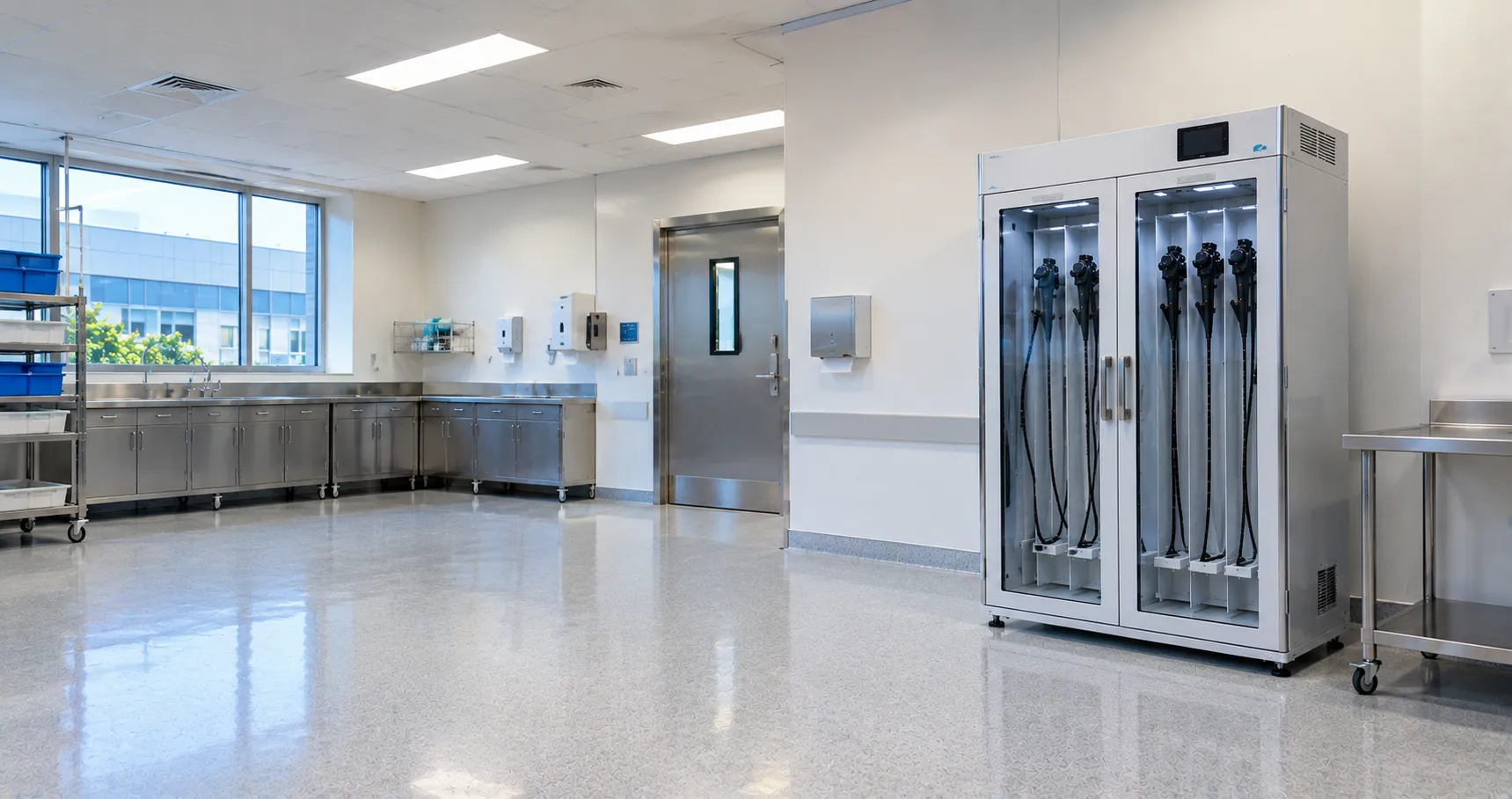
An endoscope drying cabinet (or drying and storage cabinet) is a controlled enclosure that dries the internal channels and outer surfaces of flexible endoscopes with filtered, medical-grade air and then stores them ready for use. By forcing HEPA-filtered air through each channel, it removes the residual moisture left after reprocessing — the moisture in which waterborne organisms such as Pseudomonas multiply — and extends the safe storage interval well beyond that of a simple hanging cupboard. For any service running flexible scopes, the cabinet is the step that turns a clean, disinfected endoscope into one that is genuinely ready for the next patient.
This article is for endoscopy leads, decontamination managers, and procurement staff comparing cabinets. It explains why drying matters, how channel drying works, the storage times you can claim, and the standards a cabinet must meet.
Why a damp channel is the real risk
After automated reprocessing, an endoscope's narrow channels — some under 2 mm across and over a metre long — hold residual water. Moisture is the single biggest driver of microbial regrowth in stored scopes: biofilm and waterborne bacteria thrive in wet lumens, so a scope that is clean on removal from the washer can be contaminated by the time it is used if it sits damp. Hanging a scope in an ambient cupboard dries it slowly and unevenly, if at all. A drying cabinet actively pushes dry air through every channel, so the lumen is dry within a defined time rather than left to chance.
How filtered-air channel drying works
The cabinet connects each scope to a manifold that delivers a metered flow of air, filtered through a HEPA filter (typically rated to remove particles to 0.2- 0.3 microns), into every internal channel via channel-specific connectors. Airflow, and sometimes gentle warming, is maintained for a validated drying period — commonly in the region of 30 to 60 minutes for full channel drying, depending on scope and cabinet. The same filtered air then circulates to keep the storage environment dry and clean. Better cabinets monitor and log airflow to each channel and alarm if a connection is missing or a channel is blocked, so a scope cannot be recorded as dry when it is not.
Storage time: 3 hours, 72 hours, or longer
The headline benefit of controlled drying is a longer permitted storage interval before a scope must be reprocessed again. Guidance and validated cabinet performance vary, but the pattern is consistent: a scope stored uncontrolled and damp may need reprocessing within a few hours, whereas a scope properly channel-dried and held in a validated drying and storage cabinet can commonly be stored for far longer — many cabinets are validated to support storage measured in days rather than hours. The exact figure you can claim depends on your cabinet's validation, your local policy and national guidance, so always work to the validated interval for your specific cabinet rather than a generic number.
HTM 01-06 and the standards behind the cabinet
Endoscope decontamination in the UK is governed by the HTM 01-06 series of health technical memoranda, which set out managing decontamination of flexible endoscopes end to end, including drying and storage. Cabinet performance is addressed by BS EN 16442, the standard for controlled-environment storage cabinets for processed thermolabile endoscopes, which covers air quality, drying and storage claims. Cabinets should be UKCA or CE marked, and services align their practice with national infection-prevention expectations reflected across the NHS and the guidance published on gov.uk. Validation and periodic testing of the cabinet are part of the quality system, not optional extras.
Capacity, connectors and channel compatibility
The practical fit of a cabinet turns on connectors and capacity. Every scope model has its own channel configuration, so the cabinet's connector set must match your endoscope fleet — gastroscopes, colonoscopes, bronchoscopes and duodenoscopes differ, and a channel that is not connected is a channel that is not dried. Cabinets are sized from small units holding a handful of scopes to large pass-through cabinets holding a dozen or more, sometimes loaded from the reprocessing side and unloaded from the clean side. Vertical hanging with the distal tip free prevents fluid pooling and protects the delicate bending section. Check door glazing, internal lighting an, and traceability features that record which scope was stored when and by whom.
Specifying an endoscope drying cabinet
A cabinet is a long-lived capital purchase that has to fit your scopes, your room and your quality system.
-
Confirm validation to BS EN 16442 and alignment with HTM 01-06 for drying and storage.
-
Match the connector set to every endoscope model in your fleet, including channel counts.
-
Check the validated storage interval the cabinet supports and how it is verified.
-
Verify HEPA air filtration rating and per-channel airflow monitoring with alarms.
-
Size capacity for peak demand and decide between standard and pass-through configurations.
-
Confirm traceability logging of scope identity, storage time,e and operator.
-
Review filter change intervals, service access and UKCA/CE marking.
Filters, servicing and lifetime cost
A drying cabinet's running cost is modest but real. The HEPA filtration that keeps its air clean is the same air-cleaning technology used in laboratory containment enclosures such as the laminar flow cabinet and the biosafety cabinet, including the widely used Class 2 biosafety cabinet, though those protect an open workspace rather than drying an endoscope channel. HEPA filters and any pre-filters are periodic consumables with defined change intervals; they wear and must be replaced to keep a good seal, and the cabinet needs planned preventive maintenance plus periodic validation to keep its storage claim defensible. Air-quality and airflow verification should be scheduled, and records kept. When comparing models, weigh the filter and connector consumable cost, the ease and frequency of servicing, and the downtime a failed cabinet would cause against the purchase price — a cabinet out of action forces scopes back to a short storage interval and can throttle the whole list.
Where drying cabinets fit in the endoscopy pathway
A drying cabinet sits at the clean end of the endoscopy decontamination pathway, after the endoscope washer-disinfector and before the scope returns to the procedure room. In a busy endoscopy unit it lets a fleet of scopes be reprocessed, dried and held ready so lists are not delayed waiting on the washer, and it removes the pressure to reprocess a scope again purely because it has been stored for a few hours. Day-case units, treatment centres and larger acute endoscopy services all rely on cabinets; smaller units running only a handful of scopes may use compact cabinets or, where storage times are short, reprocess immediately before use. Cabinets matter particularly for scopes used intermittently, such as bronchoscopes or ENT nasendoscopes, where a long validated storage interval avoids the waste of re-reprocessing a rarely used device before every list. The cabinet also protects the scope physically, holding it vertically with the distal tip free so the delicate bending section is not stressed and fluid cannot pool. Positioning the cabinet in a clean, controlled area, separate from the dirty side and the washer, keeps the flow one-directional and stops just-dried scopes being recontaminated by traffic from the reprocessing zone. In practice th, the cabinet is not a passive cupboard but an active part of infection prevention, and its place in the room layout is as important as its internal performance.
The verdict on drying cabinets
An endoscope drying cabinet is the difference between a scope that is merely disinfected and one that is dry, protected and ready, safely, for far longer. Specify to BS EN 16442 and HTM 01-06, match connectors to your fleet, insist on per-channel airflow monitoring, and budget for filters, connectors and validation. MediGear works with UK endoscopy and decontamination teams on storage and reprocessing equipment; register your requirements as a buyer or contact our team to specify the right cabinet for your fleet.
Disclaimer
This article is for informational purposes only. It is published by MediGear (medigear.uk) for general information and procurement guidance, and is not clinical, diagnostic, treatment, technical, engineering, legal or regulatory advice, nor a product endorsement, guarantee or substitute for professional assessment. MediGear does not provide medical consultations. Buyers should consult their clinical, biomedical, estates and regulatory contacts, and the manufacturer's documentation, and independently verify all specifications, certifications, compatibility and suitability before purchase. Specifications, certifications and availability are correct at the time of publication and may change without notice. MediGear is a medical-equipment distributor and does not sell medicines or pharmaceutical products.