Linen disinfection machines are industrial washing machines that decontaminate healthcare linen by holding it at a validated temperature long enough to kill micro-organisms—a process known as thermal disinfection. In UK healthcare laundries, accepted parameters include a wash at 65 °C for at least 10 minutes or, preferably, 71 °C for no less than 3 minutes, with additional mixing time. Hence,o the heat penetrates the whole load. Reaching and holding that temperature is what turns an ordinary hot wash into a disinfection cycle.
For an estates or procurement lead equipping an on-site laundry, the machine is only part of the specification: workflow, load segregation, dosing and verification all sit alongside it. This guide explains how thermal disinfection works, the main machine types, and what to check before buying.
How thermal disinfection actually works
Disinfection depends on temperature and time. A machine ramps the wash liquor to the set point and then holds it — the disinfection is only credited once the whole load, not just the water, has reached temperature, so a mixing margin is added: typically around four extra minutes at 71 °C and eight at 65 °C to allow heat to penetrate a packed drum. Detergent and mechanical action lift soil during the wash, but the held temperature inactivates bacteria, most viruses, and vegetative organisms. Machines log the temperature-time profile so each cycle can be shown to have met the parameters. The same temperature-time principle governs instrument decontamination, where a washer-disinfector disinfects surgical tools and an endoscope reprocessor does the same for flexible scopes.
Barrier washers and the clean-dirty divide
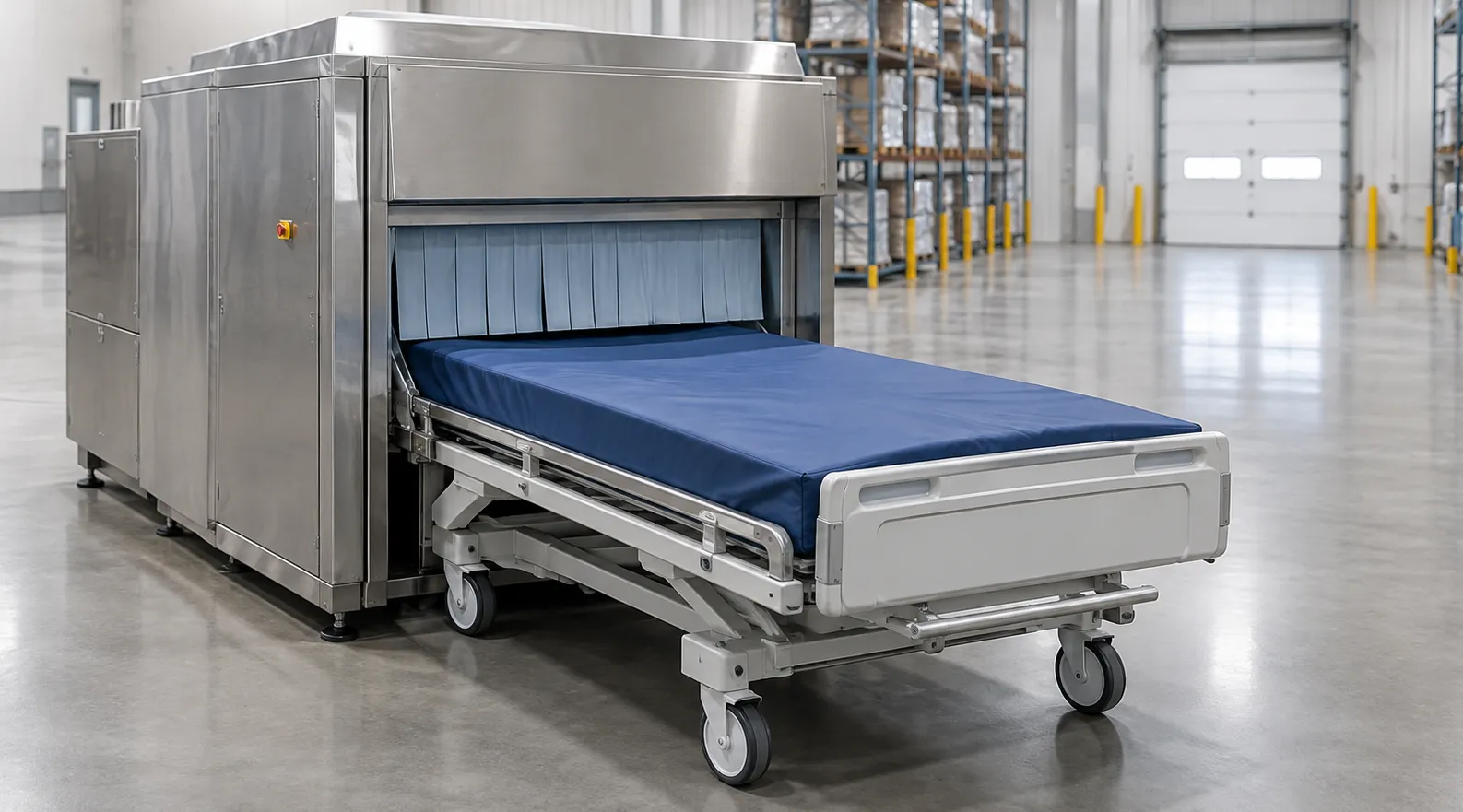
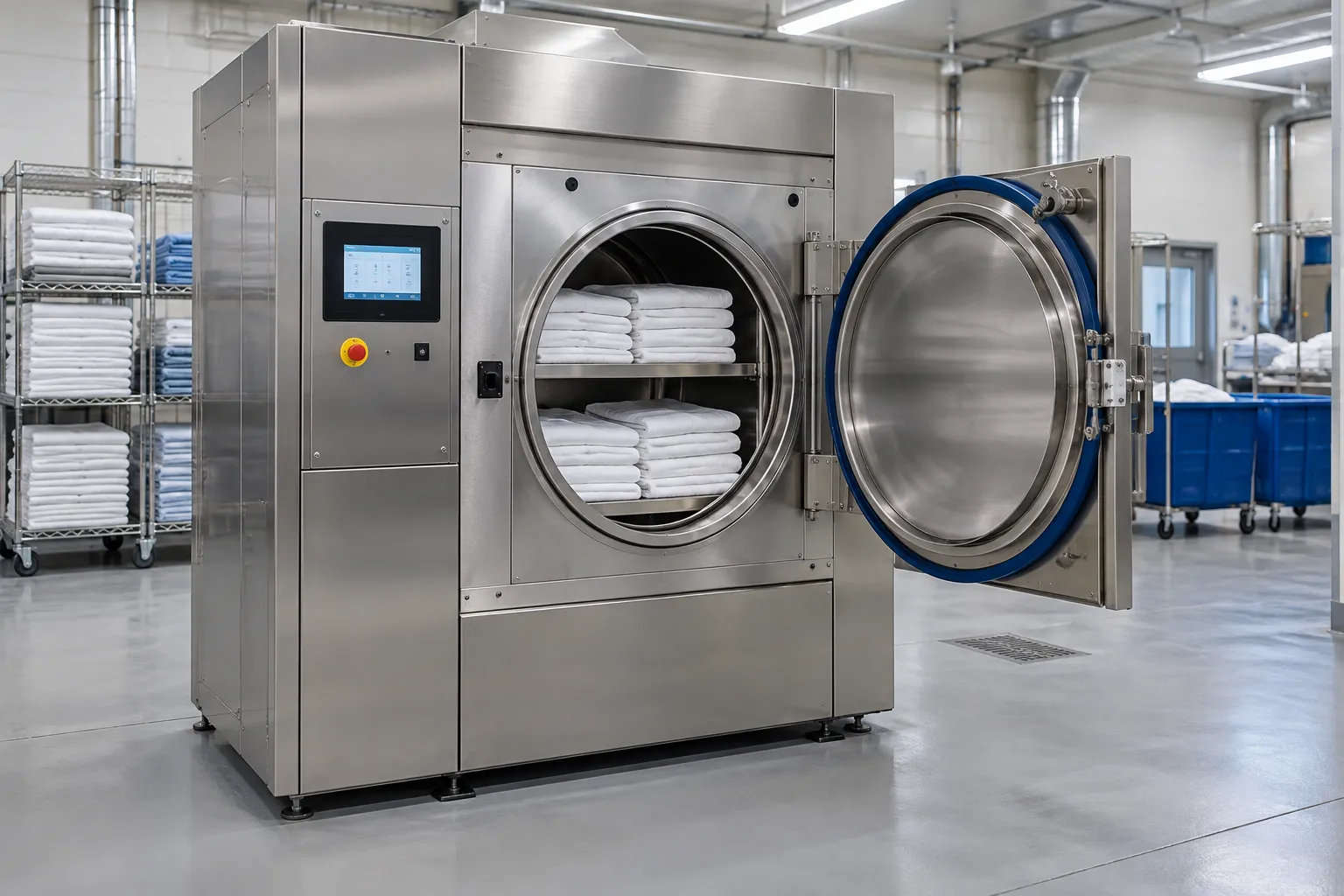
The defining feature of a healthcare laundry machine is often the barrier, or hygienic, design. A barrier washer-extractor is a double-door pass-through: staff load contaminated linen on the dirty side of a physical wall, and once disinfected, unload clean linen on the opposite clean side. This prevents freshly washed linen from ever crossing back into the contaminated zone, breaking the recontamination path that a single-door machine leaves open. For infection control, barrier construction is frequently the deciding specification rather than a luxury.
Washer-extractors, tunnel washers and matching volume
Machine choice follows throughput. A washer-extractor processes discrete batches, washing then spinning at high speed to extract water before drying, and suits GP practices, care homes, clinics and small hospital laundries. High-volume operations move to a continuous batch (tunnel) washer, where linen passes through successive compartments — pre-wash, main wash, rinse, and disinfection zones — in a counterflow of water, processing very large daily volumes at low water and energy cost per kilogram. The right machine is sized to daily linen weight, with headroom for peaks.
Handling infected and heat-labile linen
Not all linen is treated alike. Used (soiled) linen is washed and thermally disinfected as standard. Infectious linen is bagged at the bedside in water-soluble or alginate inner bags and loaded, bag and all, straight into the machine so staff never handle contaminated fabric — the bag dissolves in the wash. Heat-labile items that cannot tolerate 71 °C, such as some specialist garments, need a low-temperature cycle with chemical disinfection instead, using an added disinfectant dose to compensate for the lower heat. Segregating these categories on the dirty side is essential.
Dosing, water and cycle control
A healthcare wash is as much a chemistry sequence as it is heat: automatic dosing pumps meter detergent, alkali builder, bleach, a souring agent to neutralise residual alkalinity, and, where needed, a low-temperature disinfectant, each at the right point in the cycle. Programmable controllers store validated cycles for each linen category, so operators select a programme rather than setting parameters by hand, removing a common source of error. Water quality matters too — hardness and incoming temperature affect both the chemistry and the energy needed to reach the disinfection set point, and hard-water sites may need softening to protect both the machine and the fabric. Rinse and sour stages then strip residual chemistry so linen returns to the ward soft, neutral and skin-safe.
Drying and clean-side handling
Disinfection does not end at the wash. Once linen leaves the clean side of a barrier machine, it must be dried, finished, and stored without recontamination, so tumble dryers, ironers, and folding tables sit within the clean zone and clean linen is handled with clean hands and stored off the floor in covered trolleys. Effective water extraction in the wash directly shortens drying time and energy use, which is why a high final spin speed is worth specifying. Clean and dirty linen flows should never cross, and dedicated clean transport keeps disinfected stock protected to the ward.
Validation and thermometric testing
Because a wash either reached the disinfection parameters or it did not, record-keeping is central to the process. Machines with cycle logging capture the temperature-time profile of every load, and periodic thermometric testing with independent probes confirms that the displayed temperature reflects the coolest part of the load, not just the water around the sensor. These records are what an infection-control audit relies on to demonstrate that linen was genuinely decontaminated rather than merely washed warm. A machine that cannot produce this evidence is difficult to defend when the process is questioned.
The rules that govern healthcare laundry
Healthcare linen decontamination in the UK follows national guidance — historically HSG(95)18 and now the Choice Framework for local Policy and Procedures CFPP 01-04, Decontamination of linen for health and social care — which defines the linen categories and the thermal disinfection parameters above. Linen is disinfected rather than sterilised, so instruments needing full sterility go through a steam autoclave and heavily soiled reusables are pre-cleaned at an instrument decontamination sink instead. The framework sits within wider infection-prevention expectations, and general guidance on managing the risks is available from GOV. UK and NHS resources.UK and NHS resources.UK and NHS resources. Machines should be able to demonstrate, through logged cycles, that they met the disinfection parameters on every load.
Specifying a linen disinfection machine
-
Confirm the machine holds a validated thermal disinfection cycle (65 °C/10 min or 71 °C/3 min) with a mixing margin.
-
Decide whether barrier (double-door pass-through) construction is required for your infection-control workflow.
-
Size capacity to daily linen weight with headroom, and choose washer-extractor or tunnel to match volume.
-
Check automatic multi-product dosing and stored programmes for each linen category.
-
Confirm temperature-time logging and a means to verify and print cycle records.
-
Verify compatibility with water-soluble infectious-linen bags and a low-temperature chemical cycle for heat-labile items.
-
Review water, drainage, power and floor-loading requirements for the laundry room.
Running costs of a laundry disinfection machine
The purchase price is a fraction of lifetime cost. Water, energy to heat it, laundry chemicals, drying and servicing dominate the running total, which is why high-throughput sites favour tunnel washers with heat and water recovery. Extraction efficiency feeds directly into drying cost, so a hard spin saves energy downstream. Reliable dosing avoids chemical waste and re-washes, and a service contract with guaranteed spare availability protects a laundry a hospital cannot run without. Downtime on a sole machine can force linen out to a costly external contractor, so redundancy or a rapid-response service level is worth pricing in. Sizing correctly at purchase remains the biggest single saving over the machine's life.
Choosing well for laundry disinfection
A linen disinfection machine earns its place by holding a validated temperature-time profile on every load, keeping clean and dirty linen apart, and logging proof that it did. Match the machine type to your volume, insist on barrier design where infection control demands it, and back it with reliable dosing and a service contract. To specify a linen disinfection machine and the consumables around it, speak to the MediGear buyers' team or get in touch to match a machine to your laundry.
Disclaimer
This article is for informational purposes only. MediGear (medigear.uk) publishes it for general information and procurement guidance; it is not clinical, diagnostic, treatment, technical, engineering, legal, or regulatory advice, nor a product endorsement, guarantee, or substitute for professional assessment. MediGear does not provide medical consultations. Buyers should consult their clinical, biomedical, estates, and regulatory contacts and the manufacturer's documentation, and independently verify all specifications, certifications, compatibility, and suitability before purchase. Specifications, certifications and availability are correct at the time of publication and may change without notice. MediGear is a medical-equipment distributor and does not sell medicines or pharmaceutical products.