Cholangioscopy is the direct endoscopic visualisation of the inside of the bile ducts, and often the pancreatic duct, using a very fine scope passed into the biliary tree. Where standard imaging shows the ducts as shadows and outlines, cholangioscopy puts a camera and a working channel inside them, so a clinician can look at the duct lining directly, take targeted biopsies, and treat stones under vision. It answers questions that indirect imaging leaves open: is a stricture benign or malignant, and can this stubborn stone be broken up and cleared.
For procurement the field splits cleanly into two families: single-operator digital catheter systems that pass down a duodenoscope, and reusable fibre-optic or hybrid scopes. The buying decision turns on volume, per-case cost, reprocessing burden and the treatment accessories the system supports.
How the bile ducts are visualised
Most cholangioscopy is performed during endoscopic retrograde cholangiopancreatography (ERCP). A duodenoscope is passed to the duodenum, the bile duct is cannulated through the papilla, and a slim cholangioscope is advanced through the duodenoscope’s working channel into the duct — a “scope through a scope” arrangement. The cholangioscope carries illumination, an imaging sensor or fibre bundle, an irrigation channel to clear bile and debris, and a working channel for instruments. Saline irrigation keeps the field clear, and the small calibre lets the scope follow the duct.
Direct per-oral cholangioscopy, using an ultra-slim gastroscope advanced straight into a dilated duct, is used in selected cases without a mother scope. Either way, the principle is the same: bring a light, a camera and a working channel to the duct wall so the mucosa can be inspected and sampled under vision rather than inferred from a contrast outline.
System variants and how they compare
Single-operator digital systems
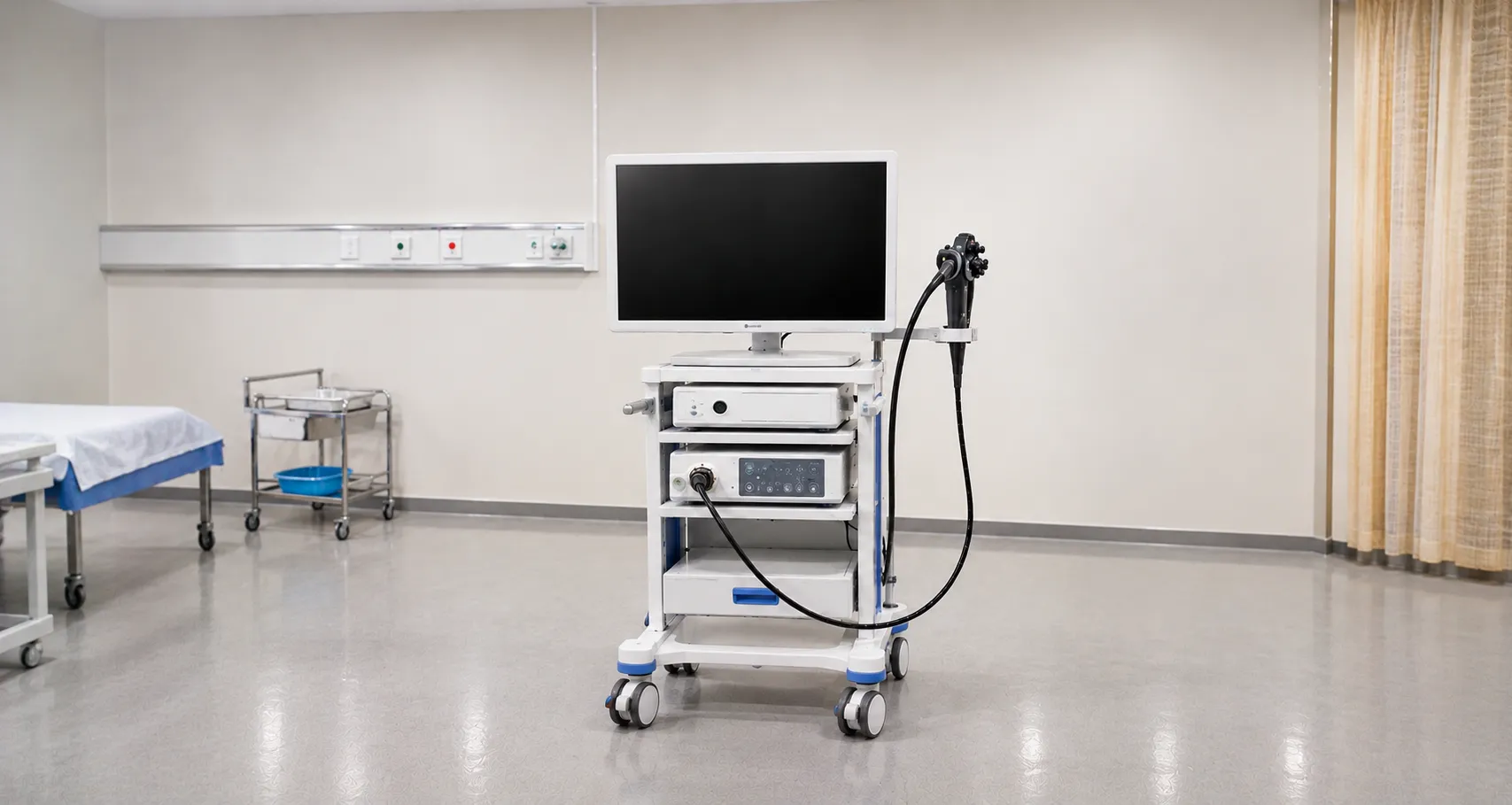
Modern practice is dominated by single-operator cholangioscopes: a largely disposable digital catheter with a distal camera and LED, controlled by one endoscopist and driven from its own compact console. Digital chip-on-tip imaging is far clearer than older fibre-optic images, four-way tip deflection aids navigation, and a dedicated channel supports biopsy forceps, lithotripsy fibres and baskets. Because the catheter is single-use or largely disposable, cross-contamination risk and reprocessing are minimal, but per-case cost is high.
Reusable fibre-optic and hybrid scopes
Older reusable cholangioscopes lower per-case cost but need two operators, deliver a dimmer fibre image, and demand meticulous reprocessing of an extremely narrow, fragile instrument that is easily damaged. Many units have moved away from them for infection-control and image-quality reasons.
Direct per-oral approach
Using an ultra-slim gastroscope directly avoids a dedicated cholangioscope but is limited to suitable anatomy and dilated ducts. It reuses existing scopes but is not a routine substitute.
Key specifications a buyer must check
Check the insertion-tube diameter, because the duct calibre it can enter depends on it, and the working-channel size, which dictates whether biopsy forceps, baskets and lithotripsy fibres will pass. Confirm the degrees of tip deflection and the number of directions, the image type (digital chip versus fibre) and resolution, and the irrigation channel. For single-use systems, confirm console compatibility with your existing stack and the range of compatible accessories. Confirm the cholangioscope passes through the specific duodenoscopes you already own — channel compatibility is not universal. Check which lithotripsy modality the system supports, since electrohydraulic and laser lithotripsy need different fibres, generators and safety controls, and confirm the dedicated biopsy forceps are sized for the miniature channel rather than borrowed from a standard set. Ask whether the console outputs to your existing monitors and image-capture system, so cholangioscopy images sit alongside the ERCP record rather than in a separate silo.
Standards, regulation and documentation
A cholangioscope and its console are medical devices requiring valid UKCA or CE marking and instructions for use that define intended purpose and, for reusable scopes, the validated reprocessing method. Any powered console, light source or electrosurgical or laser lithotripsy accessory used with the system sits under the IEC 60601-1 electrical-safety family, with IEC 60601-1-2 for electromagnetic compatibility and laser accessories carrying their own safety requirements. Request the declaration of conformity and confirm Great Britain market registration. The MHRA regulates devices in the UK and receives safety reports, with wider guidance on GOV.UK; clinical guidance on related procedures is published by NICE. Keep the instructions for use, especially the reprocessing section for any reusable component.
Decontamination, single-use and infection control
Reprocessing is the crux of the reusable-versus-disposable decision. Duodenoscopes and reusable cholangioscopes have narrow channels and complex tips that are hard to clean, and duodenoscope-associated infection has driven a strong move towards single-use and disposable-component designs across the biliary field. Single-operator digital cholangioscopes are largely disposable, which removes scope reprocessing and the associated risk at the cost of consumable spend. Reusable scopes must follow a validated manual clean and high-level disinfection or sterilisation cycle, with channel brushing, leak testing and drying, plus tracking of each cycle. Whatever you buy, the reprocessing pathway must be validated, resourced and recorded; the duodenoscope carrying the cholangioscope needs the same rigour.
Use across care settings
Cholangioscopy lives in hospital endoscopy units and hepatobiliary centres with an ERCP service; it is not a GP or domiciliary technique. It concentrates in tertiary and cancer centres handling indeterminate strictures and difficult stones. Case volume drives the economics: high-volume units may justify the console and steady disposable spend, while lower-volume units weigh per-case disposable cost against occasional use. Match the system to your ERCP throughput and the mix of diagnostic versus therapeutic cases you actually perform. A regional network may prefer to concentrate cholangioscopy at one hub so the console, expertise and disposable stock are used efficiently rather than spread thinly across sites.
Consumables, spares and total cost of ownership
For single-use systems the disposable cholangioscope catheter is the dominant recurring cost, alongside biopsy forceps, baskets and lithotripsy fibres, so model total cost against annual case volume rather than the console price alone. For reusable systems the running cost shifts to reprocessing chemicals, staff time, channel brushes, leak-test and drying equipment, and frequent repairs to a fragile scope. Ask about console warranty, software updates, the price and availability of disposable catheters, and lithotripsy accessory costs. Our team can help you model disposable against reusable for your ERCP volume — register as a buyer or contact us to compare systems.
Procurement checklist
-
Decide between single-use digital and reusable cholangioscopy based on volume, per-case cost and reprocessing capacity.
-
Confirm the cholangioscope passes through the specific duodenoscopes you already own.
-
Check the working-channel size supports the biopsy, basket and lithotripsy accessories you need.
-
Verify tip deflection, image type and resolution, and the irrigation channel.
-
For reusable scopes, confirm a validated, resourced and recorded reprocessing pathway.
-
Request UKCA or CE documentation, IEC 60601 compliance and instructions for use.
-
Model total cost of ownership, including disposable catheters or reprocessing, against annual case volume.
Conclusion
Cholangioscopy brings a camera and a working channel directly into the bile ducts, turning indirect shadows into a view you can biopsy and treat. The procurement decision is really disposable versus reusable, shaped by infection control, image quality and per-case economics. Confirm compatibility with your duodenoscopes, resource the reprocessing pathway honestly, and model consumable cost against your real ERCP volume. MediGear can line up suitable systems and accessories so your hepatobiliary service sees the ducts clearly and safely.
Disclaimer
This article is for informational purposes only. It is published by MediGear (medigear.uk) for general information and procurement guidance, and is not clinical, diagnostic, treatment, technical, engineering, legal or regulatory advice, nor a product endorsement, guarantee or substitute for professional assessment. MediGear does not provide medical consultations. Buyers should consult their clinical, biomedical, estates and regulatory contacts, and the manufacturer's documentation, and independently verify all specifications, certifications, compatibility and suitability before purchase. Specifications, certifications and availability are correct at the time of publication and may change without notice. MediGear is a medical-equipment distributor and does not sell medicines or pharmaceutical products.