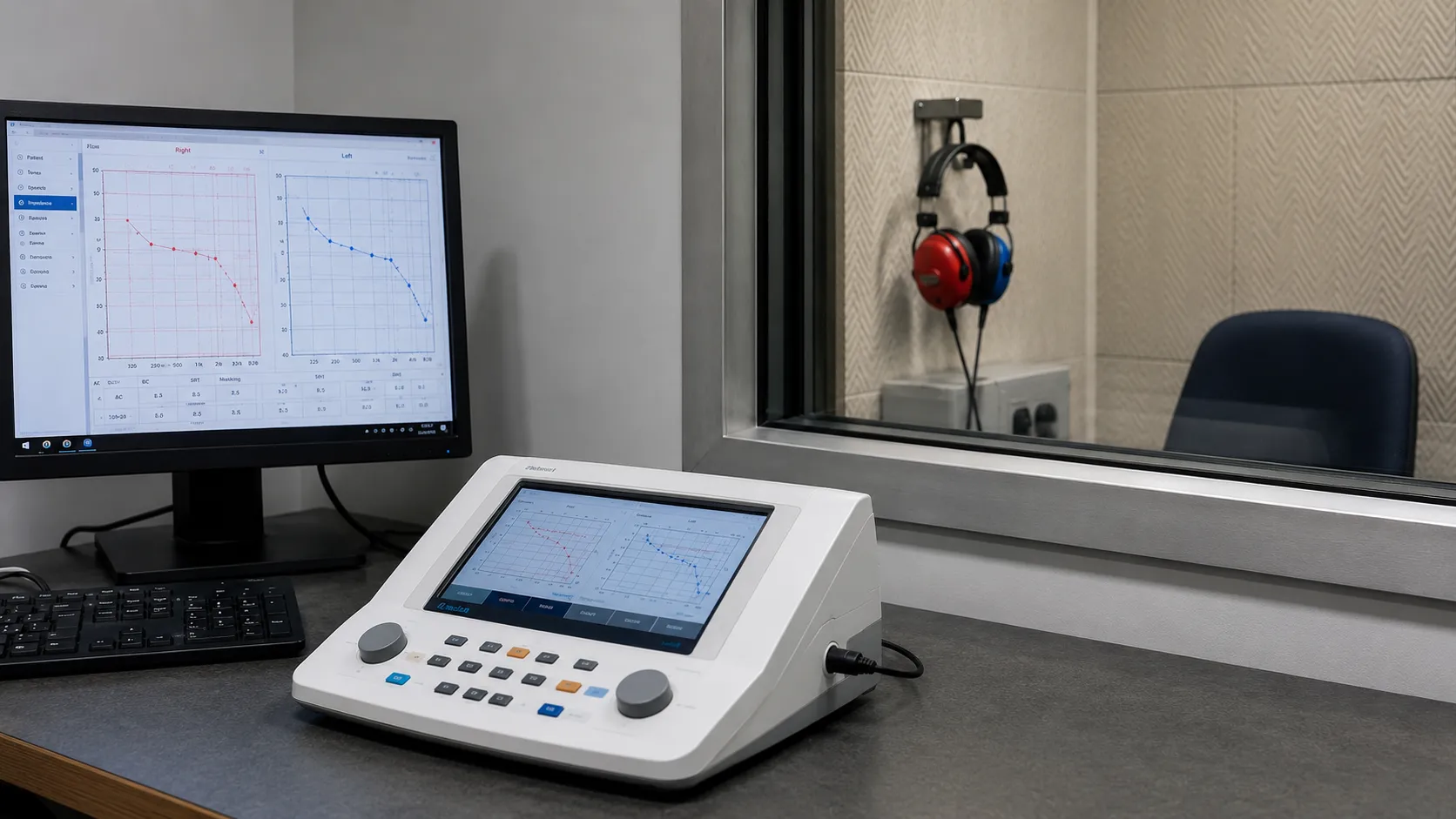
Audiometry is the measurement of hearing: how quiet a sound a person can detect across the range of pitches that matter for speech and daily life. A clinical hearing test uses an audiometer to present precise tones and speech at controlled levels, and records the softest level the person reliably hears at each frequency. The result, a plotted audiogram, shows the type and degree of any hearing loss.
For a buyer equipping an audiology service, an occupational health team or an ENT clinic, the audiometer is the central instrument of the pathway. Purchasing an audiometer includes the test supported, transducer options, calibration, the required acoustic environment, and its integration into the record.
How a Clinical Hearing Test Works
In pure-tone audiometry, the audiometer generates tones at set frequencies, typically 250 Hz up to 8000 Hz, and the tester lowers and raises the level to find the quietest tone the patient signals hearing. This threshold is recorded in decibels hearing level (dB HL) for each frequency and ear.
Air conduction and bone conduction
Air-conduction testing delivers sound through headphones or insert earphones and tests the whole hearing pathway. Bone-conduction testing uses a small vibrator on the mastoid to send sound directly to the inner ear, bypassing the outer and middle ear. Comparing the two tells the clinician whether a loss is conductive, sensorineural or mixed.
Masking explained
When one ear hears much better than the other, a loud tone meant for the poorer ear can cross the skull and be heard by the better ear, giving a false result. To prevent this, the tester plays a controlled noise into the non-test ear so it is kept quiet while the test ear is measured. Good masking is a skill, and instruments that make masking noise easy to set and monitor reduce errors and speed the test, which is a real usability feature for a busy clinic.
Speech audiometry
Beyond tones, speech audiometry measures how well a person recognises words at different levels, which reflects real-world hearing better than tones alone. Many diagnostic audiometers include speech testing with recorded or live-voice material, and support an external input for a CD or digital word list as well as a talk-back channel so the tester can hear the patient inside the booth. If your service reports speech scores, confirm the audiometer offers these inputs and stores the results with the audiogram.
Types of Audiometer
Screening audiometers are simple air-conduction devices for pass-or-fail or pass-or-refer screening in schools, occupational health, and general practice. Diagnostic audiometers add bone conduction, masking and speech testing for full clinical assessment. Clinical and research systems extend to high-frequency testing, more transducer options and advanced masking. Some are standalone boxes with a built-in interface; others are PC-based systems driven by software, which simplifies data handling and updates. Choosing between them starts with the decisions the service needs to make, not the feature list.
Transducers and the Test Environment
Transducer choice shapes both accuracy and comfort. Supra-aural headphones sit on the ear and are common, but insert earphones improve interaural attenuation and reduce the need for masking; they also suit clean and infection-control situations because the foam tips are single-use. Single-use is essential for diagnostic work. None of this counts for much without a controlled acoustic environment: reliable thresholds require ambient noise, which is why audiology relies on sound-treated booths that meet background-noise limits. Occupational health often uses an on-site booth, or an acoustically suitable room, and factors it into the total project rather than treating it as separate.
Standards, Regulation and Calibration
An audiometer is a medical device that must carry a UKCA or CE mark, with the supplier registered with the regulator. Audiometers are specified under the IEC 60645 series, which classifies instruments by type and capability, and reference threshold levels for transducers follow the relevant ISO 389 parts. Electrical safety sits under the IEC 60601-1 family. Calibration is central: audiometers require routine calibration against traceable references, commonly an annual laboratory calibration plus regular listening and functional checks by the user. Transducers are calibrated as matched pairs to the instrument, so you cannot freely swap a headset between devices without recalibration. Build calibration turnaround, loan cover and cost into the plan. The MHRA gives device guidance, and HSE is the reference for workplace hearing surveillance where audiometry supports health surveillance duties.
Decontamination and Consumables
Headphone cushions and the bone vibrator contact the patient, so they wipe them clean with approved agents; confirm what the manufacturer allows so you do not degrade the acoustic seal. Insert earphones use disposable foam tips, a recurring consumable to budget for. Response buttons and audiogram paper or printer rolls are minor but real running costs. Where insert tips replace supra-aural cushions for infection control, cost the tips across your annual test volume.
Warranty, Servicing and Spares
An audiometer is a long-life instrument, so servicing terms matter as much as the purchase price. The parts most likely to need attention are the transducers and their leads, the response button and, on PC systems, the software licence and driver support. Ask how long the warranty runs, whether the annual calibration is included in the early years, and how a matched transducer set is replaced if one earpiece fails, since the pair is calibrated to the instrument. Confirm loan cover during calibration or repair, because a clinic without a calibrated audiometer cannot report valid thresholds. Long-term software support is a real factor for PC-based systems that must stay compatible with your patient record.
Use Across Care Settings and Total Cost of Ownership
A school screening programme or a GP surgery may need only a screening audiometer and a quiet room. Occupational health needs repeatable pure-tone air-conduction testing, often in a mobile booth, to support workplace hearing surveillance. Audiology and ENT need full diagnostic capability, including tone conduction, masking, and speech. Total cost of ownership brings together the audiometer, transducers, the booth or room treatment, annual calibration, disposable tips, and the software or licence for PC-based systems. Connectivity to Noah or a documented export into the patient record removes manual transcription and its errors on every test. When you plan a service or refresh a fleet, our team can help you align specifications and calibration through MediGear for buyers.
What to Check Before You Buy
-
Test types needed: air conduction, bone conduction, masking and speech audiometry.
-
Frequency range and whether high-frequency testing is required.
-
Transducer options, including insert earphones for masking and infection control.
-
The acoustic environment, whether a sound-treated booth or a suitable room.
-
Calibration to traceable references under IEC 60645 and ISO 389, with cost and turnaround.
-
UKCA or CE marking and IEC 60601-1 electrical safety.
-
Noah or data-export connectivity into your patient record system.
Conclusion
Audiometry turns hearing into a measurable, repeatable record, and the value of that record depends on the right test types, calibrated transducers and a quiet enough room. Buy against the decisions your service makes, cost the booth and calibration alongside the instrument, and insist on IEC 60645 and IEC 60601-1 conformity. To scope an audiometry setup or a fleet refresh, talk to MediGear and specify for the pathway, not just the box.
Disclaimer
This article is for informational purposes only. It is published by MediGear (medigear.uk) for general information and procurement guidance, andisi not clinical,diagnostict, technical, engineering, lega,l orregulatoryy advice,,nor aproductt endorsement, guarante,e orsubstitutee forprofessional advicet. MediGear does not provide medical consultations. Buyers should consult their clinical, biomedical, estates and regulatory contacts, and the manufacturer's documentation, and independently verify all specifications, certifications, compatibility and suitability before purchase. Specifications, certifications and availability are correct at the time of publication and may change without notice. MediGear is a medical-equipment distributor and does not sell medicines or pharmaceutical products.