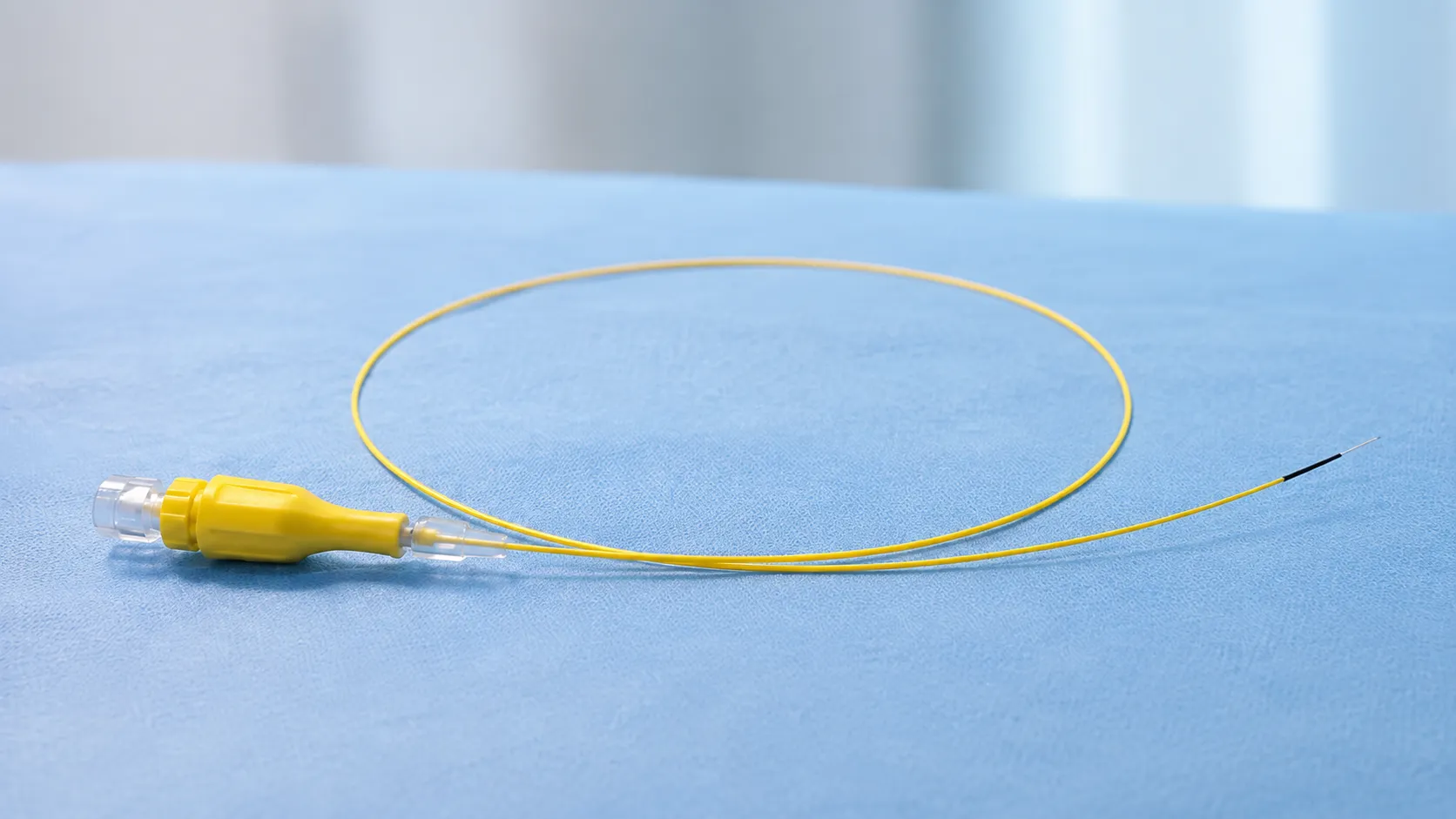
A ureteroscopy laser fibre is a thin, flexible optical fibre that carries laser energy from a surgical laser generator down the working channel of a ureteroscope to the surface of a stone inside the ureter or kidney. The surgeon passes the scope up the urinary tract, advances the fibre until its tip touches the stone, and fires the laser to break it up from the inside. This is an intracorporeal technique: the energy is delivered directly to the tissue itself, in contrast to shockwaves aimed outside the body. The fibre is a consumable, and its size and handling shape both the procedure and its cost.
For a urology or theatre procurement lead, laser fibres are a recurring consumable tied to the laser platform, so choosing core sizes, single-use versus reusable, and reliable supply options are central to running an efficient endourology service.
How laser fragmentation works at the stone
The laser generator produces pulses of energy that travel down the fibre and emerge at the tip. When the tip is held against, or very close to, the stone, the energy is absorbed. It breaks the stone by a photothermal effect, with some influence on the photoacoustic bubble effect. Two clinical strategies follow. In fragmentation, the surgeon breaks the stone into pieces small enough to be removed with a basket or to pass spontaneously. In dusting, settings are chosen to reduce the stone to fine dust that passes spontaneously, avoiding basketing. The laser settings, pulse energy, frequency and pulse width, and the fibre size together determine which strategy is achieved.
Laser types: holmium and thulium
Two laser sources dominate stone work, and the fibre must suit the platform:
- Holmium:YAG (Ho: YAG) — the long-established workhorse for stone fragmentation, effective on stones of all compositions and also used for soft-tissue work—modern high-power holmium systems with pulse modulation provide both efficient fragmentation and fine dusting.
- Thulium fibre laser (TFL) — a newer source whose wavelength is strongly absorbed, giving very efficient dusting, fine control at low pulse energies and a compact, quieter platform. It has grown quickly in endourology.
The fibre, the generator and the settings work as a system, so fibres must be specified for the laser platform in use.
Fibre core sizes and why they matter
Fibres are described by their core diameter, commonly itypically00 micrometres. The choice is a genuine trade-off:
- Smaller cores (around 200 µm) are highly flexible. Hence, they permit maximum deflection of the ureteroscope to the lower pole of the kidney; they leave more of the working channel free for irrigation. They carry less energy per pulse.
- Larger cores (around 550 to 1000 µm) carry more energy and suit larger, harder stones and rigid-scope work, but they stiffen the scope tip and reduce deflection and irrigation flow.
Matching the core size to the stoney is one of the most important choices in the procedure. Buyers should stock a range so surgeons can select appropriately, and confirm the fibres are rated for the laser's power.
Single-use versus reusable fibres
Fibres come as single-use (single-patient) or reusable. Single-use fibres arrive sterile and are discarded after one case, giving guaranteed performance, no reprocessing and no cross-contamination risk, at a higher per-case price. Reusable fibres are reprocessed and re-cleaved (the damaged tip is stripped and cleaved fresh) between uses, lowering the per-case cost but requiring careful reprocessing, tip preparation and tracking of remaining life, since each reuse and cleave shortens the fibre and can degrade transmission. The choice hinges on case volume, sterile-services capability and the true cost per case including reprocessing labour and fibre attrition. A protective effect on the delicate ureteroscope also matters: a fibre fired while looped inside the scope, or a poorly stripped tip, can damage an expensive flexible scope.
Key specifications a buyer must check
Confirm the laser platform the fibres must serve, holmium or thulium, and that the fibres are rated for its power and pulse settings. Decide the core-size range to stock against your stone-based on scope mix, ensuring small cores for flexible lower-pole access and larger cores for bulky stones. Choose single-use or reusable based on volume and reprocessing capability, and if reusable, check the stripping-and-cleaving kit and guidance on maximum reuses. Review connector compatibility with your generator, tip design, and any features that protect the scope. Confirm sterility and single-patient labelling, batch and expiry, and reliable supply, since a stalled fibre supply stalls a stone list.
Protecting the ureteroscope
Flexible ureteroscopes are among the most fragile and costly items in urology, and laser fibres are a common cause of damage. A fibre must not be fired while the scope is fully deflected with the fibre looped, and the tip should protrude beyond the scope before firing. Stripping the fibre jacket cleanly and cleaving a fresh tip on reusable fibres protects transmission and avoids tip burn-back inside the channel. Because of this, fibre handling, training and the choice between single-use and reusable interact directly with scope repair costs, and that repair budget belongs in any honest comparison of fibre options.
Use across settings and service models
Laser fibres are used ed wherever ureteroscopic stone treatment is done, from large stone centres to district general urology units. A high-volume endourology service may favour a mix of core sizes and weigh reusable fibres against single-use on cost, backed by robust reprocessing. A lower-volume unit often prefers single-use fibres to avoid the reprocessing overhead and guarantee performance. The laser platform (holmium or thulium) and the balance between ESWL and percutaneous provision shape how many fibres of which sizes a service uses. Matching the fibre range and single-use policy to real caseload keeps both performance and cost under control.
Consumables and total cost of ownership
The fibre is a recurring per-case consumable, so model annual usage by core size and by procedure. For single-use fibres, the cost is simply the fibre per case; for reusable fibres, factor in reprocessing labour, the stripping-and-ving consumables, and the shortened life, then compare true cost per case. Add the often-overlooked cost of scope repairs influenced by fibre handling. Standardising on a laser platform and a defined fibre range simplifies stock, training and supply. Reliable delivery and clear lead times matter because fibres are essential to every stone case. We can help you scope a fibre range and supply arrangement around your laser platform — register as a buyer or get in touch.
Regulation and safe use
Laser fibres and the generators they serve are active medical devices. They must carry a valid UKCA or CE marking with instructions for use, and surgical devices fall under laser-safety requirements in the IEC 60601 family. The MHRA regulates medical devices in the UK, with wider guidance on GOV.UK, and laser use in the workplace engages HSE duties around eye protection and controlled areas. The procurement role is to ensure the procurement platform meets the standards and is supplied with the reprocessing or single-use provisions the service needs; safe laser use itself depends on trained staff, eye protection, and correct settings.
Procurement checklist
-
Confirm the laser platform — holmium or thulium — and that fibres are rated for its power.
-
Stock a range of core sizes, from around 200 µm for flexible access to larger cores for bulky stones.
-
Choose single-use or reusable fibres based on volume and reprocessing capability.
-
For reusable fibres, check the stripping-and-cleaving kit and maximum-reuse guidance.
-
Verify connector compatibility, tip design and features that protect the scope.
-
Confirm sterility, single-patient labelling, batch, expiry and reliable supply.
-
Include ureteroscope repair costs when comparing single-use against reusable fibres.
Conclusion
Ureteroscopy laser fibres deliver energy directly to a stone inside the urinary tract, allowing the surgeon to see it under vision. The fibre's core size, laser rating, and single-use or reusable format shape both the procedure and its cost. Buying matching fibres to your holmium or thulium platform, stocking the right core-size range, choosing a single-use policy that fits your reprocessing capability, and counting scope-repair risk in the true cost per case. Confirm the standards, compatibility and supply, then size the range to your stone workload. MediGear can supply ureteroscopy laser fibres matched to your compatible platform, so your endourologists can run reliably and cost-effectively.
Disclaimer
This article is for informational purposes only. It is published by MediGear (medigear.uk) for general information and procurement guidance. It is not a clinical diagnosis, clinical treatment, technical, engineering, legal, or regulatory advice, nor a product endorsement, guarantee, or substitute for professional assessment. MediGear does not provide medical consultations. Buyers should consult their clinical, biomedical, estates and regulatory contacts, and the manufacturer's documentation, and independently verify all specifications, certifications, compatibility and suitability before purchase. Specifications, certifications and availability are correct at the time of publication and may change without notice. MediGear is a medical-equipment distributor and does not sell medicines or pharmaceutical products.