
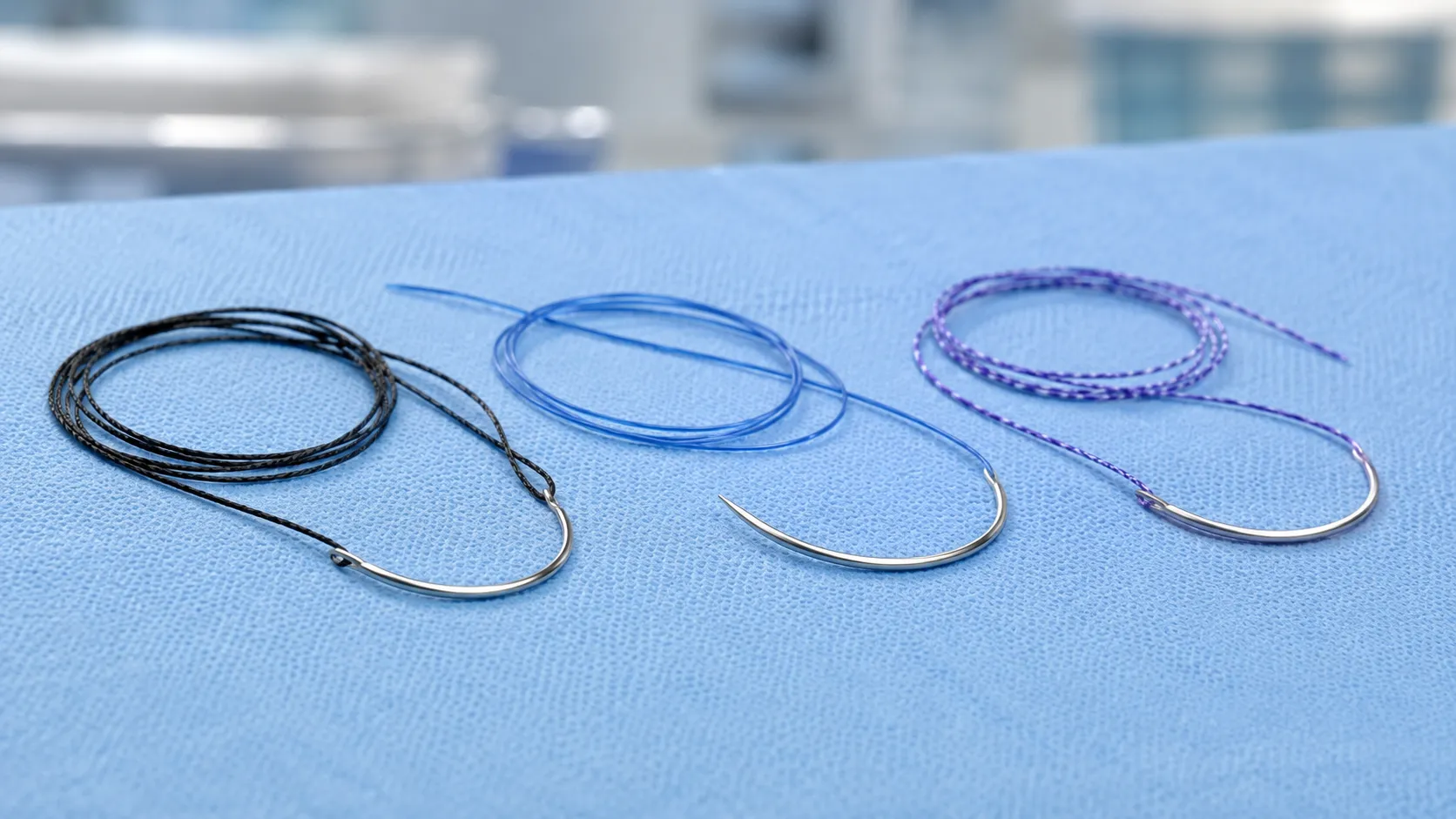
Surgical sutures are sterile threads, usually swaged to a needle, used to hold tissue together while it heals and to tie off blood vessels. The material choice governs how the wound behaves: whether the thread dissolves or stays, how much it drags through tissue, how securely a knot holds, and how much tissue reaction it provokes. Matching the right suture to the right tissue is a core theatre decision, and stocking the range correctly is a core procurement one.
This guide sets out the material families a theatre buyer must understand: absorbable versus non-absorbable, monofilament versus braided, natural versus synthetic, the needle types they come swaged to, and the USP gauge system used to size them. It stays focused on materials and how they compare, so that you can build a rational suture formulary rather than an overly long, complicated stock list.
Absorbable versus non-absorbable
Absorbable sutures are broken down in the body by hydrolysis or enzymatic action over a defined period, so they hold tissue during healing and then disappear, needing no removal. Their useful strength is described by two figures: how long they retain tensile strength, and how long until full absorption, which are not the same. Fast-absorbing threads suit mucosa and skin closures under tension for only days; longer-lasting synthetics hold for weeks and suit deeper layers such as fascia. Non-absorbable sutures resist breakdown and remain indefinitely; they are used where lasting support is needed, such as tendons and vascular anastomoses, and are removed later when placed. Buyers should stock both families across the sizes their surgical specialities use, versus braided (multifilament)
A monofilament is a single smooth strand. It passes through tissue with little drag, harbours fewer bacteria in its structure, and resists infection, which makes it valued for contaminated wounds and vascular work. Its drawback is memory and handling: it is stiffer, and knots must be tied carefully because a nicked or crushed monofilament can fail. A braided or multifilament suture is many fine strands twisted or woven together. It handles softly, holds a knot securely and has good tensile strength for its size, but the in. Still, they can wick fluid and shelter bacteria, so some braided materials carry an antibacterial coating and are avoided in dirty wounds. The monofilament-versus-braided choice trades handling and knot security against infection resistance.
Natural versus synthetic
Older natural materials such as silk (non-absorbable, braided) and catgut (absorbable, from collagen) are still referenced, though catgut is no longer supplied in many markets. Natural threads tend to provoke more tissue reaction and less predictable absorption. Modern synthetics, made from polymers, give predictable strength retention profiles and lower reactivity, which is why most theatre stock is synthetic. Knowing the family helps a buyer read a surgeon's preference card: a request framed by a brand or generic name maps back to one of these material types.
Needle types swaged to the suture
Most sutures are supplied swaged, with the thread pressed into the end of a needle so there is no eye and no double thickness of thread dragging through tissue. Buyers must specify the needle as carefully as the thread. The point geometry matters: a cutting needle has a sharp edge for tough tissue such as skin; a reverse-cutting needle places the cutting edge on the outer curve to resist tissue cut-through; a taper (round-bodied) needle spreads tissue without cutting, for delicate or friable tissue such as bowel and vessels; a blunt point reduces needlestick risk on friable tissue such as liver. Needle curvature, expressed in fractions of a circle, and needle length are chosen for access and depth. The same thread is offered on several needle options, so the preference card specifies both.
USP gauge and sizing
Suture diameter follows the United States Pharmacopoeia scale, and the numbering is counter-intuitive. Larger sizes run 1, 2, 3, and so on for the thickest threads; finer sizes run 0, then 2-0 (written 2/0 and spoken "two-oh"), 3-0, 4-0, and onward, with each added zero indicating a finer thread. So 6-0 is far finer than 2-0, and 5 is a heavy thread. Finer sutures are weaker but cause less trauma and scarring, so fine gauges suit face and vascular work while heavier gauges suit fascia and orthopaedic closure. USP also sets minimum knot-pull strength for each size and material, which is why gauge is stated alongside material on every packet. Standardising the gauge range you hold per speciality keeps the formulary tight.
Matching material to tissue and layer
The practical logic is layered: deep fascia, which must hold for weeks, favours a long-lasting, absorbable or non-absorbable of adequate gauge. Bowel and vascular anastomoses favour taper needles and low-drag threads. Skin may be closed with non-absorbable monofilament for later removal, or a subcuticular absorbable to avoid removal. Vessel ligation uses ties without needles. A buyer does not make these clinical choices, but understanding them helps explain why the formulary includes several items, gauges, and needle types rather than a single universal single-use option.
Standards, regulation and sterility
Sutures are sterile, single-use medical devices and must carry a valid UKCA or CE marking with instructions for use; the foil packet shows material, gauge, needle type, batch, and expiry date. They must never be reprocessed, and packet integrity must be checked before use. Suture dimensions and knot-pull strengths are defined in pharmacopoeial and BS EN ISO standards, so a compliant product performs to a stated specification. The MHRA regulates surgical sutures in the UK and issues field safety notices here with broader guidance on GOV. Uavailable K. Traceability by batch matters for any implanted non-absorbable material.
Formulary, consumables and total cost of ownership
Sutures are high-frequency single-use consumables, so the recurring cost is unit price multiplied by large volumes, and waste is the hidden cost. A rationalised formulary, agreed with surgeons, holds the materials, gauges, and needle types the service genuinely uses and drops near-duplicates, which cuts stock, reduces expiry write-offs, and reduces errors. Standard preference cards then map to formulary lines. Reliable supply and short lead times protect lists, because a missing suture size stock can stop a case. We can help you rationalise a suture formulary and set par levels — register as a buyer or contact our team to review options.
Use across surgical settings
A district general hospital carries a broad formulary, including general, orthopaedic, obstetric, and emergency care. ency At the stimetiwecardiothoracic surgeonsppefine-gauge neele and suture weghrWhile cardiothoracic holds fine-needle sutures, fne-auge needleweightsdiothoracic fine gauges, and orthopaedics holds heavy threads and specialist needles. Primary care and minor-surgery clinics hold a small, limited range. Veterinary practice uses the same material families scaled to the patient. Matching the formulary to the case mix keeps the right thread on the shelf without over-holding; service seldom opens.
Procurement checklist
-
Stock both absorbable and non-absorbable families across speciality uses, using speciality monofilament and braided options for handling, knot security, and infection resistance.
-
Specify needle point geometry, curvature and length on every formulary line.
-
Confirm USP gauge against the tissue and layer the surgeons close.
-
Check UKCA or CE marking, sterile packet integrity, material, batch and expiry.
-
Rationalise near-duplicate lines to cut stock value and expiry write-off.
-
Set par levels and reliable lead times so a missing size never stops a case.
Conclusion
Suture material is a small consumable with an outsized effect on wound healing, and buying it well means understanding the families behind the packet: absorbable versus non-absorbable, monofilament versus braided, the swaged needle types, and the USP gauge scale. A formulary built on those distinctions, agreed with surgeons and kept free of near-duplicates, holds the right thread for every layer without tying up stock or generating waste. MediGear can supply a full suture range across materials, gauges and needle types so that theatres are close to hand, the right thread to hand, for every woundimer
Disclaimer
This article is for informational purposes only. It is published by MediGear (medigear.uk) for general information and procurement guidance. It is not diagnostic, treatment, technical, engineering, legal or regulatory advice, nor a product endorsement, guarantee or substitute for professional assessment. MediGear does not provide medical consultations. Buyers should consult their clinical, biomedical, estates and regulatory contacts, and the manufacturer's documentation, and independently verify all specifications, certifications, compatibility and suitability before purchase. Specifications, certifications and availability are correct at the time of publication and may change without notice. MediGear is a medical-equipment distributor and does not sell medicines or pharmaceutical products.