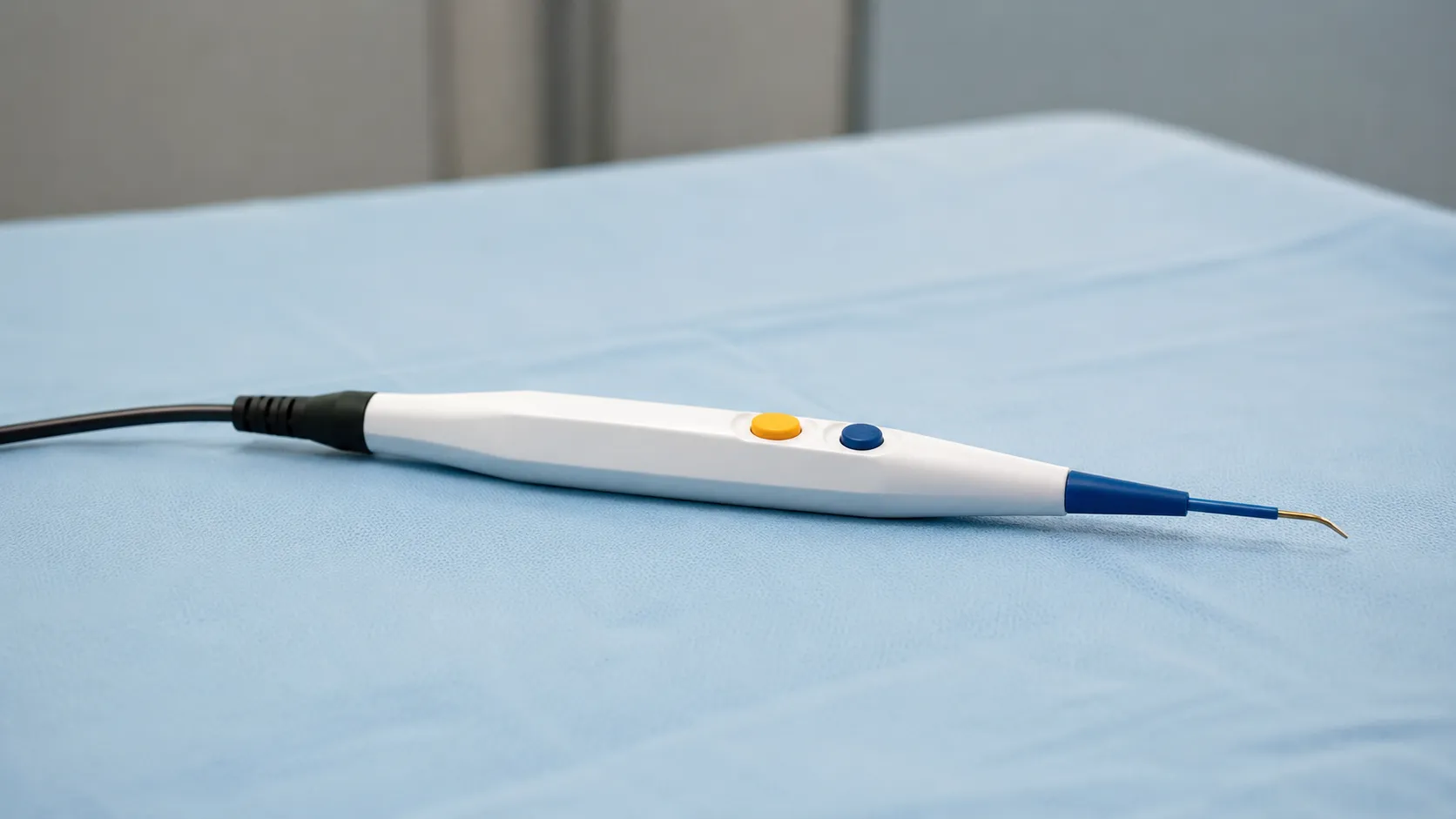
A surgical cautery pen is a handheld, battery-powered device that seals or destroys small amounts of tissue with a heated tip. The tip is a fine wire that glows hot when current from the internal battery passes through it, and it is that physical heat—heavy electrical current entering the patient—that stops minor bleeding or removes a tiny lesion. This makes thermal cautery a self-contained tool for minor and office-based procedures, quite different from the mains-driven electrosurgical generators used in a main theatre.
For a buyer, the cautery pen is one of the least expensive energy tools in the catalogue, but it is b. Still, it has volume across GP minor-surgery lists, ophthalmology, dermatology, and ENT clinics, so choosing the right tip temperature, battery format, and single-use policy has a real bearing on running costs and clinical convenience.
How thermal cautery differs from electrosurgery
The distinction matters and is often blurred in ordering. A thermal cautery pen heats a resistive filament and touches that hot filament to tissue; the patient is never part of an electrical circuit, so there is no return electrode, no patient plate and no radio-frequency current. An electrosurgical or diathermy unit, by contrast, passes high-frequency current through the patient to generate heat inside the tissue itself. Because a cautery pen keeps all the electricity within the piece, it can often be used safely near the eye, on patients with implanted electronic devices where stray current is a concern, and in settings without a generator. de-off is that a battery filament delivers modest, localised heat suited to pinpoint work rather than dividing bulkier tissue.
High-temperature and low-temperature models
Cautery pens are broadly split by the temperature at the tip; high-temperature units run the element at a high heat and are used for haemostasis and for cutting or destroying small lesions. Low-temperature units hold the tip at a gentler heat and are favoured where the surrounding tissue must be protected, such as ophthalmic work close to delicate structures. Some devices offer a fixed output; others let the clinic allow modulating heat with a slider via tip selection. When comparing models, the buyer should look at the quoted tip temperature range and the time the element takes to reach working heat, because a slow warm-up interrupts a clinic list.
Tip shapes and their typical uses
Fine and ophthalmic tips
The finest tips are used in ophthalmology and oculoplastics for epilation of lashes, sealing tiny vessels and fine eyelid work, where precision matters far more than power. A narrow, sharply formed loop concentrates heat on a very small area.
Standard and dermatology tips
Broader loop and ball tips suit dermatology and general minor surgery: removing skin tags, treating small vascular lesions and achieving haemostasis at a punch-biopsy or excision site. ENT clinics use them for minor nasal cautery.
Elongated and specialty tips
Longer shafts and shaped tips are supplied for vasectomy and other reach-limited procedures, where a straight fine tip must seal the vas deferens or reach a confined field. Matching tip geometry to the procedure list is the single most useful specification decision.
Key specifications a buyer must check
Confirm the tip temperature range and whether the output is fixed or adjustable, and check how the tips attach — some pens use push-fit reusable tips; others are sealed, single-use units where the whole pen is discarded. Establish the battery format: many pens use standard AA cells, some use a sealed internal battery, and a few sit in a rechargeable base. Look at the switch design: accidental activation with an exposed hot tip is the main hazard, so a recessed or two-stage switch is preferable. Check the range of tip shapes offered for the specific procedures your clinicians run, and whether tips are sold separately or only as complete units. Finally, verify sterility status on arrival, since many are supplied sterile for single-patient use
Single-use, sterility and infection control
Most modern cautery pens are designed as single-use, single-patient items supplied sterile and discarded after the procedure. This removes any decontamination burden and guarantees a clean, correctly formed tip every time, which is why single-use has become the default in primary care and clinic settings. Where a reusable handpiece with replaceable tips is used, the infection-control team must confirm the validated cleaning route and that the tip cannot be reprocessed beyond its intended life. Battery disposal also needs a route: pens with internal cells fall under waste-electrical and battery regulations, and clinics should agree how spent units are segregated rather than dropped into clinical waste without thought.
Regulation and electrical safety
A cautery pen is a medical device and must carry valid UKCA or CE marking with instructions for use that state its intended purpose and single-use status. Although it is a low-energy, battery-powered instrument, the general medical electrical safety standard IEC 60601-1 underpins the design, and the manufacturer's declaration of conformity should be available on request. Because the device does not pass current through the patient, the high-frequency surgical equipment requirements that govern diathermy do not apply in the same way. However, the buyer still confirms the fire-risk guidance in the instructions, as a hot tip near alcohol-based skin preparation or supplemental oxygen is a recognised ignition source. The MHRA registers medical devices for the Great Britain market and is the route for reporting any device-related incident.
Use across care settings.
Thermal cautery pens are at their most useful where a full electrosurgical generator is neither available nor warranted. GP practices running minor-surgery sessions, community dermatology clinics, ophthalmology and oculoplastic units, ENT outpatient rooms and family-planning services for vasectomy all rely on them. They also appear in veterinary practice for small-animal minor procedures. In each case the appeal is the same: an immediate, portable heat source with no cabling, no generator and minimal setup, which fits a clinic room far better than a trolley-mounted diathermy unit.
Total cost of ownership
Because single-use pens are inexpensive individually, the meaningful figure is annual consumption: the number of procedures multiplied by the unit price, plus the cost of any special-service uses less often. A clinic that performs cautery on most lists should model this honestly and compare it with a reusable-handpiece system where only the tips are replaced, remembering to add decontamination and tracking costs to the reusable option. Storage of sterile stock, expiry dating and the small carbon and disposal footprint of battery units all belong in the calculation. Our team can help a service size its order and compare single-use against reusable options — register as a buyer or reach us through the contact page.
Procurement checklist
-
Confirm tip temperature range and whether output is fixed or adjustable.
-
Check the tip shapes offered against the procedures your clinicians perform.
-
Establish the battery format and the disposal of spent units
-
Prefer a recessed or two-stage switch to prevent accidental activation.
-
Confirm single-use status or whether a sterile supply or a validated route is used for any reusable handpiece.
-
Request UKCA or CE documentation and IEC 60601-1 compliance.
-
Review fire-risk guidance for use near skin prep and supplemental oxygen.
-
Model annual consumption against a reusable-tip alternative.
Conclusion
A surgical cautery pen delivers minor procedures without passing any current through the patient, which is exactly why it suits clinic and office settings that have no diathermy; it means matching tip shape and temperature to the procedures on the list, deciding between single-use and reusable-tip formats, and confirming the UKCA or CE paperwork and fire-safety guidance before stocking up. MediGear can help GP, ophthalmology, dermatology and ENT services choose the right cautery format and size their orders sensibly.
Disclaimer
This article is for informational purposes only. It is published by MediGear (medigear.uk) for general information and procurement guidance, and is not cl. It is not diagnostic treatment, technical or regulatory advice, a product endorsement, a warranty, or a substitute for professional assessment. Gearnot does not provide medical consultations. Buyers should consult their clinical, biomedical, estates and regulatory contacts, and the manufacturer's documentation, and independently verify all specifications, certifications, compatibility and suitability before purchase. Specifications, certifications and availability are correct at the time of publication and may change without notice. MediGear is a medical-equipment distributor and does not sell medicines or pharmaceutical products.