Diathermy is the use of high-frequency electrical current to generate heat inside body tissue during surgery, allowing a surgeon to cut, coagulate or seal. The current oscillates far too fast to stimulate nerves or muscle, but as it is forced through the tissue's resistance, it produces intense, localised heat at the point of contact. That heat, delivered in controlled bursts by an electrosurgical generator, is what cuts tissue cleanly or stops bleeding — the electricity is simply the means of getting heat exactly where the surgeon wants it.
For a theatre buyer, diathermy is a capital purchase built around the generator, and getting it right means understanding the two circuit types, the waveforms that separate coagulation from non-coagulation, and the electrical-electrical safety that keeps the current from burning the patient anywhere other than the surgical site.
How high-frequency current makes heat
Mains electricity alternates at 50 hertz, a frequency that would cause dangerous neuromuscular stimulation if passed through a patient. An electrosurgical generator steps that up to hundreds of thousands of hertz, typically in the radio-frequency band. At these frequencies, the current no longer excites nerves so that it can be safely driven through tissue, and the heating effect depends on the current density. Where current is packed into the tiny area of an active electrode tip, the tissue there reaches a high temperature almost instantly; where it spreads out over a large area, the same current produces negligible heat. Every diathermy technique is really an exercise in managing current density: high at the working point, deliberately low everywhere else.
Monopolar and bipolar circuits
Monopolar diathermy
In monopolar diathermy, the current flows from a single active electrode held by the surgeon, through the patient's body, and out through a large return electrode — the patient plate or dispersive pad — placed on the skin and connected back to the generator. Because the return pad has a large surface area, the current density there is low, and the skin stays cool; the concentrated active tip does the work. Monopolar is versatile and fast, but it depends completely on correct placement of the return electrode.
Bipolar diathermy
In bipolar diathermy, the current travels only between two poles held close together, typically the two tips of a pair of forceps, so it passes through just the small piece of tissue grasped between them and does not traverse the patient's body. No return pad is needed, and the technique is inherently more contained, which is why it is chosen near delicate structures. It cannot cut in the same way as monopolar and is used chiefly for precise coagulation.
Cutting, coagulation and blended waveforms
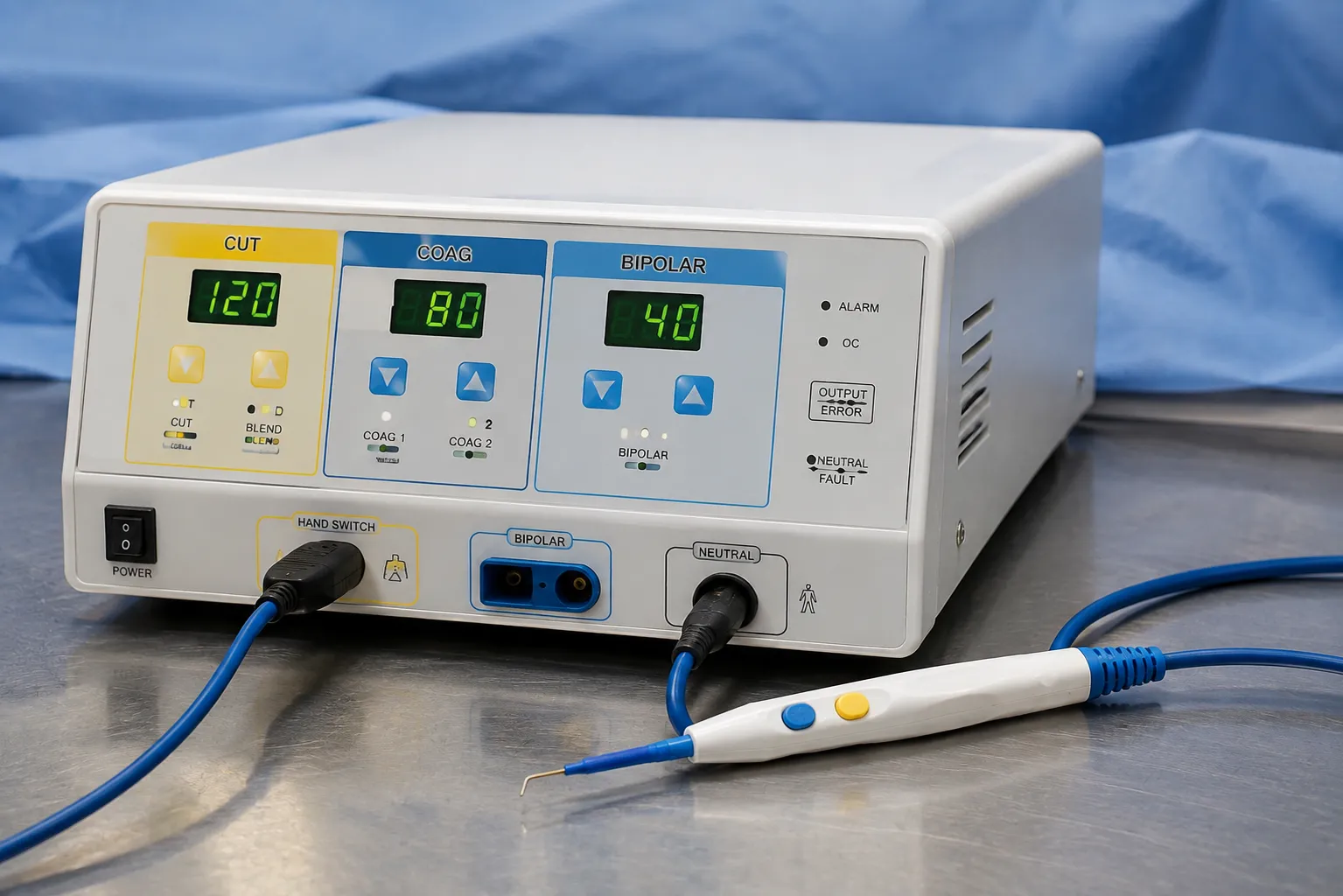
The difference between cutting and coagulating is largely the shape of the electrical output. A continuous, lower-voltage waveform delivers steady energy that vaporises cells and parts tissue — the cutting effect. An interrupted, higher-voltage waveform delivers energy in short bursts that heat and desiccate tissue to seal vessels rather than divide them — the coagulation effect. Generators also offer blended settings that mix the two to cut with some haemostasis. Modern tissue-response generators go further, sampling tissue impedance thousands of times per second and adjusting their output to maintain a consistent effect. A buyer should understand which modes a generator provides and how its power is expressed, because settings are not directly comparable between makers.
The dispersive electrode and patient safety
The single most important safety element in monopolar diathermy is the return (dispersive) electrode. If it peels, is poorly sited or has too little skin contact, the exit current concentrates and can cause a burn under the pad. To manage this, generators use a contact-quality monitoring system, often called a return-electrode monitor, that continuously checks the impedance of a split dual-pad and stops outp, if contact is lost, ut with an alarm if contact follows a consistent rule: site the pad over a well-vascularised muscle mass reasonably close to the operative field, keep it clear of bony prominences, scar tissue, hair and any metal implant, and never trim a pad to fit a smaller patient, because cutting it changes the contact area the monitor relies on. When specifying a generator, confirm it supports contact-quality monitoring and theching splsplit-returnectrodes, because this feature is a core defence against electric diathermy injury. Surgical smoke is a further consideration: the plume from tissue vaporisation should be extracted, and many generators integrate a smoke-evacuation control.
Standards and regulation that apply
An electrosurgical generator is an active surgical device and must carry valid UKCA or CE marking. The particular standard that governs it is IEC 60601-2-2, the requirement for high-frequency surgical equipment, which sits under the general safety standard IEC 60601-1 and sets out the tests for output limits, return-electrode monitoring and leakage current. When comparing generators, ask the supplier to confirm compliance with IEC 60601-2-2 by number and to provide the declaration of conformity. Registration for the Great Britain market and adverse-incident reporting run through the MHRA, and broader device and safety guidance for employers is published by the HSE, which is relevant to surgical-smoke exposure and electrical safety at work.
Key specifications a buyer must check
Confirm the maximum power outputs for cut and coagulation, and the modes offered; check that the generator supports both monopolar and bipolar modes on a single console if the department needs both. Verify it uses contact-quality return-electrode monitoring and specify the compatible dual-pad electrodes. Check the range of compatible instruments, footswitch and hand-control options, and whether the unit integrates smoke evacuation or vessel-sealing functions. Look at the display and preset memory, since stored surgeon settings speed list turnover. Confirm the accessory connectors match the forceps, and leads already in stock that are universal across manufacturers.
Servicing, testing and consumables
Diathermy generators are included in our medical equipment management system and require electrical safety testing by biomedical engineering, including verification of output accuracy and return-electrode monitoring. Active electrodes come in several tip shapes — a standard blade for cutting, a needle or wire loop for fine work and a ball for surface coagulation — and the hand pencil may switch modes with finger buttons or a footswitch, so confirm which the surgeons prefer and whether the pencils are single-use or reusable. Consumables dominate the running cost: single-use active electrode pencils, patient return pads, cleaning tips and, for bipolar work, forceps and leads. Reusable pencils and forceps must follow a validated decontamination route. When budgeting, separate the one-off generator and cart cost from the costs of securing the generator; factor in service contracts, software updates and smoke-free cartridges if smoke-free is built in. Our team can compare generators against the modes and instrument connectors a theatre already uses — register as a buyer or contact us through the contact page.
Procurement checklist
-
Confirm maximum cut and coagulation power and the blended modes offered.
-
Check the generator provides both monopolar and bipolar if both are needed.
-
Vereturn-electrodeity re,turn-andtrode monidual pads; ask the supplier to confirm IEC 60601-2-2 compliance by number.
-
Match accessory connectors to existing pencils, forceps and leads.
-
Review integrated smoke evacuation and vessel-sealing options.
-
Plan biomedical testing of output accuracy and return-electrode monitoring.
-
Separate the generator cost from the recurring per-case consumables.
Conclusion
Diathermy applies high-frequency current to generate heat within the tissue, cutting or coagulating depending on the mode and the circuit, either monopolar through the body to a return pad, or bipolar across the guided tissue, and being well means matching the generator's modes and power to the surgery, insisting on contact-quality return-electrode monitoring, confirming IEC 60601-2-2 compliance, and checking that the accessory connectors fit existing instruments. MediGear can help theatres compare electrosurgical generators and their consumables so the platform matches the department's casework and safety expectations.
Disclaimer
This article is for informational purposes only. It is published by MediGear (medigear.uk) for general information and procurement guidance, not diagnostic or engineering error, legal, or regulatory advice, nor a product endorsement, guarantee, or substitute for professional assessment. MediGear does not provide medical consultations. Buyers should consult their clinical, biomedical, estates and regulatory contacts, and the manufacturer's documentation, and independently verify all specifications, certifications, compatibility and suitability before purchase. Specifications, certifications and availability are correct at the time of publication and may change without notice. MediGear is a medical-equipment distributor and does not sell medicines or pharmaceutical products.