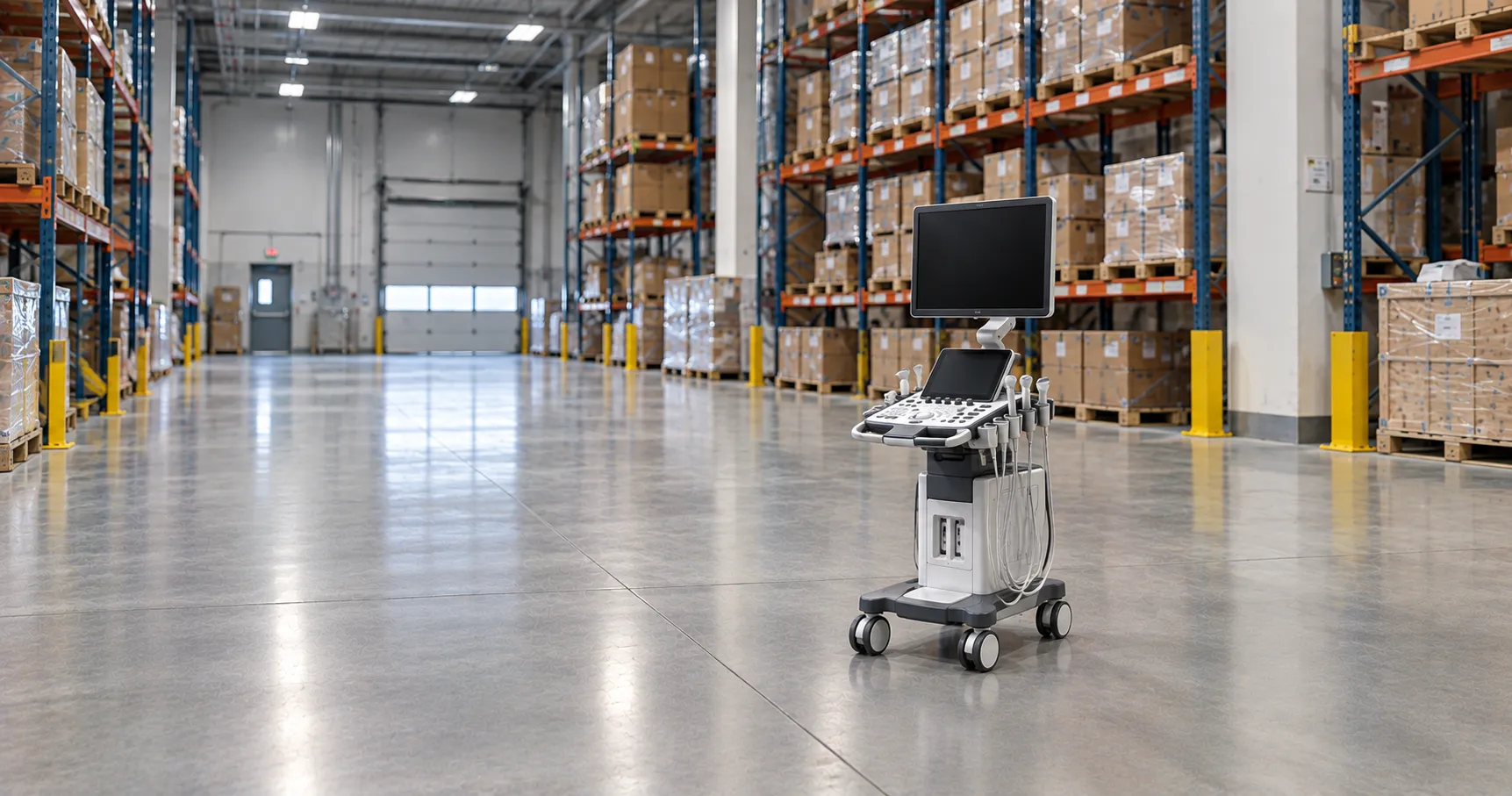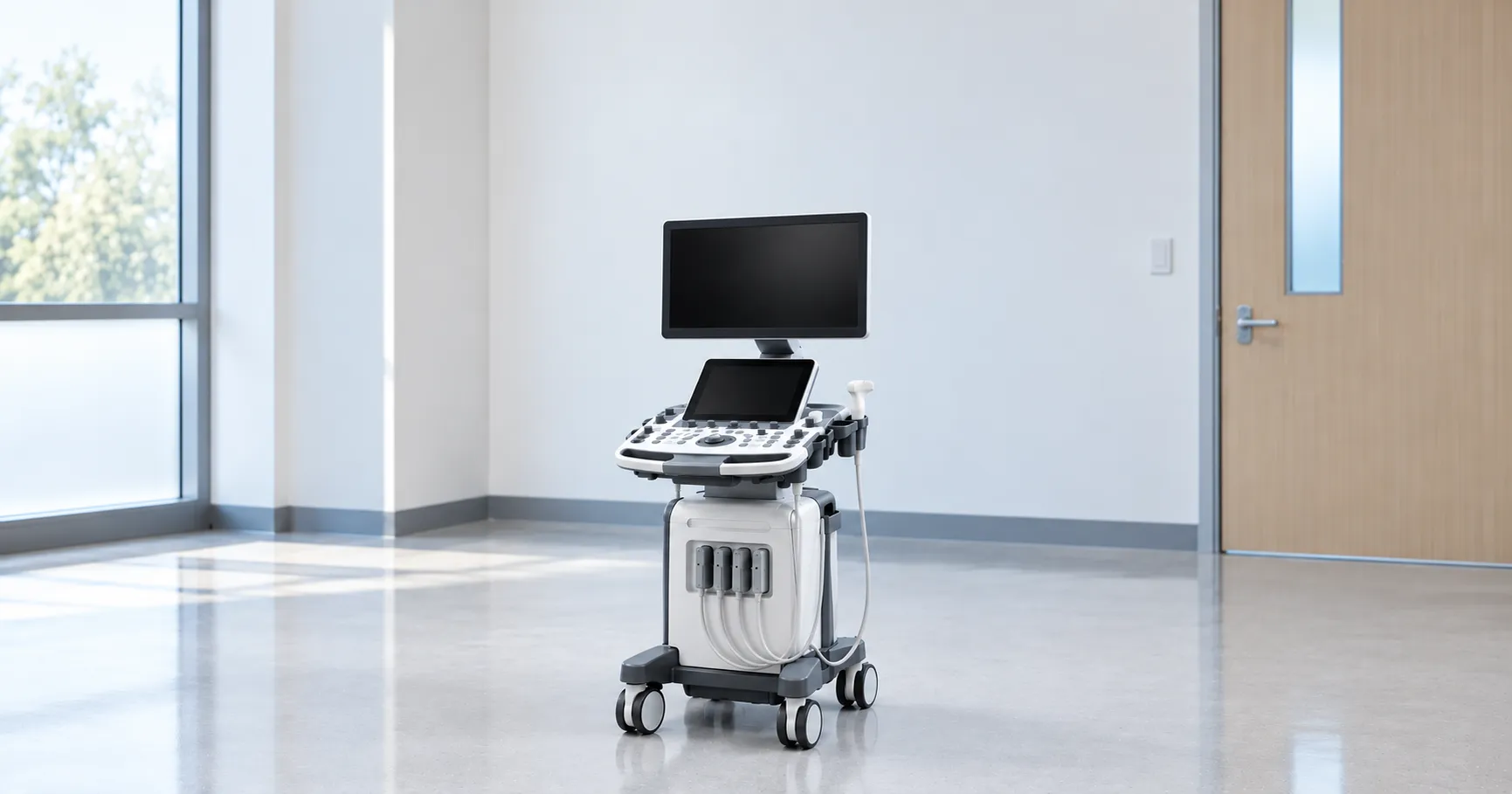
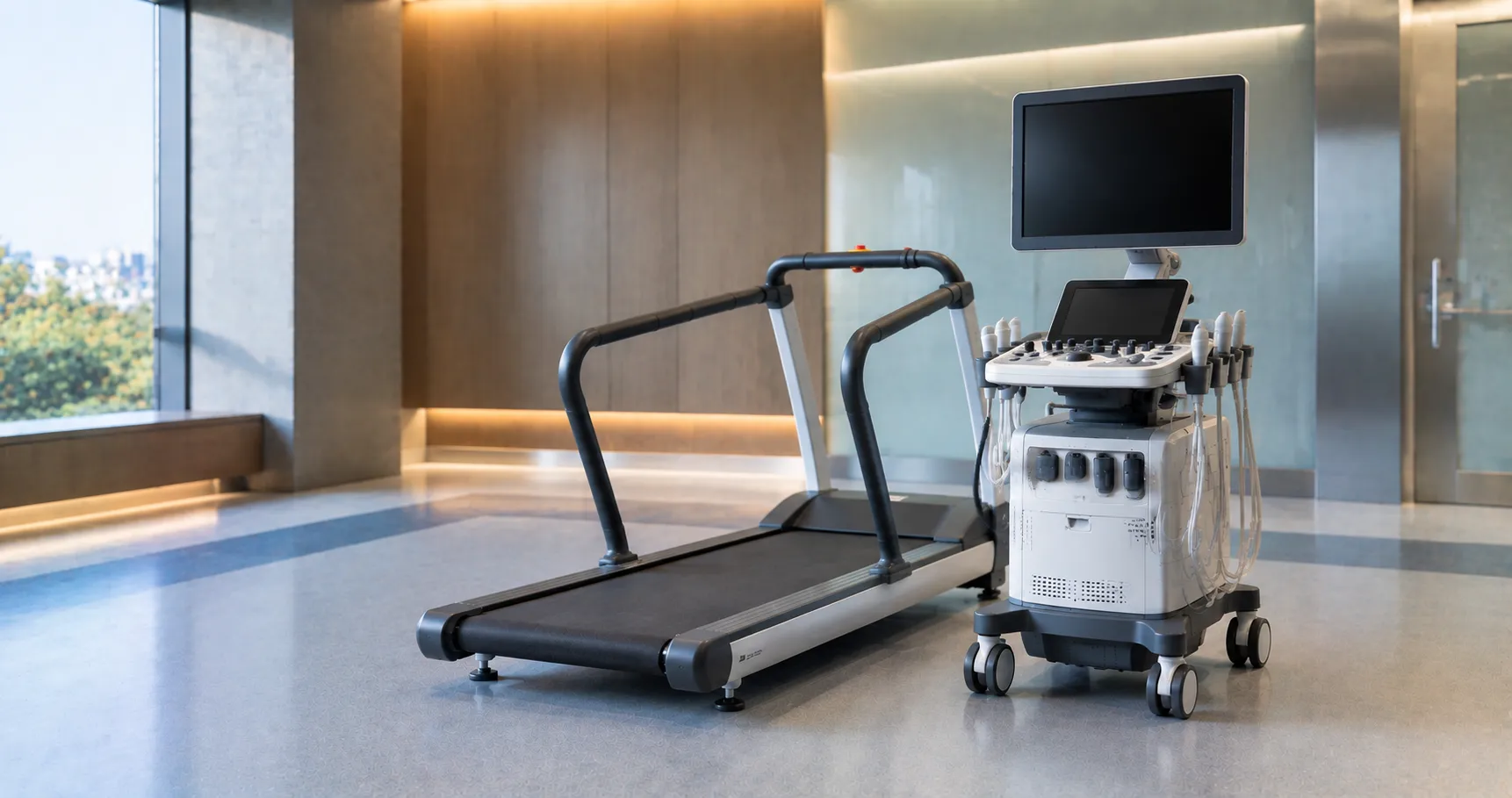
A stress echo system is an echocardiography setup configured to image the heart before, during, and immediately after physical or pharmacological stress, so clinicians can see whether wall motion stays normal when the heart is pushed to work harder. A region that contracts well at rest but falters under stress points to a coronary artery that cannot supply enough blood — the core of ischaemia testing without radiation.
For a buyer,r a stress echo system is less about a single box and more about a workflow: a capable echocardiography machine, the stress-acquisition software, and either an exercise device or a pharmacological protocol. The software that captures and compares images at each stage is what turns an ordinary echo machine into a stress-testing platform.
Where stress echo fits in ischaemia testing
Stress echocardiography is a mainstay of assessing suspected coronary disease and the significance of known lesions. It competes with stress cardiac MRI and nuclear perfusion imaging, but uses no ionising radiation and needs only an echo machine and trained staff, which makes it attractive for many services. The National Institute for Health and Care Excellence sets out where stress imaging fits in chest-pain and coronary pathways in its guidance at nice.org.uk, and matching your service to those pathways justifies the investment.
Two ways to stress the heart
There are two routes, and a stress echo system may support one or both.
Exercise stress
The patient exercises on a treadmill or, better for continuous imaging, a supine or semi-supine bicycle ergometer. A bike lets the sonographer scan throughout the whole effort; with a treadmill, the peak images must be captured in the seconds after the patient lies down. Exercise is physiological and adds functional-capacity information a drug cannot.
Pharmacological stress
When a patient cannot exercise, a drug does the work. Dobutamine, infused in increasing doses, raises heart rate and contractility to mimic exercise and is the standard agent for wall-motion ischaemia testing; a vasodilator may be used for perfusion-based protocols. Pharmacological stress needs an infusion pump, close monitoring, and drugs to reverse the effect.
The stress acquisition workflow
What defines a stress echo system is the software that structures the study into stages — rest, low dose or low level, peak, and recovery — and stores matched views at each. At review, ew the system displays the same view from each stage side by side in a synchronised quad-screen, so the reporter compares wall motion frame for frame. Continuous ECG and regular blood-pressure monitoring run throughout, and the protocol advances on heart-rate targets. Capturing clean, matched images at peak stress, quickly, is the whole game, so the acquisition tools and the operator's speed matter more than any single hardware spec.
The base machine behind a stress echo system
A stress study asks a lot of the base machine. It needs strong tissue harmonic imaging and a high frame rate to freeze a fast-beating heart, reliable endocardial border definition, and increasingly the ability to run contrast echo — an intravenous ultrasound contrast agent that opacifies the left ventricle when the border is hard to see. Many services now add speckle-tracking strain to support the wall-motion read. A stress echo system is only as good as the echocardiography machine underneath it, so specify the console capability first.
Contrast echo and image quality under stress
A meaningful share of stress studies have segments that are hard to assess on a resting image, and stress only shortens the window. Ultrasound contrast agents that cross the pulmonary circulation opacify the cavity and sharpen the endocardial border, rescuing otherwise non-diagnostic studies. If your service expects difficult chests, confirm the machine is licensed for contrast imaging and budget for the agent and its governance.
Safety, staffing and the crash trolley
Pushing a heart to peak stress carries real risk, so a stress echo system is never just imaging kit. The room needs continuous monitoring, resuscitation equipment and drugs, and staff trained to manage arrhythmia or ischaemia, with medical cover immediately available. Workplace and equipment-safety duties overseen by the Health and Safety Executive at hse.gov.uk apply to the department. Building the safety framework and staffing model is part of specifying the service, not an afterthought.
Standards, marking and integration
The echocardiography machine at the heart of a stress echo system is medical electrical equipment built to IEC 60601-1, with the ultrasonic particular standard IEC 60601-2-37 governing acoustic output; connected exercise and monitoring equipment carry their own conformance. Confirm UKCA or CE marking and that studies export cleanly to PACS and the cardiology information system with the stress-stage structure intact. This guide draws on manufacturer documentation, the IEC 60601 family and UK clinical guidance, and is written for procurement and clinical-engineering teams.
Beyond the purchase price
Cost the whole system. Beyond the console and stress software, budget for the ergometer or treadmill, infusion pumps, monitoring, contrast agent, service contracts,cts and staff training. Throughput depends on room turnaround and staffing as much as the equipment. Compare whole-life cost across suppliers, and use MediGear to weigh verified suppliers on equal terms.
How stress echo compares with other ischaemia tests
A buyer weighing a stress echo system is usually choosing between imaging modalities as well as machines. Stress cardiac MRI and nuclear perfusion imaging answer similar questions, and CT coronary angiography looks at the arteries directly. Stress echo's advantages are that it uses no ionising radiation, needs no large fixed installation, and runs on equipment a cardiology service already owns, which keeps the cost per study low and access good. Its main limitation is dependence on image quality and operator skill, which contrast and strain help offset. Placing stress echo correctly in your local pathway, rather than treating it as a standalone buy, is what makes the investment pay.
Reaching target and study endpoints
A stress echo only answers the question if the heart is stressed enough, so a target heart rate is set for the patient's age and the protocol is driven towards it. On a dobutamine study, the dose is stepped up, and atropine may be added to reach the target; an exercise study is pushed to symptoms or a set workload. The operator and supervising clinician also watch for endpoints that stop the test early — a new wall-motion abnormality, a fall in blood pressure, significant arrhythmia, or intolerable symptoms. A stress echo system therefore has to support real-time monitoring and quick capture right at peak, because a study that never reaches an adequate stress is inconclusive and has to be repeated.
Wall-motion scoring and reading the study
A stress echo is only as good as its read, and reading it is a skill. The left ventricle is divided into a standard segment model, and each segment is scored for how it moves at rest and at peak: normal, reduced, absent or paradoxical. A new or worsening wall-motion abnormality that appears with stress is the marker of inducible ischaemia. This subjectivity is why reader training and reproducibility matter so much, and why many services add speckle-tracking strain to put a number behind the visual read. When you specify a stress echo system, weigh the analysis and comparison tools that support consistent reporting, not just the acquisition hardware.
Room design and patient throughput
A stress echo room has to hold more than an ultrasound machine. It needs space for a treadmill or supine ergometer, the monitoring and infusion equipment, resuscitation kit, and room for staff to work around a patient at peak effort. Cable management, sightlines to the monitor, and quick patient positioning all affect how safely and quickly a list runs, and on an exercise-treadmillprotocol,l the seconds saved getting the patient onto the couch decide whether the peak images are diagnostic. Plan the room layout alongside the equipment specification, because a cramped or poorly arranged room throttles throughput no matter how capable the machine is.
Specifying a stress echo system: checklist
-
Base echocardiography machine with strong harmonic imaging, high frame rate, TE, and contrast capability.
-
Stress-acquisition software with staged capture and synchronised quad-screen comparison.
-
Exercise mode — treadmill or supine bike — and/or pharmacological protocol support.
-
Integrated ECG and blood-pressure monitoring through every stage.
-
Speckle-tracking strain if your reporters use it to support the wall-motion read.
-
Resuscitation equipment, drugs and trained staff with immediate medical cover.
-
Conformance to IEC 60601-2-37, UKCA or CE marking and clean PACS export of staged studies.
-
Service cover, consumables and training in the running-cost picture.
Choosing well for your stress service
A stress echo system rewards buyers who see it as a workflow rather than a device: the right base machine, acquisition software that captures matched peak images fast, a stress method that fits your patients, and a safety framework that lets the team push the heart with confidence. Get those aligned and the service delivers radiation-free ischaemia testing that earns its place. If you are scoping a system, MediGear can help you reach the right suppliers.
Disclaimer
This article is for informational purposes only. It is published by MediGear (medigear.uk) for general information and procurement guidance, and is not clinical, diagnostic, treatment, technical, engineering, legal or regulatory advice, nor a product endorsement, guarantee or substitute for professional assessment. MediGear does not provide medical consultations. Buyers should consult their clinical, biomedical, estates and regulatory contacts, and the manufacturer's documentation, and independently verify all specifications, certifications, compatibility and suitability before purchase. Specifications, certifications and availability are correct at the time of publication and may change without notice. MediGear is a medical-equipment distributor and does not sell medicines or pharmaceutical products.