
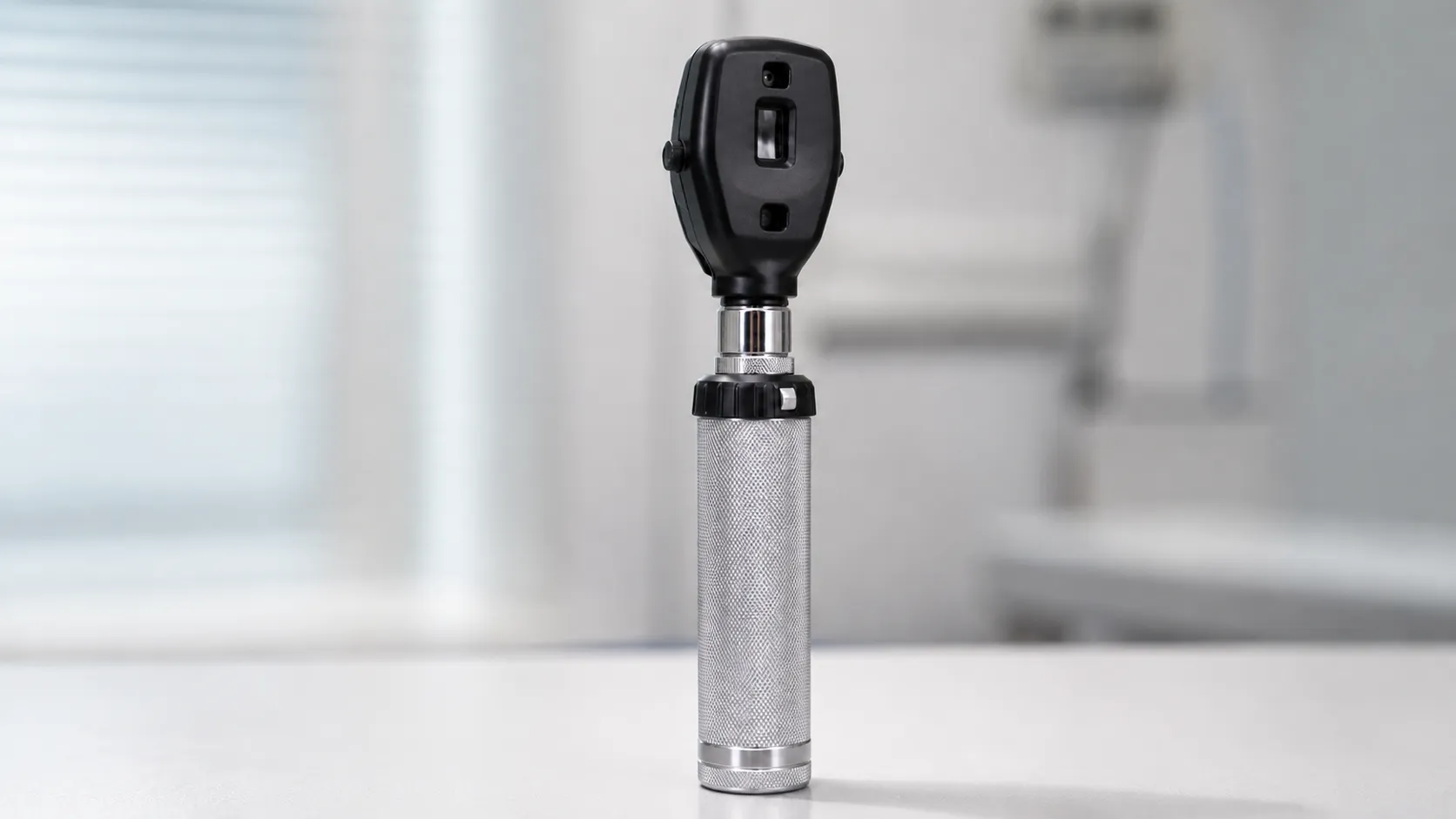
A retinoscope is a hand-held instrument that lets a clinician objectively measure a patient's refractive error, without the patient having to read a chart or say which lens looks clearer for paediatric work; that is the whole point. Infants and young children cannot give reliable subjective answers, so retinoscopy provides a number the practitioner can trust. For a buyer equipping an optometry practice, a hospital eye clinic or a community paediatric service, the retinoscope is a low-cost, high-use instrument whose quality quietly affects every young patient seen.
In short, the clinician shines a streak or spot of light into the eye, watches the reflex move across the pupil, and neutralises that movement with trial lenses. The lens that stops the reflex moving reveals the refractive error. Under cycloplegic drops that relax accommodation, retinoscopy gives an especially dependable result in children.
The Measurement Principle
Light projected into the eye reflects off the retina and emerges through the pupil as a glowing reflex. When the clinician sweeps the beam, the reflex appears to move. Its direction, speed, width and brightness reveal whether the eye is myopic, hyperopic or astigmatic. The examiner introduces lenses until the reflex fills the pupil and stops moving, the point of neutralisation, and reads off the correction after allowing for working distance. Because it reads the optics of the eye directly, the technique works on a sleeping infant or a non-verbal child where a letter chart cannot.
With and Against Movement
A reflex that moves the same way as the beam (with movement) and one that moves opposite (against movement) tell the examiner which side of neutralisation they are on and which lens to add. Reading these subtle cues is a skill, and a bright, crisp reflex from a good instrument makes it far easier, particularly through a small or uncooperative pupil.
Streak Versus Spot Retinoscopes
Two main types dominate. A streak retinoscope projects a line of light that can be rotated, which makes finding and neutralising astigmatic axes straightforward, so most refraction is done with a streak instrument. A spot retinoscope projects a circle of light, and some clinicians prefer it for certain reflexes, but it is less precise on astigmatism. For paediatric refraction t, the streak type is the usual choice because young eyes commonly have astigmatism that needs an accurate axis. Some instruments let the examiner adjust the streak from divergent to convergent vergence, changing how the reflex behaves and helping confirm neutralisation.
Key Specifications to Check
Retinoscopes look similar across the market, yet the details decide how easy they are to use all day on wriggling children.
-
Streak brightness and evenness, since a dim reflex is hard to read through a small pupil.
-
Rheostat control for adjustable illumination when working with photophobic children.
-
Streak rotation and vergence sleeve smoothness for quick astigmatic axis finding.
-
Power source: rechargeable handle, disposable cells or wall transformer, and battery life.
-
Bulb type and life, whether halogen, xenon or LED, and the ease of replacement.
-
Weight and balance in the hand for steady use during a fleeting cooperative moment.
-
Compatibility with your existing handle system so you can share batteries and chargers
-
Availability of spare bulbs and a warranty that covers the head and electronics.
LED Versus Halogen and Other Optics
Light source matters more than it first appears. Traditional halogen and xenon bulbs give a warm, familiar reflex, while LED hea. At the same time, LEDs offer whiter light, longer life, and lower running costs, though the cost per rendering differs and some experienced clinicians prefer one over the other. Whatever the source, a clean, well-aligned mirror and lens system, plus a rheostat for fine brightness control, make the reflex easier to judge. When comparing instruments, look through each one on a real eye if you can, because specification sheets rarely capture how a reflex actually reads.
Standards and Regulation
A retinoscope sold in the UK is a medical device and must carry valid UKCA or CE marking, with the manufacturer meeting obligations overseen by the MHRA. Mains-charged handles and transformers fall under the IEC 60601-1 family for electrical safety, and light-emitting ophthalmic instruments come under the ISO 15004 series covering light-hazard limits for eye instruments. Ask the supplier for the declaration of conformity and keep it on file with your other device records.
Decontamination and Single Patient Contact
Retinoscopy is largely non-contact, but the instrument and handle are touched constantly and moved close to children's faces, so wipe down between patients, following your infection control policy and the manufacturer's approved cleaning agents, to protect both the patient and the optics. Avoid solvents that can craze plastic or degrade coatings. Where trial frames or lenses touch the child, they need cleaning too. Keeping the front optic clear of smears is as much about clean handling as formal decontamination.
Use Across Different Care Settings
The same instrument serves very different services. A high-street optometry practice values a durable, comfortable everyday retinoscope on a shared handle system. A hospital paediatric or orthoptic clinic may want several matched units and reliable spares to keep clinics running. Community and domiciliary teams need something light and battery-powered that travels well. Special-school and learning-disability screening leans the same way, since objective retinoscopy suits patients who cannot manage a subjective refraction. Map where the instrument will be used before fixing the specification, and buy handles and chargers that standardise across your other diagnostic sets.
Total Cost of Ownership, Warranty and Spares
Retinoscopes are inexpensive compared with other equipment, but running costs still add up across a fleet. Bulbs, rechargeable batteries and handles wear out, and proprietary parts can cost more than expected, so check spare-bulb price and availability before you buy. LED heads reduce bulb changes but cost more up front. A sensible warranty on the head and electronics, plus a supplier who stocks spares, keeps instruments in service for years. Standardising on one handle platform across retinoscopes and ophthalmoscopes cuts spare-battery and charger duplication. Our buyers hub can help specify a matched diagnostic set rather than a mix of incompatible handles.
Training, Skill and Everyday Handling
Retinoscopy is a learned skill, and the instrument should support the learning curve rather than fight it. A bright, evenly lit streak with smooth rotation and vergence control makes neutralisation easier for a trainee optometrist or orthoptist and quicker for an experienced clinician working through a busy paediatric list. Weight, grip and the position of the rheostat all affect how steady the instrument feels during the brief window a young child stays still. Because the same clinicians often use the practice's ophthalmoscopes and retinoscopes interchangeably, consistent ergonomics across the set reduces fumbling and speeds trialling instruments, letting the people who will actually use them assess reflex quality and handling on a real eye, since a specification sheet cannot show how a streak reads through a small, restless pupil or how the handle balances after twenty examinations.
Conclusion
For paediatric refraction, the retinoscope is the instrument that turns an uncooperative young patient into a reliable measurement, so buying well means judging reflex quality, streak control, light source and spares support, not just price. Standardise your handle platform, confirm the UKCA or CE position, and if you want help specifying retinoscopes across a clinic or service, contact MediGear to review the options in our diagnostic equipment range.
Disclaimer
This article is for informational purposes only. MediGear (medigear.uk) publishes it for general information and procurement guidance. It is not clinical diagnostic, treatment, technical, engineering, legal, or regulatory advice, nor a product endorsement, gguarantee or ssubstitute forprofessional assessment. MediGear does not provide medical consultations. Buyers should consult their clinical, biomedical, estates, and regulatory contacts, and the manufacturer's documentation, and independently verify all specifications, certifications, compatibility, and suitability before purchase. Specifications, certifications and availability are correct at the time of publication and may change without notice. MediGear is a medical-equipment distributor and does not sell medicines or pharmaceutical products.