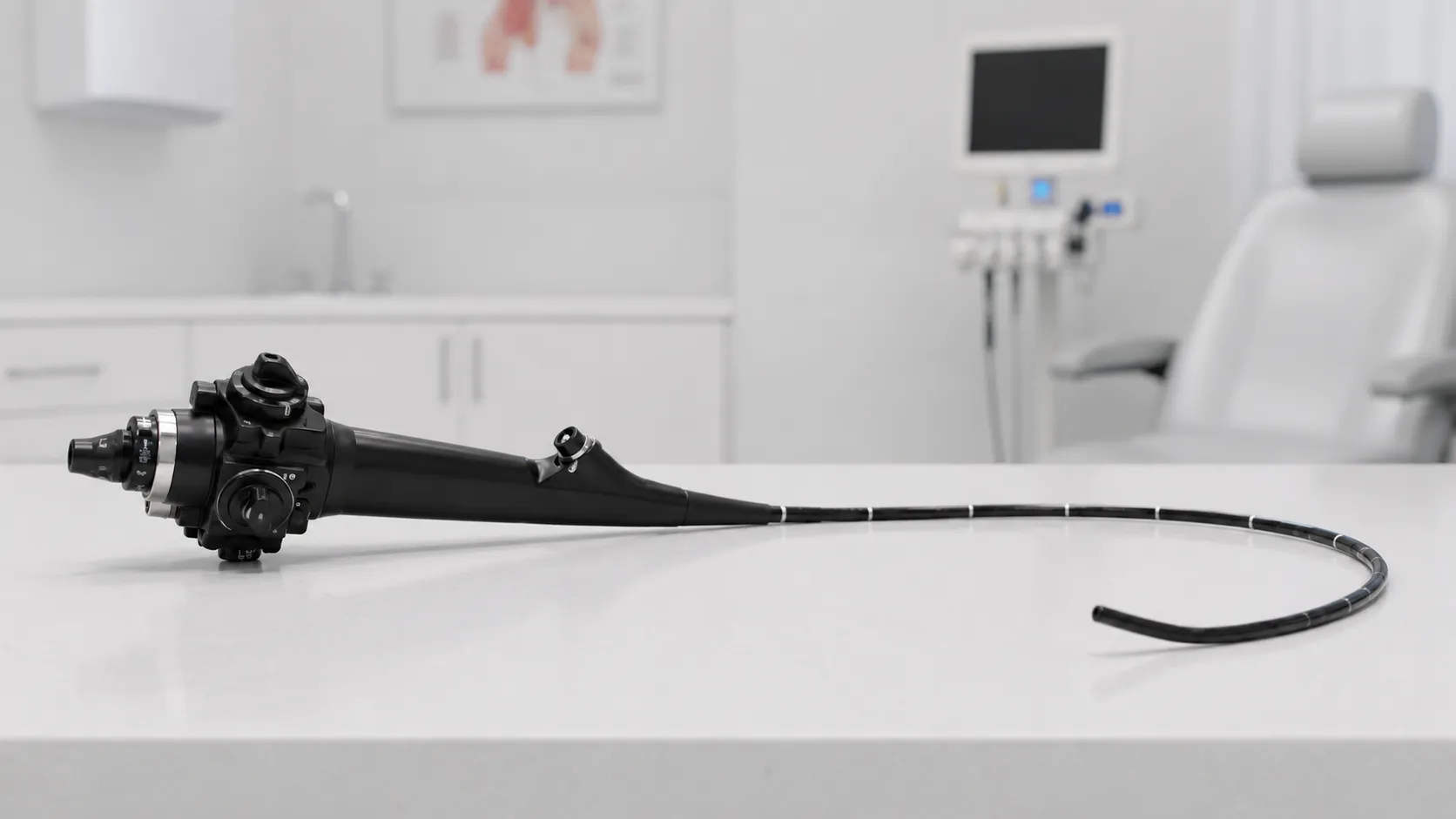
A nasopharyngoscope is a slim endoscope that passes through the nose, giving ENT clinicians a direct view of the nasal passages, nasopharynx, pharynx, and larynx. It lets a specialist assess the upper airway in the clinic, in real time, while the patient breathes and speaks. For a procurement lead in an ENT department, a head and neck service or a community diagnostic hub, it is a high-use instrument whose optics, durability and decontamination demands drive both clinical value and running cost.
The principle is direct visualisation. Light travels down the scope to illuminate the airway, and an image returns either through fibreoptic bundles to an eyepiece or, in newer instruments, from a miniature camera chip at the tip to a monitor. The clinician steers the flexible tip to inspect structures a rigid instrument cannot easily reach around.
Flexible Versus Rigid Instruments
ENT airway work uses two families of scopes. A flexible nasopharyngoscope is a thin, steerable endoscope passed transnasally; its narrow diameter and articulating tip make it comfortable and ideal for dynamic assessment of the larynx and pharynx during breathing and phonation. A rigid endoscope gives excellent optics for a focused nasal or sinus view but cannot follow the airway's curves. Most airway and laryngeal evaluation in clinic uses the flexible type. Choosing between them, or stocking both, depends on the case mix your clinicians handle.
Fibreoptic Versus Chip-Tip (Video) Scopes
Within the flexible family, the older design carries the image up glass fibreoptic bundles to an eyepiece, which can be viewed directly or through a camera coupler. Newer chip-tip or video scopes place the camera sensor at the distal tip and send a digital image straight to a processor and monitor. Video scopes provide brighter, higher-resolution images, easier recording and teaching, and eliminate the fragile fibre bundles that break and create black dots in the image over time. They cost more up front and need a compatible processor and stack. Fibreoptic scopes remain capable and cheaper, and pair with a portable camera for mobile work.
Key Specifications to Check
Scopes that look alike differ sharply in handling, image quality and lifetime cost. Weigh these before you compare quotes.
-
Insertion tube outer diameter, since a slimmer scope is more comfortable for the patient.
-
Tip articulation range up and down for full laryngeal and pharyngeal views.
-
Image type and resolution, fibreoptic versus chip-tip, and processor compatibility.
-
Working channel, if any, for suction, insufflation or passing small instruments.
-
Whether the scope is reusable or single-use and how that fits your workflow.
-
Compatibility with your existing light source, camera stack and reprocessing equipment.
-
Durability of the bending section and the cost and turnaround of repairs.
-
Validated decontamination method and compatibility with your automated reprocessor.
Single-Use Versus Reusable Scopes
A growing option is the sterile single-use nasopharyngoscope, supplied ready to use and discarded afterwards. It removes reprocessing, eliminates the cross-infection and repair risks tied to flexible scope channels, and suits settings without a decontamination unit or where demand is intermittent. The trade-off is per-procedure cost and waste. Reusable scopes have a lower cost per use at high volume but carry reprocessing, tracking, drying-cabinet and repair overheads. The right answer depends on caseload, available decontamination facilities and how much downtime a scope out for repair would cause.
Image Quality, Recording and Documentation
The clinical value of an airway examination rests on what the clinician can actually see and keep. Higher-resolution video scopes resolve subtle mucosal changes, small lesions and vocal-fold movement far better than an ageing fibreoptic bundle, and they let findings be captured as still images or video for the record, for multidisciplinary review and for teaching. Recorded studies also support consistent reporting and comparison over time, which matters in surveillance and voice work. If documentation matters to your service, confirm the processor can capture and store images in a format your systems accept, that storage meets information-governance rules, and that the light source gives even illumination without glare. A scope that produces a crisp, well-lit, recordable image reduces repeat examinations and strengthens the diagnostic and medico-legal record, so weigh image quality and capture alongside the raw mechanical specification.
Decontamination and Reprocessing
Flexible endoscopes that enter the airway are semi-critical devices and must be cleaned and high-level disinfected between patients following a validated process, national endoscope reprocessing guidance and the manufacturer's instructions. That means manual cleaning, automated endoscope reprocessing, controlled drying and storage in a ventilated cabinet, plus per-scope traceability of every cycle. Any scope with a working channel demands particular care because channels are hard to clean. Before buying reusable instruments, confirm they are compatible with your reprocessor and detergents, and budget for the consumables, cabinet space, and staff time reprocessing requires. UK guidance and your infection-prevention team should shape the policy.
Standards and Regulation
A nasopharyngoscope placed on the UK market is a medical device requiring valid UKCA or CE marking, with manufacturer obligations overseen by the MHRA. Any powered light source, processor or camera stack falls under the IEC 60601-1 family for electrical safety, and endoscope reprocessing links to the ISO 15883 series for washer-disinfectors and the wider decontamination standards. Ask the supplier for the declaration of conformity and the validated reprocessing instructions, and keep both with your device and decontamination records. If a fault or adverse incident occurs, established routes exist to report it to the regulator, so make sure the responsible person in your service knows the process.
Use Across Different Care Settings
The instrument turns up well beyond the main ENT theatre suite. A hospital ENT clinic runs high volumes and usually justifies a video stack with reusable scopes and a full reprocessing unit. Community diagnostic centres and voice clinics may prefer portable systems or single-use scopes to avoid building a decontamination facility. Speech and language therapy services use nasendoscopy for swallowing assessment, often at the bedside or in a therapy room where a compact portable system earns its place. Emergency and anaesthetic teams value an immediately available scope for a difficult airway, where a sterile single-use device removes any wait for reprocessing. Mobile and outreach teams lean the same way. Map your caseload and the reprocessing facilities you actually have before deciding between a reusable stack and a single-use model, because the decontamination question and the need for instant availability often settle the choice.
Total Cost of Ownership, Warranty and Spares
The scope price is a fraction of the lifetime cost. Reusable flexible endoscopes are delicate, and repairs are frequent and expensive, so factor in a realistic repair budget, loan-scope coverage during downtime, and the reprocessing consumables and staff time each cycle needs. Video systems add the processor, monitor and light source, though these serve many scopes. Single-use models shift cost to a predictable per-procedure price with no repairs. Check the warranty on the bending section and camera, the supplier's repair turnaround, and whether spares and loan units are available. Our buyers hub can help model reusable against single-use for your volumes.
Conclusion
A nasopharyngoscope gives ENT teams a clear, dynamic view of the upper airway, but buying well means weighing flexible against rigid, chip-tip against fibreoptic, and reusable against single-use around your caseload and decontamination facilities. Confirm the UKCA or CE and reprocessing position, and to specify a scope or video system sized to your service, speak to MediGear about our diagnostic equipment range.
Disclaimer
This article is for informational purposes only. MediGear (medigear.uk) publishes it for general information and procurement guidance. It is not clinical, diagnostic, treatment, technical, engineering, legal, or regulatory advice, nor a product endorsement, guarantee, orsubstitute for professional assessment. MediGear does not provide medical consultations. Buyers should consult their clinical, biomedical, estates and regulatory contacts, and the manufacturer's documentation, and independently verify all specifications, certifications, compatibility and suitability before purchase. Specifications, certifications and availability are correct at the time of publication and may change without notice. MediGear is a medical-equipment distributor and does not sell medicines or pharmaceutical products.