
Introduction
A private hospital brings many departments together under one roof, so equipping one means planning across the whole facility — theatres, wards, imaging, laboratory, critical care, pharmacy and outpatients — rather than a single unit. Setting one up means building an equipment plan department by department, sized to the services offered, so the hospital works as a whole and delivers the quality and experience private patients expect.
This guide sets out the full private hospital equipment list by department, the surrounding infrastructure and safety, the planning sequence, and the approval and compliance points — for a new hospital, an expansion, or added services, wherever you operate. It focuses on the equipment and planning decisions across departments, and flags where clinical, biomedical and estates input is essential.
What makes equipping a private hospital different from equipping a single unit is scale and integration. Each department — theatres, critical care, imaging, the laboratory — has its own detailed equipment needs, but they must also work together: imaging and the lab support the wards and theatres, sterile services supply the theatres, and pharmacy serves the whole hospital. Alongside the clinical requirements sits the patient experience that private care is built on, so comfort, quality and reliability run through the choices. Planning is best done department by department against the services offered, then joined up so nothing is missed and nothing is duplicated.
In practice, the decisions that matter most are about matching equipment to the services offered and getting the shared departments right. It helps to plan each clinical area against its own detailed guide — theatres, critical care, imaging, laboratory and the rest — then check that the shared services, sterile supply, imaging, laboratory and pharmacy are sized to serve them all. Standardising equipment across the hospital simplifies training, servicing and consumables, while phasing the build and balancing new and refurbished lets a private hospital open with the quality it needs without overreaching. The whole is planned as a system, not a set of separate lists.
The short version — what every private hospital is built around
Strip it back, and equipping a private hospital means three things — a plan for each clinical department, shared services that support them all, and the quality and reliability private patients expect.
-
Clinical departments — theatres, wards, critical care and outpatients, each equipped to its service.
-
Shared services — imaging, laboratory, sterile services and pharmacy that support the whole hospital.
-
Quality & experience — reliable, well-supported equipment and the comfort private care expects.
Private hospital equipment by department
-
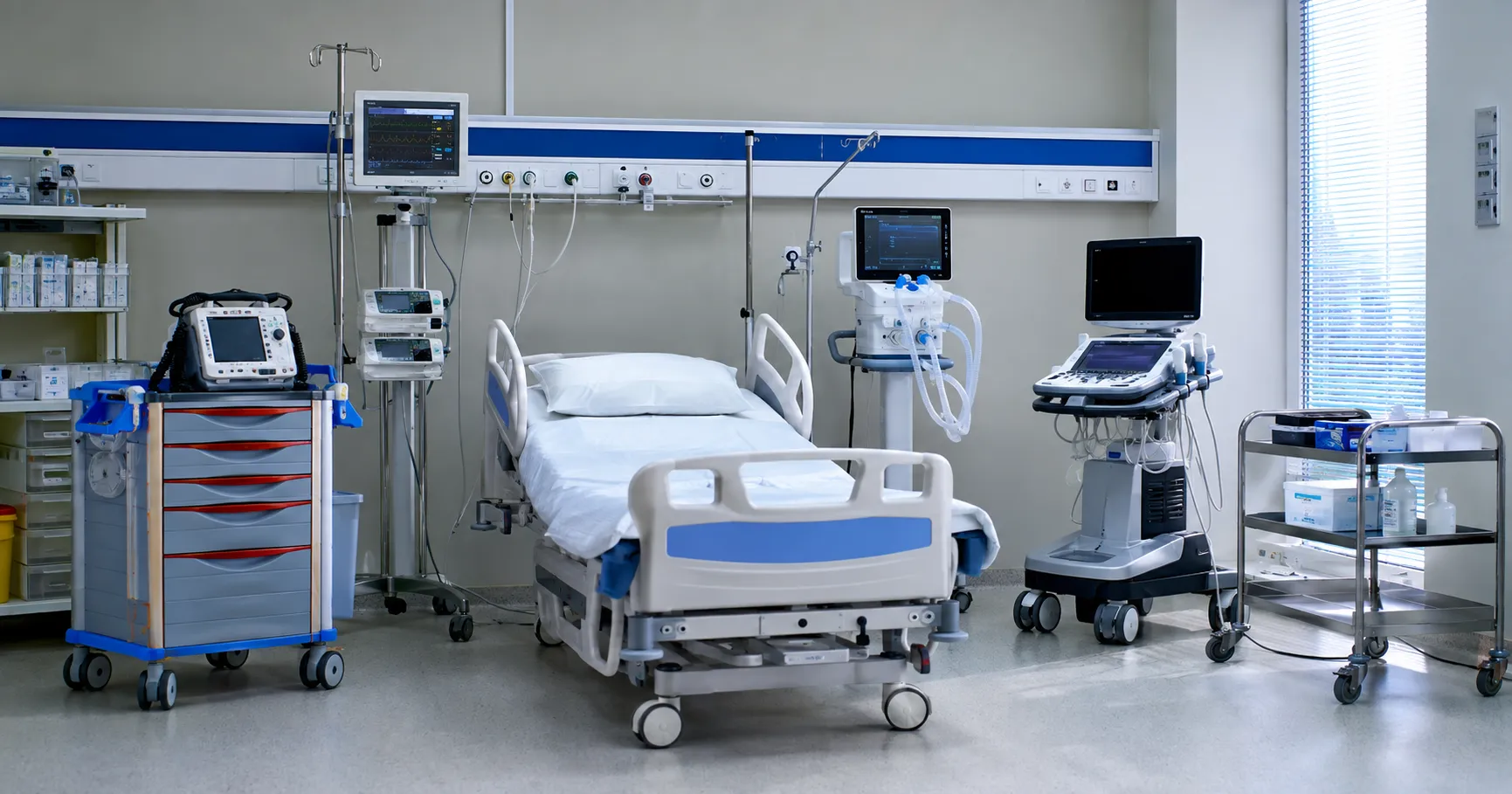
Operating theatres. Operating tables, surgical lights, anaesthesia, monitoring and energy devices for the surgical specialities the hospital offers, with theatre-grade air handling.
-
Wards & patient rooms. Beds, patient monitoring, and nurse-call and ward equipment, often in single rooms, reflecting the comfort and privacy private patients expect.
-
Diagnostic imaging. X-ray, ultrasound and, depending on services, CT and MRI, with the shielding, protection and reporting that imaging requires.
-
Laboratory. Analysers and equipment for haematology, chemistry, microbiology and more, or a partnership for tests sent out, to support diagnosis across the hospital.
-
Critical care. An intensive care or high dependency unit with ventilation, monitoring and organ support for the sickest patients and post-operative recovery.
-
Outpatients & consulting. Consulting and examination rooms, treatment equipment and day-case facilities for the outpatient services that drive much private activity.
-
Sterile services & pharmacy. A sterile services department to supply the theatres and a pharmacy to supply the whole hospital, both sized to the services offered.
-
Infrastructure. Piped medical gases, resilient power, IT and records, and the building services that tie a multi-department hospital together.
Private hospital equipment checklist
|
Section |
Equipment |
Notes |
|
Theatres |
Tables; lights; anaesthesia; monitoring |
Air handling |
|
Wards |
Beds; monitoring; nurse-call |
Comfort, privacy |
|
Imaging |
X-ray; ultrasound; CT/MRI as offered |
Shielding, reporting |
|
Laboratory |
Analysers or send-out partnership |
Diagnosis hospital-wide |
|
Critical care |
ICU/HDU; ventilation; monitoring |
Sickest patients |
|
Outpatients |
Consulting; treatment; day case |
Drives activity |
|
Shared services |
Sterile services; pharmacy |
Serve the whole hospital |
|
Infrastructure |
Gases; power; IT; building services |
Tie it together |
Scale each department to the services you offer — a small private hospital focused on elective surgery and a large multi-speciality hospital with critical care and complex imaging differ widely across every department.
Planning a new private hospital?
We'll help you equip it end-to-end. Tell us your services, size, budget and market — we'll build the department-by-department equipment plan, balance new and refurbished units, and make sure everything's compliant and supported.
No pressure, no obligation. → Talk to the team
What else does setting up a private hospital involve
-
Planning department by department. Each clinical area has its own detailed equipment needs, so a private hospital is best planned department by department against its services, then joined up so nothing is missed or duplicated.
-
Shared services that serve all. Imaging, the laboratory, sterile services and pharmacy support the whole hospital, so they are sized to serve every department, not planned in isolation.
-
Quality and patient experience. Private care is built on comfort, quality and reliability, so these run through the equipment choices as much as clinical capability does, from patient rooms to theatres.
-
Standardising and phasing. Standardising equipment across the hospital simplifies training, servicing and consumables, and phasing the build lets a hospital open well without overreaching.
-
Consumables, staffing and service. Consumables across every department, trained clinical and technical staff, and service contracts hospital-wide all shape the running model, not just the purchase.
Setting up a private hospital, step by step
-
Define the services and size of the hospital — which specialities, how many theatres, beds and departments.
-
Confirm infrastructure across the hospital — gases, power, imaging shielding, IT and building services — and start works early.
-
Build the equipment plan department by department, sized to your services, with shared services sized to serve them all.
-
Decide new versus refurbished per item and department and plan consumable and service contracts alongside.
-
Install, commission and test everything department by department, integrate systems, and train teams before go-live.
A hospital-wide build is phased and takes time — build commissioning and training into the schedule so each department opens safely, not just fitted out.
Budget and procurement
Equipping a hospital is capital- and service-intensive across every department, so the purchase price is only part of the story; theatres, imaging, critical care and their service contracts all carry ongoing costs. A common approach is to buy new for high-throughput core units and certified refurbished for ancillary equipment. Because these are regulated devices, check the device risk class and the certification for your market. Match each department's equipment to the services it offers, and phase the build, so the hospital opens with the quality it needs across departments without overreaching on any one.
Approval and accreditation by region
|
Region |
Regulator |
Device requirement |
|
United Kingdom |
UKCA mark (CE accepted to 2028–2030) |
|
|
European Union |
CE marking under the MDR |
|
|
United States |
FDA clearance or approval |
|
|
Gulf (GCC) |
SFDA & GCC bodies |
National registration / GCC conformity |
|
South Africa |
Medical device licensing |
All the medical devices across a hospital are regulated, so confirm each is approved for your market. A private hospital may also need accreditation and licensing as a facility on top of device approval, so plan for both. For quality standards and clinical guidance, the World Health Organisation and NICE are useful references. If you're equipping a private hospital, our buyer hub sets out how to purchase with confidence.
More from Business
-
Buyers — source a full, department-by-department equipment package for your private hospital.
-
Suppliers — list your equipment and reach buyers worldwide.
-
Advertise — promote your products and services to a clinical audience.
-
Business overview — explore everything MediGear offers healthcare organisations.
Disclaimer
This article is for general information only. It is not clinical, medical, procurement, engineering or regulatory advice. Hospital design, equipment, infrastructure, accreditation and safety requirements vary by country, service and facility, and change over time. The checklist is a planning aid, not a specification. Always work with qualified clinical, biomedical, facilities and procurement professionals. And confirm every device is approved for your market — for example, UKCA, CE, FDA, SFDA/GCC or SAHPRA. Requirements change, so check the current position before you buy. medigear.uk accepts no liability for actions taken on this content.
Equip your private hospital end-to-end.
From theatres and wards to imaging, laboratory, critical care and pharmacy, we help hospitals across the UK, Europe, the US, the Gulf and South Africa build private hospitals department by department — compliant, supported and on budget.
Frequently Asked Questions
A private hospital needs equipment across every department: operating theatres, wards and patient rooms, diagnostic imaging, a laboratory, critical care, outpatients and consulting, and the shared sterile services and pharmacy that support them all. Rather than a single list, it is planned department by department against the services offered, then joined up so the hospital works as a whole.
The main departments are operating theatres, wards and patient rooms, diagnostic imaging, the laboratory, critical care, outpatients and consulting, and the shared services of sterile supply and pharmacy, all on hospital-wide infrastructure. These are planned together, because shared services support every department and nothing should be missed or duplicated.
Costs depend heavily on the services offered and the departments included, since theatres, imaging and critical care are far more capital-intensive than outpatients, so there is no single figure. Weigh the purchase price against service contracts and running costs across every department over their life, and phase the build.
Yes, across many departments. Certified refurbished imaging, theatre and ward equipment can be sensible where it is fully supported, balanced with new for high-use core systems. Every device must be approved for your market and fully supported with service and consumables, whether new or refurbished.
It varies greatly with the size and services, but planning, building and equipping a hospital department by department typically takes many months to years, with departments phased and commissioned in turn. Shared services, imaging shielding, IT integration and commissioning are the parts most often underestimated.
A private hospital needs piped medical gases, resilient power, imaging shielding, IT and records, and the building services that tie many departments together, alongside shared sterile services and pharmacy. This infrastructure is as important as the clinical equipment, because the departments must work together as one hospital.