
Introduction
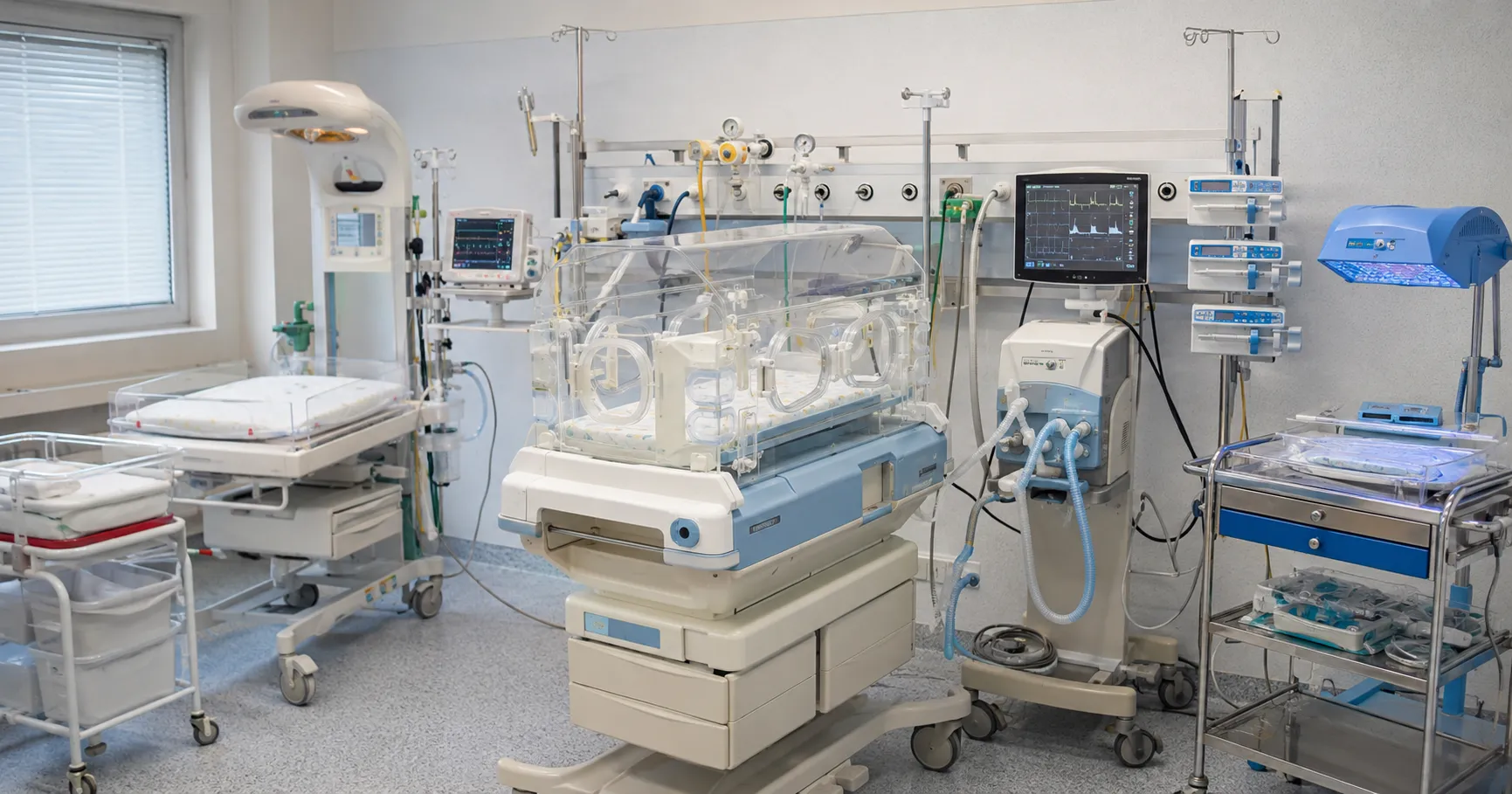
A neonatal unit keeps the smallest, most vulnerable patients warm, breathing and monitored. Thermal care, respiratory support and close monitoring decide outcomes, so a unit that's well-equipped, safe and tightly controlled is the foundation of newborn care.
This guide sets out the full neonatal equipment list by function, the monitoring and respiratory support, the planning sequence, and the compliance points — for a special-care unit, a full NICU, or an upgrade, wherever you operate.
The short version — what every neonatal unit is built around
Strip it back, and a neonatal unit needs three things — thermal care to keep babies warm, respiratory support to help them breathe, and continuous monitoring to catch problems early.
-
Thermal care — incubators and radiant warmers that hold a precise temperature for fragile newborns.
-
Respiratory support — neonatal ventilators, CPAP and blended oxygen for babies who need help breathing.
-
Monitoring & phototherapy — neonatal monitors, pulse oximeters and phototherapy units for observation and jaundice.
Neonatal unit equipment by function
-
Thermal care. Closed incubators and open radiant warmers with servo temperature control to keep newborns at a stable temperature.
-
Respiratory support. Neonatal ventilators, bubble or driver CPAP, high-flow and air/oxygen blenders with humidification.
-
Resuscitation. A neonatal resuscitaire, T-piece resuscitator and self-inflating bags for delivery-room and unit resuscitation.
-
Monitoring. Multi-parameter neonatal monitors, pulse oximeters and apnoea monitoring for continuous observation.
-
Phototherapy. LED phototherapy units and transcutaneous bilirubinometers to manage and measure jaundice.
-
Infusion & feeding. Syringe and infusion pumps for precise low-volume fluids and drugs, plus feeding pumps and equipment.
-
Point of care. Blood-gas analysis and glucometers for rapid bedside results in unstable babies.
-
Transport. A transport incubator with its own ventilation, monitoring and power for moving babies safely.
Neonatal unit equipment checklist
|
Section |
Equipment |
Notes |
|
Thermal care |
Incubators; radiant warmers |
Servo-controlled |
|
Respiratory |
Neonatal ventilators; CPAP; blenders |
With humidification |
|
Resuscitation |
Resuscitaire; T-piece; neonatal bags |
Delivery + unit |
|
Monitoring |
Neonatal monitors; pulse oximeters |
Continuous |
|
Phototherapy |
LED phototherapy; bilirubinometer |
Jaundice care |
|
Infusion |
Syringe pumps; infusion pumps |
Low-volume precision |
|
Point of care |
Blood-gas analyser; glucometer |
Bedside results |
|
Transport |
Transport incubator |
Self-contained |
Scale each function to your cot numbers and level of care — a special-care baby unit and a tertiary intensive-care NICU differ widely in ventilation, monitoring and intensive-care capacity.
Building or upgrading a neonatal unit?
We'll help you equip it end-to-end. Tell us your level of care, your cot numbers, your budget and your market — we'll build the equipment list, balance new and refurbished units, and make sure everything's compliant and supported.
No pressure, no obligation. → Talk to the team
What else does setting up a neonatal unit involve
-
Infection control. Newborns are highly vulnerable to infection — hand hygiene, spacing, cleanable surfaces and incubator decontamination are designed in.
-
Medical gases & power. Reliable medical air, oxygen and vacuum at every cot, with backup power, are essential — plan the services to the cot count.
-
Environment. Temperature, light and noise control protect development; layout supports observation, parental access and infection control.
-
Monitoring & alarms. Central monitoring, alarms and clear sightlines let a small team watch many babies safely — plan the layout around them.
-
Family & developmental care. Space for parents, kangaroo care and quiet support family bonding alongside the clinical equipment.
Setting up a neonatal unit, step by step
-
Define your level of care and cot numbers — special care, high dependency or full intensive care.
-
Confirm services — medical gases, power, backup, ventilation and layout — and start works early.
-
Build the equipment list by function, sized to your cots, with ventilation and monitoring to match.
-
Decide new vs refurbished per item and plan consumables, gases and service contracts alongside.
-
Install, validate and commission equipment, set up monitoring, and prepare the unit to open safely.
Commissioning and validation take time — build them into the schedule so the unit opens fully tested and ready, not just equipped.
Budget and procurement
Neonatal equipment is intensive and highly regulated, so the purchase price is only part of the story. A common approach is to buy new for ventilators and incubators and certified refurbished for monitors, pumps and ancillary kit. Because neonatal devices are higher-risk, check the device risk class and the certification for your market, and align cot capacity with your wider plans for intensive care and the operating theatre.
Approval and compliance by region
|
Region |
Regulator |
Device requirement |
|
United Kingdom |
UKCA mark (CE accepted to 2028–2030) |
|
|
European Union |
CE marking under the EU MDR |
|
|
United States |
FDA clearance or approval |
|
|
Gulf (GCC) |
SFDA & GCC bodies |
National registration / GCC conformity |
|
South Africa |
Medical device licensing |
Neonatal devices follow the same medical-device rules as the rest of healthcare, at the higher-risk end. For quality standards and clinical guidance, the World Health Organisation and NICE are useful references. If you're equipping a unit, our buyer hub sets out how to purchase with confidence.
More from Business
-
Buyers — source a full neonatal unit equipment package for your hospital.
-
Suppliers — list your neonatal and infant-care equipment and reach buyers worldwide.
-
Advertise — promote your products and services to a clinical audience.
-
Business overview — explore everything MediGear offers healthcare organisations.
Disclaimer
This article is for general information only and does not constitute clinical, neonatal, medical, procurement, engineering or regulatory advice. Neonatal unit design, equipment, infection control, medical-gas and compliance requirements vary by country and facility, and change over time. The checklist is a general planning aid, not a specification — always work with qualified neonatal, biomedical, infection-control and procurement professionals, and confirm that every device is approved for your market (for example, UKCA, CE/MDR, FDA, SFDA/GCC or SAHPRA). medigear.uk accepts no liability for actions taken based on this content.
Equip your neonatal unit end-to-end.
From incubators, radiant warmers and ventilators to monitors, phototherapy and infusion pumps, we help hospitals across the UK, Europe, the US, the Gulf and South Africa build neonatal units — compliant, supported and on budget.
Frequently Asked Questions
A neonatal unit needs thermal care such as incubators and radiant warmers, respiratory support including neonatal ventilators, CPAP and oxygen blenders, and monitoring with neonatal multi-parameter monitors and pulse oximeters. Add phototherapy for jaundice, syringe and infusion pumps, resuscitation equipment, bedside blood-gas and glucose testing, and a transport incubator. The mix depends on the level of care.
A neonatal unit is usually organised by level of care — special care, high dependency and intensive care — with cot or incubator spaces, a resuscitation area, space for parents, and a clean utility and milk-preparation area. Larger units run each level as a distinct area; smaller units combine them.
Neonatal devices sit at the higher-risk end of medical-device regulation and must be approved for the market (such as UKCA, CE or FDA). Units follow strict infection-control, medical-gas and monitoring standards, and equipment such as incubators, ventilators and pumps must be commissioned, validated and maintained for safe use.
Yes — certified refurbished monitors, pumps and warmers are used in many units and can reduce costs, though ventilators and incubators are often bought new given their role. Confirm certified refurbishment, a warranty, calibration and service support, and check the device is approved for your market and validated after installation.
It varies with scale and level of care. Equipping a serviced space can take weeks once equipment is procured, while a new unit with medical gases, power, ventilation and infection-control works takes several months. Commissioning, validation and staff training should be built into the timeline.
Beyond the equipment, a neonatal unit needs reliable medical gases and backup power at every cot, careful temperature, light and noise control, strong infection control, central monitoring with clear sightlines, and space for parents and developmental care. The layout is designed around observation and infection control.