
Introduction
A hotel or resort medical centre cares for guests and staff on site. Guests may be far from home and expect prompt, discreet help. So it handles everyday primary care, minor injuries, and emergencies before referral. It centres on consulting and treatment space, emergency provision, and a link to local services. Setting one up means fitting out a calm, professional space that treats what it can and stabilises what it cannot.
This guide covers the full hotel medical centre equipment list by area. It then walks through the infrastructure, the planning sequence, and the approval and compliance points. Use it for a new centre, a refit, or added capacity. It focuses on the equipment and guest-care decisions. Where clinical, hospitality and safety input is essential, it says so.
A hotel medical centre is shaped by its guests. They are often travellers, sometimes far from their own doctor, and they expect quick, private help. So the centre handles a broad, unpredictable mix. Most of it is minor illness and injury, plus travel-related complaints. But a serious event can happen at any time. So emergency and stabilisation capability matter. The centre must cope. The centre is not a hospital. Its job is to treat what it safely can, stabilise anything serious, and arrange prompt referral when needed. It bridges to real care.
In practice, the decisions that matter most are about breadth, emergencies and referral. Equip for a wide range of everyday complaints, since you cannot predict who walks in. Keep real emergency and stabilisation capability, because help may be minutes away and a guest is your responsibility until it arrives. Plan a clear referral pathway to local hospitals and services. Keep the space discreet and professional. Plan primary care, emergency provision and referral together, and the centre reassures guests and handles whatever the day brings. Readiness is quiet confidence.
The short version — what every hotel medical centre is built around
Strip it back, and a hotel medical centre needs three things. Everyday primary care and minor injury. Emergency stabilisation. And a clear referral pathway to local services.
-
Primary care & minor injury — equipment for a broad mix of guest complaints.
-
Emergency stabilisation — resuscitation and stabilisation for serious events.
-
Referral — a clear pathway to local hospitals and services.
Hotel medical centre equipment by area
-
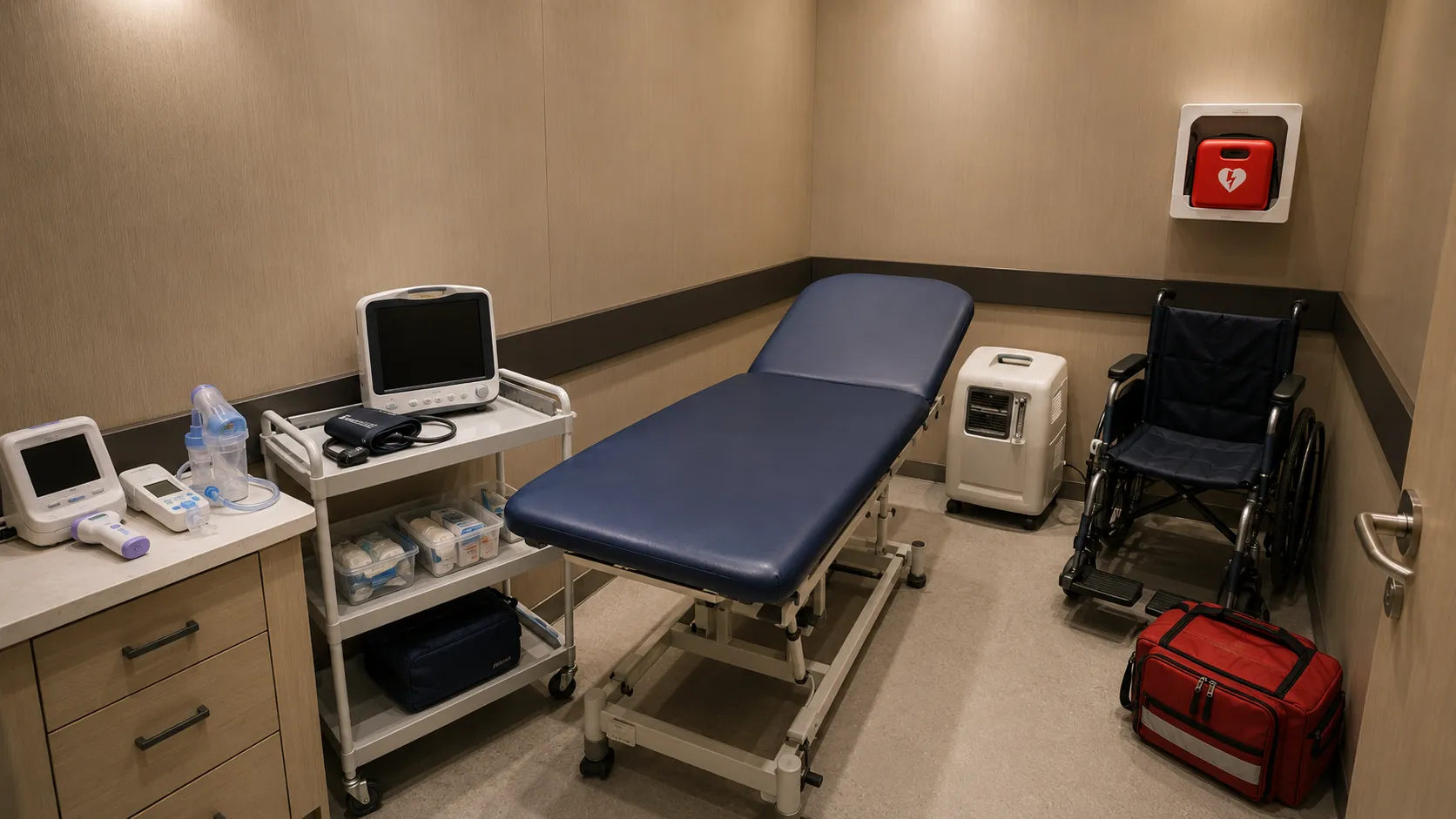
Consulting & primary care. Consulting and examination rooms for everyday guest care. Most visits are routine. A calm, private setting reassures travellers, and comfort matters. Guests feel properly looked after.
-
Treatment & minor injuries. Equipment for dressings, wound care and minor injuries. Slips, cuts and sprains are common. The centre handles them on site. No hospital trip is needed for these.
-
Emergency & resuscitation. A defibrillator, airway and resuscitation equipment are ready to use. A serious event can happen anytime. The centre must respond first, so the kit is ready and checked.
-
Stabilisation. Basic monitoring and stabilisation equipment. A guest may need holding until transfer. Stabilise first, then refer, holding safely meanwhile.
-
Diagnostics. Basic point-of-care testing and simple diagnostics. Quick results guide a treat-or-refer decision. They keep care prompt and informed.
-
Pharmacy & supplies. A small, controlled stock of medicines and supplies, with a cold chain. Common needs are met on site. Storage is safe, controlled and recorded.
-
Referral & records. Records and a clear referral pathway to local services. Serious cases move on quickly. Good records travel with them, so nothing is lost in transfer.
-
Infrastructure. A discreet, accessible, professional space, reliable power, and hand hygiene throughout. Guests value privacy above all.
Hotel medical centre equipment checklist
|
Section |
Equipment |
Notes |
|
Primary care |
Consulting; examination rooms |
Routine, discreet |
|
Minor injury |
Dressings; wound care |
On site |
|
Emergency |
Defibrillator; airway; resus |
Respond first |
|
Stabilisation |
Monitoring; stabilise |
Then refer |
|
Diagnostics |
Point-of-care testing |
Treat or refer |
|
Pharmacy |
Controlled stock; cold chain |
Safe storage |
|
Referral |
Records; local pathway |
Move on quickly |
|
Infrastructure |
Discreet; accessible; hygiene |
Professional |
Scale each area to your property and guests. A city hotel near hospitals and a remote resort far from services differ widely in stabilisation and self-sufficiency.
Planning a hotel centre?
We'll help you equip it end-to-end. Tell us your property, guests, budget and market. We'll build the equipment list, balance new and refurbished items, and make sure everything is compliant and supported.
No pressure, no obligation. → Talk to the team
What else does setting up a hotel medical centre involve
-
Ready for the unpredictable. You cannot predict who walks in. So the centre is equipped for a broad mix of complaints, from minor injury to a serious emergency. Anything at all can walk in, so real breadth of readiness is the watchword.
-
Stabilise, then refer. A hotel centre is not a hospital. So its job is to treat what it safely can, stabilise anything serious, and refer promptly to local services. Know your limits.
-
Distance changes the plan. A remote resort is far from help. So the more isolated the property, the more emergency and self-sufficient provision it needs. Distance raises the stakes.
-
Discreet and professional. Guests value privacy and reassurance. So the space is calm, discreet and professional, not clinical or alarming. First impressions reassure.
-
Consumables, staffing and service. Treatment consumables, trained staff or on-call cover, and service arrangements all shape the running model. Cover may be on call. The purchase is only the start.
Setting up a hotel medical centre, step by step
-
Define your property and guests. Decide the care, emergency and referral provision you need.
-
Confirm the space and referral pathway. Plan consulting, emergency space and local links. Start works early.
-
Build the equipment list by area, with real emergency provision, sized to your property and its distance from help.
-
Decide new versus refurbished per item. Plan safe medicine storage, consumables and service alongside.
-
Install and set up everything. Establish the referral pathway, and train the team before opening.
Emergency provision and the referral pathway take time to set up. Build them into the schedule, so the centre is ready from day one rather than only being equipped.
Budget and procurement
A hotel medical centre is consumable-led rather than heavy on major equipment. So the purchase price is only part of the story. Supplies and safe medicine storage carry ongoing costs. A common approach is to buy new for high-throughput core units and certified refurbished for ancillary equipment. Because these are regulated devices, check the device risk class and the certification for your market. Match emergency and stabilisation provision to your property's distance from help. A city hotel and a remote resort are then each equipped for the isolation they actually face.
Approval and accreditation by region
|
Region |
Regulator |
Device requirement |
|
United Kingdom |
UKCA mark (CE accepted to 2028–2030) |
|
|
European Union |
CE marking under the MDR |
|
|
United States |
FDA clearance or approval |
|
|
Gulf (GCC) |
SFDA & GCC bodies |
National registration / GCC conformity |
|
South Africa |
Medical device licensing |
Medical devices are regulated, so confirm each is approved for your market. Hotel medical provision also follows local healthcare and safety rules that vary by country, so plan for these alongside device approval. For quality standards and clinical guidance, the World Health Organisation and NICE are useful references. If you're equipping a hotel medical centre, our buyer hub sets out how to purchase with confidence.
More from Business
-
Buyers — source a full hotel or resort medical centre equipment package for your property.
-
Suppliers — list your equipment and reach buyers worldwide.
-
Advertise — promote your products and services to a clinical audience.
-
Business overview — explore everything MediGear offers healthcare organisations.
Disclaimer
This article is for general information only. It is not clinical, medical, procurement, engineering or regulatory advice. Hotel medical-centre design, equipment, emergency and referral requirements vary by country, property and location, and change over time. The checklist is a planning aid, not a specification. Always work with qualified clinical, biomedical, facilities and procurement professionals. And confirm every device is approved for your market — for example, UKCA, CE, FDA, SFDA/GCC or SAHPRA. Requirements change, so check the current position before you buy. medigear.uk accepts no liability for actions taken on this content.
Equip your hotel medical centre end-to-end.
From guest primary care and minor-injury treatment to emergency, stabilisation and referral, we help properties across the UK, Europe, the US, the Gulf and South Africa build hotel medical centres — compliant, supported and discreet.
Frequently Asked Questions
A hotel medical centre needs consulting and treatment rooms for everyday guest care and minor injury, and real emergency and resuscitation equipment including a defibrillator, since a serious event can happen anytime. It also needs basic stabilisation and diagnostics, a small controlled pharmacy with a cold chain, and a clear referral pathway to local services. It treats what it can and stabilises the rest.
The main areas are consulting and primary care, treatment and minor injury, emergency and resuscitation, stabilisation, diagnostics, pharmacy and supplies, referral and records, and the discreet infrastructure. These are planned together, because a hotel centre must treat a broad mix of guest needs and stabilise serious cases before referral.
Costs depend on the property, its guests and its distance from help, so there is no single figure. The centre is consumable-led rather than heavy on major equipment. Weigh the purchase price against supplies and safe medicine storage over time rather than the upfront price alone.
Yes, for many items. Certified refurbished examination, emergency and diagnostic equipment can be sensible where it is reliable and fully supported. Every device must be approved for your market and ready to use, whether new or refurbished. Emergency kit in particular must be reliable and well maintained.
It varies with the property and refit, but planning, fitting out and equipping typically takes a few months. Emergency provision, safe medicine storage and the referral pathway are the parts most often underestimated, so build them into the schedule from the start.
A hotel medical centre needs a discreet, accessible, professional space, reliable power, hand hygiene, safe medicine storage, and a clear referral pathway to local services. Emergency provision and referral matter as much as everyday equipment, because a serious event can happen at any time and a guest is the property's responsibility until help arrives.