
Introduction
An emergency department is a hospital's front door for the acutely ill and injured, so its equipment has to cover everything from resuscitating the sickest patients to treating minor injuries, at any hour and without warning. Setting one up means equipping resuscitation, majors and minors areas, rapid diagnostics and a triage front end — all arranged so patients can be assessed, treated and moved on quickly.
This guide sets out the full emergency department equipment list by area, the surrounding infrastructure and safety, the planning sequence, and the approval and compliance points — for a new department, an expansion, or added emergency capacity, wherever your hospital operates. It focuses on the equipment and flow decisions, and flags where clinical, biomedical and estates input is essential.
An emergency department is defined by unpredictability, so it is equipped for a range it cannot foresee: enough resuscitation capability for the worst days, enough monitored and minor-treatment space for the ordinary ones, and diagnostics fast enough to make decisions at pace. Flow matters as much as kit — how patients are triaged, where they wait, how quickly imaging and results come back — because a department that cannot move patients through safely becomes dangerous however well it is equipped. Planning is as much about layout and throughput as about the devices themselves.
In practice, the decisions that cause the most trouble are about flow and space rather than individual devices: too few monitored spaces, a triage front end that cannot cope, or imaging too far from resus. Equipment standardised across the department simplifies training and servicing and speeds up care when minutes matter. Planning for the busiest realistic day, with spare capacity and clear restocking, is what keeps a department safe when several sick patients arrive at once.
The short version — what every emergency department is built around
Strip it back, and an emergency department needs three things — the means to resuscitate and monitor the sickest patients, fast diagnostics to make decisions, and the space and flow to treat and move everyone else.
-
Resuscitation & monitoring — defibrillators, airway, ventilation and monitors for the sickest patients.
-
Diagnostics — imaging and point-of-care testing fast enough to decide and act.
-
Treatment & flow — procedure equipment, trolleys and a triage and minors area to keep patients moving.
Emergency department equipment by area
-
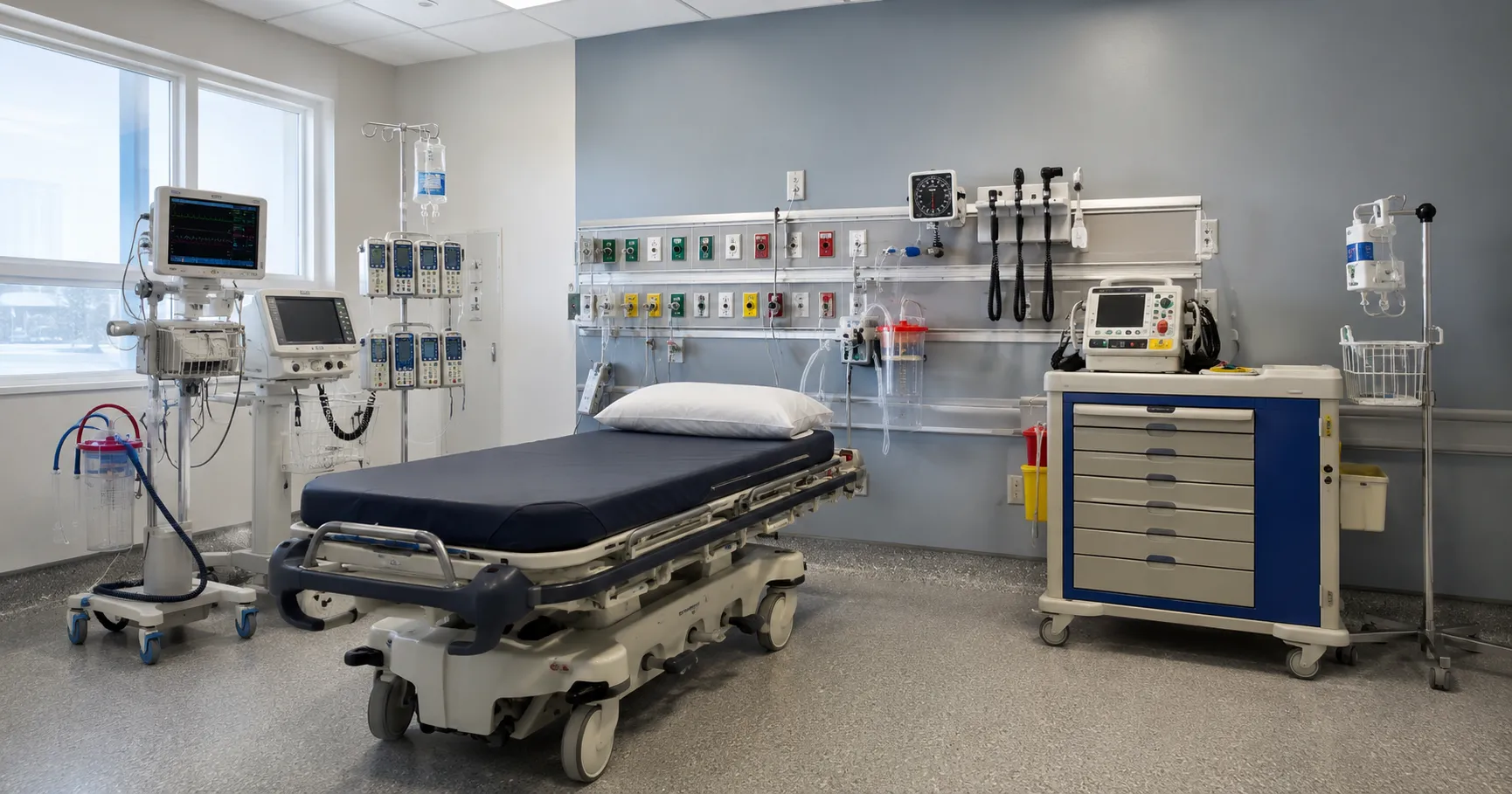
Resuscitation bay. Defibrillators, advanced airway and intubation equipment, ventilators, and fully stocked resuscitation trolleys for the sickest, most time-critical patients, where seconds decide the outcome.
-
Patient monitoring. Multi-parameter monitors across resus and majors for ECG, oxygen saturation, blood pressure and capnography, feeding a central view so staff can watch the sickest patients at a glance.
-
Diagnostic imaging. General and mobile X-ray and point-of-care ultrasound within the department, with rapid access to CT for serious injury and illness such as major trauma, stroke and bleeding.
-
Point-of-care testing. Blood-gas, glucose, lactate and rapid diagnostic testing so critical results are available at the bedside within minutes.
-
Treatment & procedures. Procedure trolleys, wound-care and suturing equipment, plaster and splinting for fractures, and minor-procedure kit for the majors and minors areas.
-
Triage & minors. A triage station to assess and prioritise arrivals, plus examination and treatment equipment for the walking wounded and minor illness.
-
Patient handling & beds. Emergency trolleys and beds, transfer aids, and bariatric-capable equipment, since patients arrive in every condition and cannot walk in.
-
Infrastructure. Piped medical gases, resilient power, isolation capacity for infectious patients, and IT linking triage, results and records.
Emergency department equipment checklist
|
Section |
Equipment |
Notes |
|
Resuscitation |
Defibrillator; airway; ventilator; crash trolley |
Time-critical, ready |
|
Monitoring |
Multi-parameter monitors |
Resus and majors |
|
Imaging |
X-ray; point-of-care ultrasound; CT access |
Fast decisions |
|
Point-of-care |
Blood-gas; glucose; lactate; rapid tests |
Results in minutes |
|
Treatment |
Procedure trolleys; wound; plaster/splint |
Majors and minors |
|
Triage/minors |
Triage station; exam/treatment kit |
Assess and prioritise |
|
Patient handling |
Trolleys; beds; transfer aids |
Every condition |
|
Infrastructure |
Gases; power; isolation; IT |
Flow and records |
Scale each area to your expected attendances and case mix — a small emergency unit and a major trauma-receiving department differ widely in resuscitation, imaging and monitored capacity.
Planning a new department?
We'll help you equip it end-to-end. Tell us your expected attendances, case mix, budget and market — we'll build the equipment list, balance new and refurbished units, and make sure everything's compliant and supported.
No pressure, no obligation. → Talk to the team
What else does setting up an emergency department involve
-
Flow and layout. An emergency department lives or dies on flow, so triage, resus, majors, minors and waiting areas must be laid out so patients move through safely — layout shapes equipping as much as the kit does.
-
Infection control and isolation. Patients arrive undiagnosed, so isolation capacity, hand hygiene and easily cleaned equipment protect a crowded, unpredictable department and its staff.
-
Medical gases and power. Piped oxygen, air and vacuum in resus and majors, with resilient power, are core infrastructure — the sickest patients cannot wait for a supply that fails.
-
IT and records. Triage, tracking, results and records must join up so staff know who is waiting, how sick they are and what is outstanding; plan the IT alongside the equipment.
-
Consumables and service. Defibrillators, monitors and imaging depend on a steady consumable supply and service contracts with calibration — factor these into the running model, not just the purchase.
Setting up an emergency department, step by step
-
Define your expected attendances, case mix and whether you receive major trauma — how many, how sick.
-
Confirm infrastructure and layout — resus, majors, minors, triage, medical gases and power — and start works early.
-
Build the equipment list by area, sized to your attendances, with the resuscitation and imaging your case mix needs.
-
Decide new versus refurbished per item and plan consumable and service contracts alongside.
-
Install, commission and test everything, integrate monitoring and IT, and train the team before go-live.
Commissioning, IT integration and staff training take time — build them into the schedule so the department can open safely, not just with equipment in place.
Budget and procurement
Emergency departments are equipment- and consumable-intensive, so the purchase price is only part of the story; defibrillators, monitors and imaging all carry running and service costs. A common approach is to buy new for high-throughput core units and certified refurbished for ancillary equipment. Because these are regulated devices, check the device risk class and the certification for your market. Match resuscitation, imaging and monitored capacity to your attendances and whether you receive major trauma, so the department is equipped for its busiest realistic day, not its average one.
Approval and accreditation by region
|
Region |
Regulator |
Device requirement |
|
United Kingdom |
UKCA mark (CE accepted to 2028–2030) |
|
|
European Union |
CE marking under the MDR |
|
|
United States |
FDA clearance or approval |
|
|
Gulf (GCC) |
SFDA & GCC bodies |
National registration / GCC conformity |
|
South Africa |
Medical device licensing |
Emergency and resuscitation devices are regulated, so confirm each is approved for your market. Emergency equipment must work first time on the sickest patients, so approval, servicing and readiness all matter to keep the department safe. For quality standards and clinical guidance, the World Health Organisation and NICE are useful references. If you're equipping an emergency department, our buyer hub sets out how to purchase with confidence.
More from Business
-
Buyers — source a full emergency department equipment package for your hospital.
-
Suppliers — list your equipment and reach buyers worldwide.
-
Advertise — promote your products and services to a clinical audience.
-
Business overview — explore everything MediGear offers healthcare organisations.
Disclaimer
This article is for general information only and does not constitute clinical, medical, procurement, engineering or regulatory advice. Emergency department design, equipment, infrastructure, flow and safety requirements vary by country, case mix and facility, and change over time. The checklist is a general planning aid, not a specification — always work with qualified clinical, biomedical, facilities and procurement professionals, and confirm that every device is approved for your market (for example, UKCA, CE, FDA, SFDA/GCC or SAHPRA). medigear.uk accepts no liability for actions taken based on this content.
Equip your emergency department end-to-end.
From defibrillators and monitors to airway, imaging and point-of-care testing, we help hospitals across the UK, Europe, the US, the Gulf and South Africa build emergency departments — compliant, supported and on budget.
Frequently Asked Questions
An emergency department needs defibrillators, airway and ventilation equipment and resuscitation trolleys for the sickest patients, multi-parameter monitoring, imaging such as X-ray and point-of-care ultrasound with rapid CT access, point-of-care testing, and treatment equipment for wounds, fractures and minor procedures — plus a triage front end. Quantities scale with attendances and case mix.
The main areas are the resuscitation bay, patient monitoring, diagnostic imaging, point-of-care testing, treatment and procedures, triage and minors, patient handling, and the underlying infrastructure of medical gases, power, isolation and IT. These are planned together with the department's layout, because flow matters as much as the equipment.
Costs depend on attendances, case mix and whether the department receives major trauma, so there is no single figure. Because emergency departments are consumable- and service-intensive, weigh the purchase price against running and service costs over the life of each device rather than the upfront price alone.
Yes, for many items. High-use core devices such as defibrillators and monitors are often bought new, while certified refurbished units can be sensible for trolleys, beds and ancillary equipment. Every device must be approved for your market and fully supported with service and consumables, whether new or refurbished.
It varies with scale and whether building works are needed, but planning, equipping, commissioning and training typically take several months. Layout and flow, IT integration and staff training are the parts most often underestimated, so build them into the schedule from the start.
An emergency department needs piped medical gases and resilient power in resus and majors, isolation capacity for undiagnosed and infectious patients, and IT linking triage, tracking, results and records. This infrastructure and a workable layout matter as much as the clinical equipment, because a department that cannot move patients safely becomes dangerous.