
Introduction
A dental clinic is built around the treatment chair, but a safe, working practice needs far more — imaging to diagnose, sterilisation to protect patients, and the plant that drives it all. Setting one up means fitting out one or more surgeries with a chair unit, handpieces, imaging and light-curing, while sharing infrastructure like a compressor, suction, water and infection-control facilities.
This guide sets out the full dental clinic equipment list by area, the surrounding infrastructure and safety, the planning sequence, and the approval and compliance points — for a new practice, an extra surgery, or a refit, wherever you operate. It focuses on the equipment and infrastructure decisions, and points to where clinical, engineering and regulatory input is essential.
Much of a dental practice is invisible plant: the air compressor, the suction and the water treatment that every surgery quietly relies on. Fitting out the chairs is the obvious step, but sizing that shared plant to the number of surgeries and the busiest sessions, and building sterilisation and radiation protection around it, is what turns a set of rooms into a working, compliant practice. Get the plant and the decontamination flow right and adding a chair later is straightforward; get them wrong and every surgery is limited by the services behind it, however good the chair itself may be.
In practice, the most common mistake is sizing the shared plant for today rather than for a busy future, so a growing practice quickly outgrows its compressor, suction or sterilisation. It is easier and cheaper to plan headroom in from the start than to upgrade the plant later. Standardising handpieces and consumables across surgeries, and building the decontamination flow around the busiest sessions, keeps a practice running smoothly as it grows and adds chairs.
The short version — what every dental clinic is built around
Strip it back, and a dental clinic needs three things — a chair and delivery unit to treat from, imaging to diagnose, and sterilisation to keep patients and staff safe.
-
Chair & delivery unit — a dental chair with handpieces, light, suction and delivery system.
-
Imaging — intraoral and panoramic X-ray to diagnose and plan treatment.
-
Sterilisation & safety — an autoclave and infection-control provision, plus the compressor and suction plant.
Dental clinic equipment by area
-
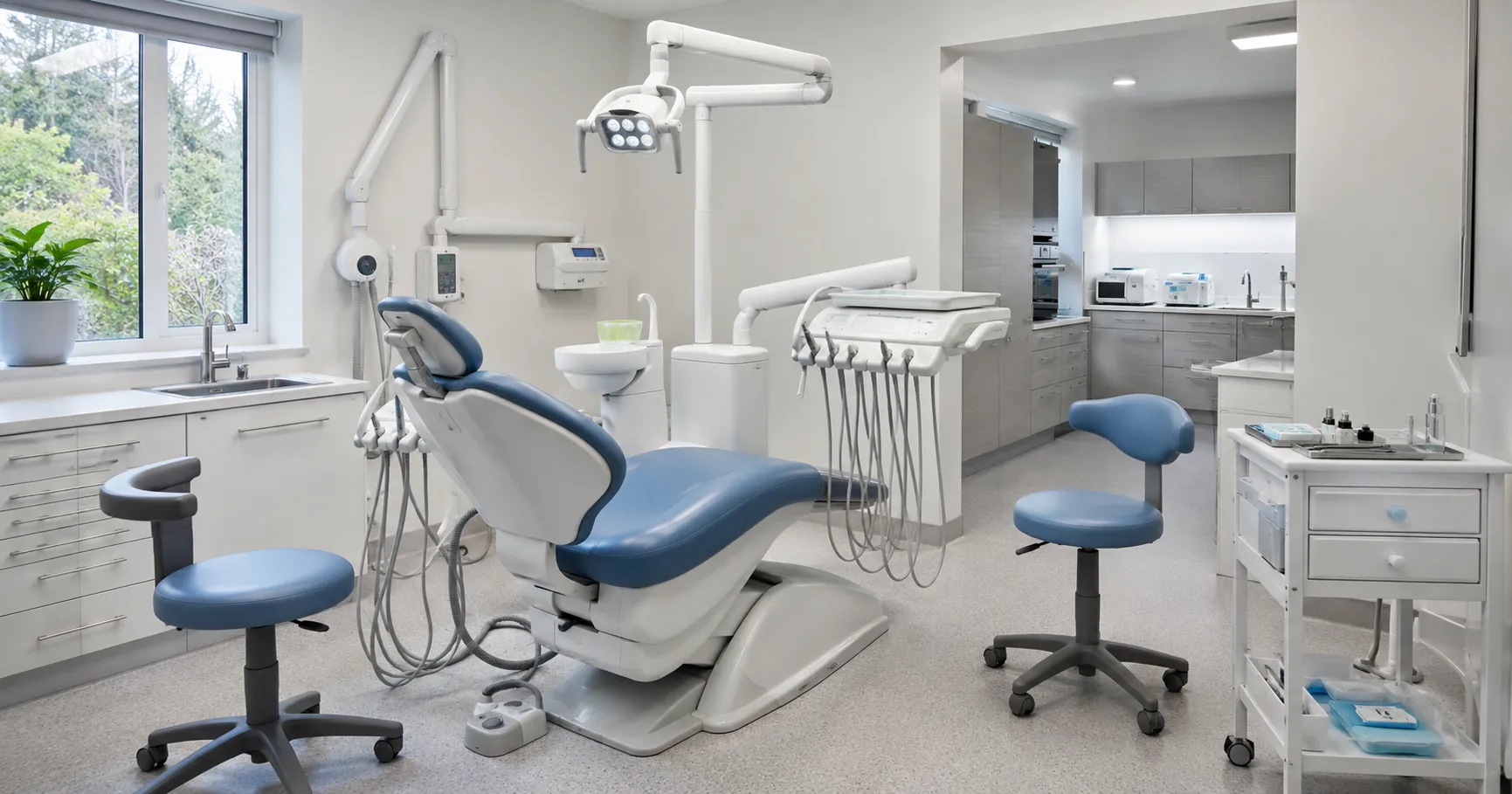
Dental chair & delivery unit. A dental chair with an operating light, delivery system for handpieces, integrated suction and an assistant's side — the heart of each surgery, chosen for ergonomics and reliability over long clinical days at the chair.
-
Handpieces & instruments. High- and low-speed handpieces, ultrasonic scalers, and hand instruments, in enough sets to cycle through sterilisation between patients without holding up the list or reusing anything before it is properly processed.
-
Imaging. Intraoral X-ray and sensors, a panoramic (OPG) unit, and cone-beam CT (CBCT) where implant, endodontic or complex work is planned, since three-dimensional detail changes planning.
-
Sterilisation & infection control. An autoclave (steam steriliser), instrument washer, sealing and tracking, sized to the number of surgeries and patient throughput, with instrument tracking for traceability from decontamination through to the patient.
-
Restorative & light-cure. Curing lights, amalgamators or composite systems, and matrix and finishing kit for restorative work.
-
Suction & compressor. A dental air compressor and suction (aspirator) plant — shared services, usually sited in a plant room, that every surgery depends on to function.
-
Chairside consumables. Restorative materials, impression and disposable items, and personal protective equipment for each treatment, ordered to a predictable par level so surgeries never run short mid-session.
-
Infrastructure. Clean water supply, drainage, reliable power, and clinical waste handling across the practice, with amalgam separation where amalgam is still used.
Dental clinic equipment checklist
|
Section |
Equipment |
Notes |
|
Surgery |
Dental chair; delivery unit; light |
One per surgery |
|
Handpieces |
High/low-speed; scaler; instruments |
Multiple sterilisable sets |
|
Imaging |
Intraoral X-ray; OPG; CBCT |
CBCT for implants |
|
Sterilisation |
Autoclave; washer; sealer |
Sized to throughput |
|
Restorative |
Curing light; composite/amalgam kit |
Chairside |
|
Plant |
Compressor; suction/aspirator |
Shared services |
|
Consumables |
Materials; PPE; disposables |
Per patient |
|
Infrastructure |
Water; drainage; power; waste |
Practice-wide |
Scale each area to your number of surgeries and case mix — a single-chair practice and a multi-surgery clinic offering implants and orthodontics differ widely in imaging and sterilisation capacity, and in the compressor and suction plant behind them.
Planning a new practice?
We'll help you equip it end-to-end. Tell us your number of surgeries, treatments offered, budget and market — we'll build the equipment list, balance new and refurbished units, and make sure everything's compliant and supported.
No pressure, no obligation. → Talk to the team
What else does setting up a dental clinic involve
-
Infection control. Effective sterilisation, single-use items, hand hygiene and clean surgery design protect patients and staff, and shape how the practice is equipped and run, from instrument flow to surface materials.
-
Compressor and suction plant. A reliable air compressor and suction system underpin every surgery; plan their capacity and location as core services, not afterthoughts.
-
Radiation protection. Dental X-ray and CBCT require radiation protection, safe positioning and local regulatory registration — plan these into the layout and workflow from the very start of the design.
-
Clinical waste and water. Clinical waste handling, amalgam separation where used, and a clean water supply are everyday requirements that shape the practice's design.
-
Software and records. Practice-management and imaging software tie appointments, records and X-rays together and support recall and audit; plan integration and data handling from the start.
Setting up a dental clinic, step by step
-
Define the treatments offered and the number of surgeries — general, cosmetic, implants, orthodontics.
-
Confirm infrastructure — compressor and suction plant, water, power, drainage and waste — and start works early.
-
Build the equipment list per surgery and the shared imaging and sterilisation, sized to your throughput.
-
Decide new versus refurbished per item and plan consumable and service contracts alongside.
-
Install, commission and test everything, register radiation equipment, and prepare the practice to open.
Radiation registration and commissioning take time — build them into the schedule so the practice can open safely, not just with equipment in place.
Budget and procurement
Dental practices are consumable- and service-intensive, so the purchase price is only part of the story; chairs, handpieces and imaging all carry running and service costs. A common approach is to buy new for high-throughput core units and certified refurbished for ancillary equipment. Because these are regulated devices, check the device risk class and the certification for your market. Size the shared compressor, suction and sterilisation to your number of surgeries and busiest sessions, so future growth does not outrun the plant behind the chairs.
Approval and accreditation by region
|
Region |
Regulator |
Device requirement |
|
United Kingdom |
UKCA mark (CE accepted to 2028–2030) |
|
|
European Union |
CE marking under the MDR |
|
|
United States |
FDA clearance or approval |
|
|
Gulf (GCC) |
SFDA & GCC bodies |
National registration / GCC conformity |
|
South Africa |
Medical device licensing |
Dental devices, including X-ray and CBCT, are regulated, so confirm each is approved and registered for your market. Dental X-ray and CBCT add radiation registration and protection on top of device approval, so plan for both from the start. For quality standards and clinical guidance, the World Health Organisation and NICE are useful references. If you're equipping a dental clinic, our buyer hub sets out how to purchase with confidence.
More from Business
-
Buyers — source a full dental clinic equipment package for your practice.
-
Suppliers — list your equipment and reach buyers worldwide.
-
Advertise — promote your products and services to a clinical audience.
-
Business overview — explore everything MediGear offers healthcare organisations.
Disclaimer
This article is for general information only and does not constitute clinical, medical, procurement, engineering or regulatory advice. Dental clinic design, equipment, imaging, sterilisation, radiation protection and infection-control requirements vary by country and facility, and change over time. The checklist is a general planning aid, not a specification — always work with qualified clinical, biomedical, facilities and procurement professionals, and confirm that every device is approved for your market (for example, UKCA, CE, FDA, SFDA/GCC or SAHPRA). medigear.uk accepts no liability for actions taken on the basis of this content.
Equip your dental clinic end-to-end.
From dental chairs and handpieces to imaging, autoclaves and compressor and suction plant, we help practices across the UK, Europe, the US, the Gulf and South Africa build dental clinics — compliant, supported and on budget.
Frequently Asked Questions
A dental clinic needs a dental chair and delivery unit for each surgery, high- and low-speed handpieces and instruments, intraoral and panoramic X-ray (and CBCT for implants), an autoclave and sterilisation workflow, curing lights and restorative kit, and the shared compressor and suction plant that drives it all. Quantities scale with the number of surgeries.
The main areas are the chair and delivery unit, handpieces and instruments, imaging, sterilisation and infection control, restorative and light-cure equipment, the compressor and suction plant, chairside consumables, and the underlying water, power and waste infrastructure. These are planned together, because every surgery depends on the shared plant and services behind it to function safely.
Costs depend on the number of surgeries, the imaging you install and the treatments you offer, so there is no single figure. Because practices are consumable- and service-intensive, weigh the purchase price against running and service costs over the life of each device rather than the upfront price alone.
Yes, for many items. Chairs, compressors and imaging can often be certified refurbished, while high-use handpieces are frequently bought new. Every device must be approved and, for X-ray equipment, registered for your market, and fully supported with service and consumables. Whether a unit is new or refurbished, reliability and support matter more than the purchase price alone.
It varies with the number of surgeries and whether building works are needed, but planning, fitting out, installing and commissioning a practice typically takes a few months. Compressor and suction plant, radiation registration and commissioning are the parts most often underestimated, so build them into the schedule from the start rather than treating them as last-minute tasks.
A dental clinic needs a reliable air compressor and suction (aspirator) plant, a clean water supply and drainage, dependable power, radiation protection for X-ray, and clinical waste handling. These shared services underpin every surgery and are planned into the practice from the outset.