
Introduction
A corporate occupational health clinic keeps a workforce healthy, safe and fit for work. Its focus is prevention, not treatment. So its equipment is built for screening, health surveillance and assessment. It centres on tools that measure health, detect work-related risks early, and check fitness for a role. Setting one up means fitting out assessment and screening rooms, with first-aid and emergency provision alongside.
This guide covers the full occupational health clinic equipment list by area. It then walks through the infrastructure, the planning sequence, and the approval and compliance points. Use it for a new clinic, an upgrade, or added capacity. It focuses on the equipment and assessment decisions. Where clinical, occupational health, and safety input is essential, it says so.
Occupational health is different from most clinics because it looks at work, not just illness. It asks whether a job is affecting someone's health, and whether someone is fit for the job. So the equipment leans towards measurement and surveillance, not treatment. Prevention is cheaper than cure. Hearing and lung-function tests spot damage early. Vision and general health checks support fitness assessments. The clinic runs screening programmes for known workplace risks. It stays ready for first aid and workplace emergencies too. Both sit side by side. The aim is to catch problems early and keep people safe and working.
In practice, the decisions that matter most are about the risks you screen for and the volume you handle. Match the surveillance equipment to the actual workplace hazards, since noise, dust and chemicals each need their own tests. Plan capacity for the numbers you assess, because occupational health runs high-volume programmes. Keep records accurate and confidential, as surveillance depends on trends over time. Standardise the assessment room so it flows. Plan screening, assessment and emergency provision together, and the clinic protects the workforce and the business. Healthy staff are the goal, and fewer absences follow.
The short version — what every occupational health clinic is built around
Strip it back, and an occupational health clinic needs three things. Screening and surveillance equipment. Fitness-assessment tools. And first-aid and emergency provision.
-
Screening & surveillance — equipment to detect work-related health risks early.
-
Fitness assessment — tools to check that someone is fit for their role.
-
First aid & emergency — provision for workplace injuries and emergencies.
Occupational health clinic equipment by area
-
Health surveillance. Audiometry for hearing, spirometry for lung function, and skin and exposure checks. These catch work-related damage early. The tests match the workplace hazards. Each hazard has its own specific test.
-
Screening & testing. Vision screening, blood-pressure and general health checks, and point-of-care testing. Screening programmes run at volume. Results feed fitness decisions. Throughput is high.
-
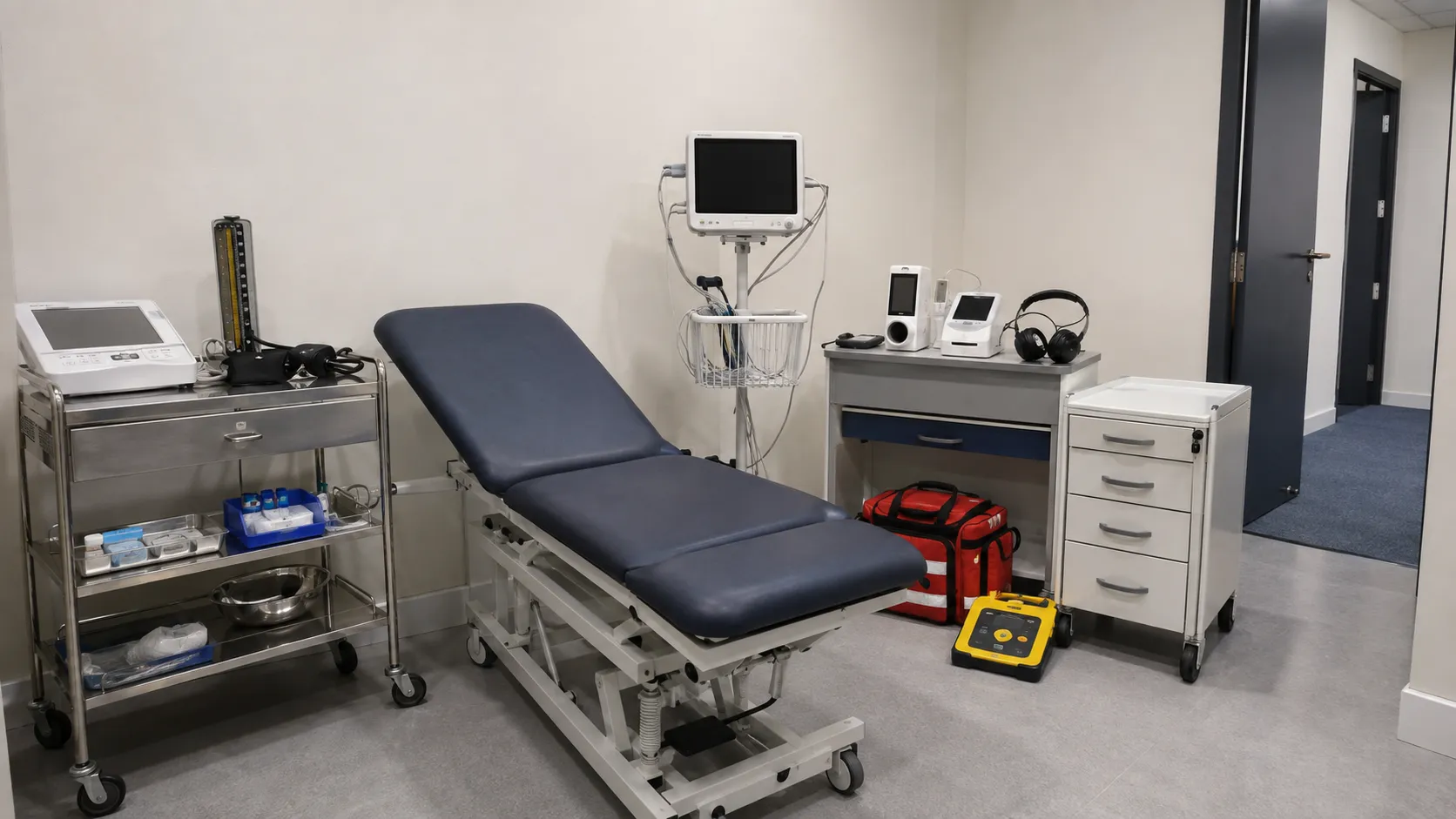
Fitness assessment. Examination couches and assessment tools for fitness-for-work reviews. The clinic checks that someone is fit for their role. Findings are recorded carefully.
-
Ergonomics & function. Basic functional and ergonomic assessment equipment. It helps judge how work affects the body. Advice can then prevent injury. Small changes help a lot.
-
First aid & emergency. A defibrillator, first-aid and basic emergency equipment. Workplace injuries and collapses happen. The clinic must respond quickly, so a ready kit saves lives.
-
Immunisation & travel health. A cold chain and equipment for workplace immunisation and travel health. Some roles need vaccination. Storage keeps vaccines safe and monitored.
-
Records & confidentiality. Systems for accurate, confidential health records. Surveillance depends on trends over time. Confidentiality is essential and expected. Data is kept secure, and access is controlled.
-
Infrastructure. Private, accessible rooms, reliable power, and a layout built for high-volume assessment. Privacy is essential in health surveillance.
Occupational health clinic equipment checklist
|
Section |
Equipment |
Notes |
|
Surveillance |
Audiometry; spirometry; skin checks |
Match the hazards |
|
Screening |
Vision; BP; point-of-care |
At volume |
|
Fitness |
Couches; assessment tools |
Fit for role |
|
Ergonomics |
Functional assessment |
Prevent injury |
|
First aid |
Defibrillator; emergency kit |
Respond quickly |
|
Immunisation |
Cold chain; vaccines |
Storage safe |
|
Records |
Confidential systems |
Trends over time |
|
Infrastructure |
Private rooms; power |
High-volume |
Scale each area to your workforce and its hazards. An office-based service and one covering heavy industry differ widely in surveillance and emergency needs. Hazards drive the plan.
Planning an OH clinic?
We'll help you equip it end-to-end. Tell us your workforce, hazards, budget and market. We'll build the equipment list, balance new and refurbished units, and make sure everything is compliant and supported.
No pressure, no obligation. → Talk to the team
What else does setting up a corporate occupational health clinic involve
-
Match surveillance to hazards. Noise, dust and chemicals each need their own tests. So the surveillance equipment matches the actual workplace hazards, not a generic list. The hazard alone sets the test.
-
Built for volume. Occupational health runs high-volume screening programmes. So capacity is planned for the numbers you assess, or the programme stalls. Volume is the norm, so plan the numbers.
-
Records and confidentiality. Surveillance depends on accurate trends over time. So confidential record systems are core, not an afterthought, and staff trust depends on them. Trust drives take-up.
-
Prevention pays. Catching problems early keeps people safe and working. So the clinic leans towards screening and assessment, more than treatment. Early action costs far less than late.
-
Consumables, staffing and service. Test consumables, trained occupational-health staff, and calibration and service all shape the running model. Calibration keeps results valid. The purchase is only the start.
Setting up a corporate occupational health clinic, step by step
-
Define your workforce and hazards. Decide the surveillance, screening and assessment you need.
-
Confirm the space and infrastructure. Plan private assessment rooms, records and flow. Start works early.
-
Build the equipment list by area, with surveillance matched to your hazards and capacity for your volume.
-
Decide new versus refurbished per item. Plan calibration, consumables and service alongside.
-
Install and commission everything. Set up confidential records, and train the team before go-live.
Records systems and calibration take time to set up. Build them into the schedule, so the clinic runs proper surveillance from day one rather than only being equipped.
Budget and procurement
An occupational health clinic is assessment- and consumable-intensive. So the purchase price is only part of the story. Test equipment and calibration carry ongoing costs. A common approach is to buy new for high-throughput core units and certified refurbished for ancillary equipment. Because these are regulated devices, check the device risk class and the certification for your market. Match surveillance and capacity to your workforce and hazards. An office service and a heavy-industry one are then each equipped for the risks they actually manage.
Approval and accreditation by region
|
Region |
Regulator |
Device requirement |
|
United Kingdom |
UKCA mark (CE accepted to 2028–2030) |
|
|
European Union |
CE marking under the MDR |
|
|
United States |
FDA clearance or approval |
|
|
Gulf (GCC) |
SFDA & GCC bodies |
National registration / GCC conformity |
|
South Africa |
Medical device licensing |
Screening and diagnostic devices are regulated, so confirm each is approved for your market. Occupational health surveillance also follows workplace-health rules that vary by country, so plan for these alongside device approval. For quality standards and clinical guidance, the World Health Organisation and NICE are useful references. If you're equipping a corporate occupational health clinic, our buyer hub sets out how to purchase with confidence.
More from Business
-
Buyers — source a full occupational health clinic equipment package for your organisation.
-
Suppliers — list your equipment and reach buyers worldwide.
-
Advertise — promote your products and services to a clinical audience.
-
Business overview — explore everything MediGear offers healthcare organisations.
Disclaimer
This article is for general information only. It is not clinical, medical, procurement, engineering or regulatory advice. Occupational health clinic design, equipment, surveillance and safety requirements vary by country, workplace and hazards, and change over time. The checklist is a planning aid, not a specification. Always work with qualified clinical, biomedical, facilities and procurement professionals. And confirm every device is approved for your market — for example, UKCA, CE, FDA, SFDA/GCC or SAHPRA. Requirements change, so check the current position before you buy. medigear.UK accepts no liability for actions taken on this content.
Equip your occupational health clinic end-to-end.
From audiometry and spirometry to screening, fitness assessment and first aid, we help organisations across the UK, Europe, the US, the Gulf and South Africa build occupational health clinics — compliant, supported and on budget.
Frequently Asked Questions
An occupational health clinic needs health-surveillance equipment such as audiometry and spirometry, screening tools such as vision and blood-pressure checks, and fitness-assessment equipment. It also needs first-aid and emergency provision including a defibrillator, a cold chain for immunisation, and confidential record systems. The focus is prevention, so the equipment leans towards screening and assessment.
The main areas are health surveillance, screening and testing, fitness assessment, ergonomics and function, first aid and emergency, immunisation and travel health, records and confidentiality, and the supporting infrastructure. These are planned together, because occupational health looks at how work affects health and whether someone is fit for the job.
Costs depend on your workforce, its hazards and the surveillance required, so there is no single figure. The clinic is assessment- and consumable-intensive. Weigh the purchase price against test consumables and calibration over time rather than the upfront price alone.
Yes, for many items. Certified refurbished audiometry, spirometry and screening equipment can be sensible where it is calibrated and fully supported. Every device must be approved for your market and properly calibrated, whether new or refurbished. Calibration is what keeps surveillance results valid over time.
It varies with the size and surveillance involved, but planning, equipping and setting up records typically takes a few months. The record systems, confidentiality and calibration are the parts most often underestimated, so build them into the schedule from the start.
An occupational health clinic needs private, accessible assessment rooms, reliable power, confidential record systems, and a layout built for high-volume screening. This privacy and record-keeping matter as much as the test equipment, because surveillance depends on accurate, confidential trends over time.