Podiatry chairs explained for foot care treatment rooms
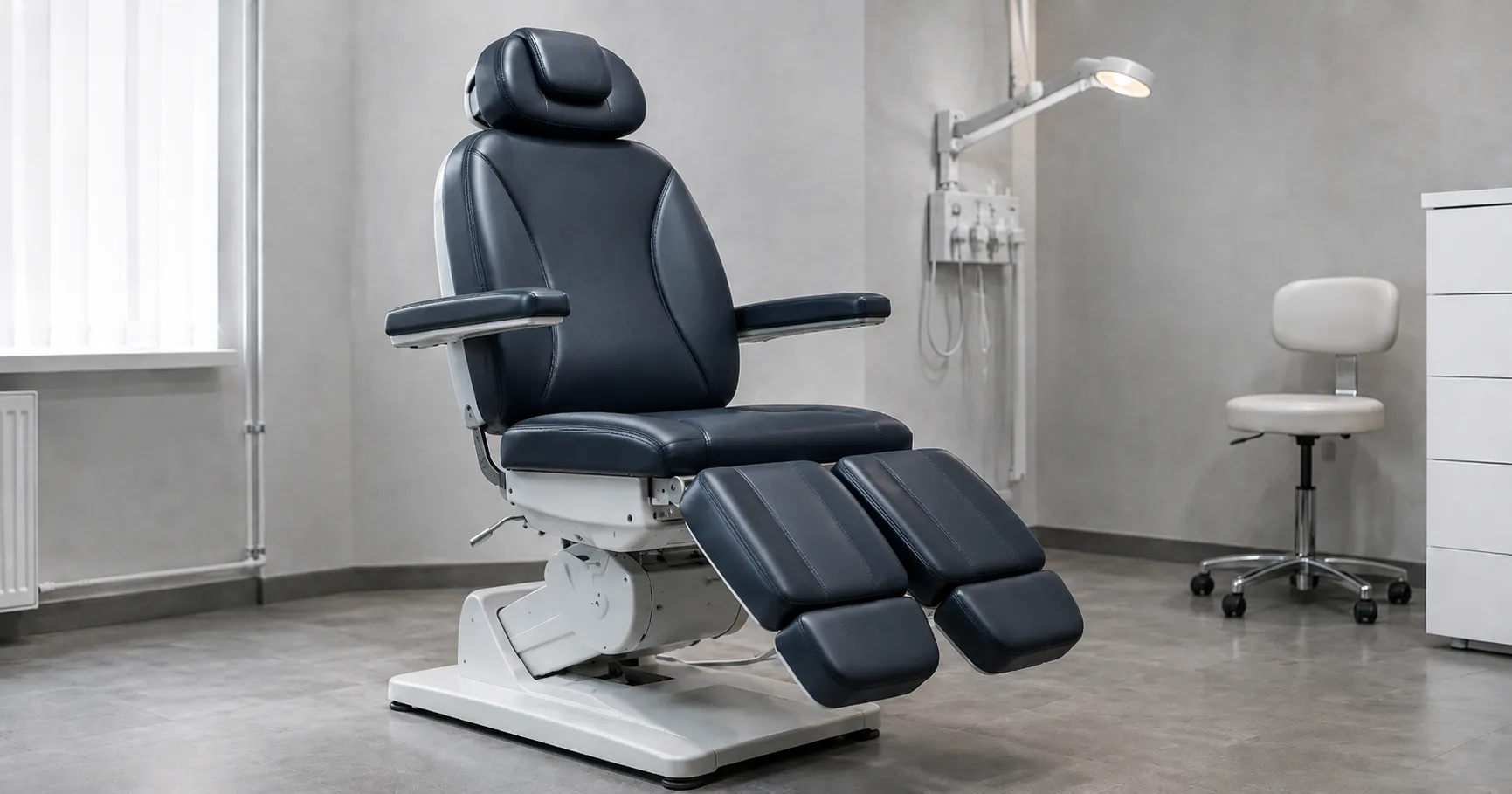
A podiatry chair is a powered treatment chair that presents a patient's feet and lower legs to a seated clinician at a comfortable working height. It reclines, rises and lowers, and splits its leg section so each foot can be held proud and steady for nail cutting, callus and corn removal, verruca treatment and diabetic foot assessment.
For anyone equipping a foot-care room, the chair sets the clinician's posture, patient access, and how smoothly a clinic runs. This guide stays with what makes a podiatry chair different from a general examination couch and what to verify before you buy.
Why a foot-care chair is built differently
Podiatry is performed at the far end of the patient, with the clinician on a saddle stool near the feet. That single working position drives the design. The chair has to sink low enough for the podiatrist to sit and reach without stooping, tilt the patient back so the legs rise towards the clinician, and separate the leg section so the treated foot sits forward and supported. A flat couch cannot do this: it leaves the clinician bent over at the end, with the foot dangling. Seat heights on podiatry chairs commonly range from roughly 500 mm to around 900 mm, though the figure varies by model, so confirm the low and high limits with your clinicians and your room.
Recline, height and the split leg section
Backrest and tilt
The backrest reclines from upright, used for consultation and history-taking, to near-flat for treatment and for nervous or faint patients. Many chairs add a slight seat tilt so the patient does not slide forward when reclined. Powered models drive the backrest and seat height via independent actuators controlled by a foot switch or hand control, freeing both of the clinician's hands.
The leg and foot section
This is the feature that defines a podiatry chair. The leg rest divides into two independently adjustable sections, allowing one, e.g., to be raised and angled. In contrast, the other rests, presenting a single foot at the height and angle the clinician wants. Look for a wide range of leg movement and abduction, a supportive heel cradle or foot plate, and smooth, quiet movement that does not startle the patient mid-procedure.
Powered versus hydraulic operation
Positioning is either electric or hydraulic, and the choice shapes daily use. Electric chairs use linear actuators and a foot switch, giving precise, repeatable height and recline with no physical effort, which suits a busy list and repeated adjustments through the day. Hydraulic chairs raise the seat with a foot pump and are simpler, with no mains dependency and fewer electronic parts, but they need more effort and offer coarser control. High-throughput NHS and private clinics usually favour electric for the speed and the reduced strain on staff; a low-volume or domiciliary setting may accept hydraulic. Confirm whether an electric chair has a manual or battery fallback for a power cut.
Clinician access and chairside working
Because the podiatrist works seated and close, clearances matter; check that the stool tucks under the raised leg section, that there is knee room beneath the foot, and that instrument trays, a drill or nail-dust extraction unit and a lamp can all reach the working area. A base that lets the saddle stool roll in without fouling the frame keeps the clinician square to the foot and protects their back over a full list.
Patient transfer and holding position
Getting patients on and off safely is part of the chair's job. A low minimum seat height lets frail or elderly patients sit without climbing, and swing-away or lift-up armrests give support during transfer, then clear the arms once seated. Some chairs offer a foot-controlled return that lowers the seat flat at the end of a treatment so the next patient can be positioned quickly. Confirm that any hand or foot controls are easy to reach and clearly marked, and that the chair holds its set position under load without drift, because a chair that creeps down mid-treatment is unsafe and slows the clinician. Anti-tip stability at full recline, with the patient towards the foot end, is worth confirming on the specification.
Lighting, drills and the wider set-up
A podiatry chair rarely works alone. It sits alongside an examination lamp or a loupe light, an instrument trolley, a nail drill and dust extractor, and often an autoclave nearby for reprocessing reusable instruments. When specifying the chair, plan how these reach the treatment site: whether the base allows a mobile trolley to come close to the foot, whether a clamp or floor-standing lamp angles onto the work, and where the power sockets are for the drill and extractor. A chair chosen without regard to the surrounding room can leave the clinician reaching across the patient for tools, which slows the list and strains the back.
Upholstery, dust and hygiene
Foot care generates skin and nail debris and involves broken skin, so cleanability is a clinical requirement, not a finish option. Specify welded-seam, fluid-resistant upholstery with no stitched seams to trap debris, and confirm the material is validated for the disinfectant your clinic uses. A smooth, wipeable base and leg sections help, as does compatibility with disposable couch roll. When a nail drill is used, pair the chair layout with dust extraction to ensure debris is captured rather than settling on surfaces. This overview is compiled from podiatry chair manufacturer specifications, MHRA medical device guidance, and infection control principles set out in NHS and Health Technical Memorandum material. It is written for clinicians and procurement leads, specifying foot-care rooms rather than for patients.
Regulation and electrical safety
A powered podiatry chair used in clinical care is generally a medical device. Electric models should meet the medical electrical safety standard BS EN 60601-1, carry UKCA or CE marking under the UK Medical Devices Regulations, and arrive with a declaration of conformity and an instruction manual. Ask for the safe working load, which for standard chairs typically ranges from 150 to 170 kg, with bariatric options above that; confirm the figure per model. For work-related manual handling and slip risks around the chair, the HSE sets the workplace framework that clinics operate within.
Podiatry chairs across settings
The right chair depends on where it will be used. A hospital or community diabetic foot clinic sees higher-risk patients and values full electric recline, easy transfer and robust cleaning. A private chiropody or podiatry practice weighs footprint and finish for a smaller room. Domiciliary podiatrists need a portable, folding chair or can work entirely around the patient's own seating, so a fixed, powered chair is not the tool for that setting. Nail-surgery and minor-procedure rooms want reliable near-flat recline and clear instrument access. Define the caseload before matching a chair to it. Buyers comparing models across suppliers can use a structured buyer comparison to hold every quote to the same specification.
Servicing, actuators and lifecycle cost
For electric chairs, the actuators, foot switch, and control box are the parts that wear out and are the main cost after upholstery. Ask about the actuator duty cycle, how easily a failed actuator or control is swapped, and whether the parts are standard supported units. Upholstery is a long-term consumable: fluid-resistant covers eventually split and are replaced, so a chair with replaceable covers avoids scrapping the frame. Factor cover replacement, actuator servicing, dust-extraction consumables and warranty into the whole-life cost rather than the purchase price alone.
Specifying a podiatry chair: what to check
-
Confirm the minimum seat height suits seated, saddle-stool working posture.
-
Check the leg section splits and raises each foot independently.
-
Decide electric or hydraulic, and confirm a fallback for power loss.
-
Verify the welded seam and fluid-resistant upholstery are validated for your disinfectant.
-
Confirm safe working load and any bariatric requirement.
-
Check the saddle stool and dust extraction reach the working area.
-
Check that powered chairs are UKCA- or CE-marked with a declaration of conformity.
-
Review warranty, replaceable covers, and spare parts availability.
Choosing well for your foot-care room
A good podiatry chair earns its place by protecting clinician posture and presenting the foot cleanly, treatment after treatment. Prioritise a genuinely low seat height, an independent split-leg section, smooth powered recline, and cleanable welded-seam upholstery, then match the load rating and footprint to your patients and room. Buyers comparing foot-care chairs across manufacturers can use Medigear.uk to review specifications and reach verified suppliers, or ask the team through the contact page for sourcing support.
Disclaimer
This article is for informational purposes only. It is published by MediGear (medigear.uk) for general information and procurement guidance. It is not clinical, diagnostic, treatment, technical, engineering, legal or regulatory advice, nor a product endorsement, guarantee or substitute for professional assessment. MediGear does not provide medical consultations. Buyers should consult their clinical, biomedical, estates and regulatory contacts, and the manufacturer's documentation, and independently verify all specifications, certifications, compatibility and suitability before purchase. Specifications, certifications and availability are correct at the time of publication and may change without notice. MediGear is a medical-equipment distributor and does not sell medicines or pharmaceutical products.