
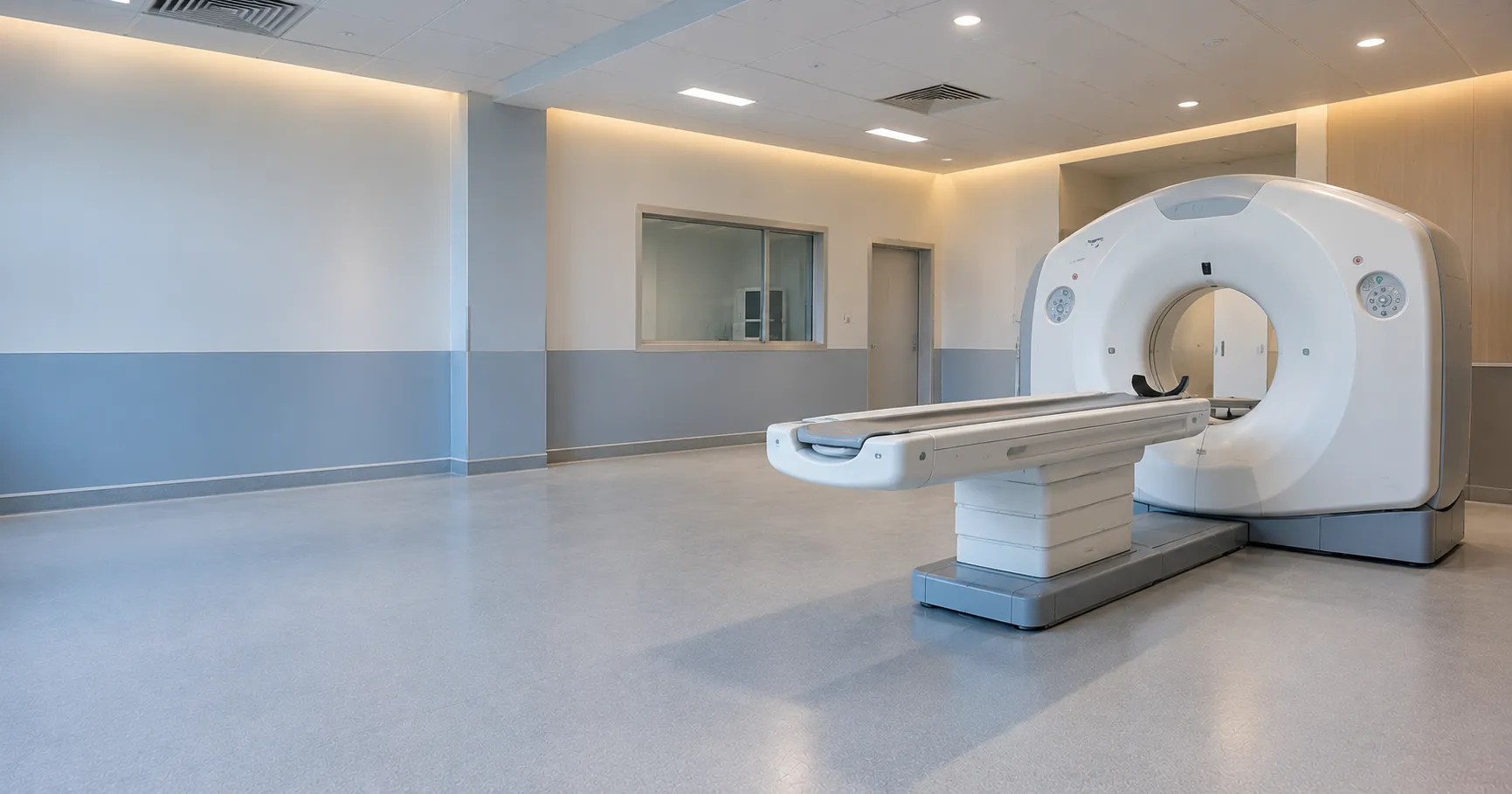
When you evaluate a refurbished CT scanner for image quality, remaining X-ray tube life is the number that determines. The tube is the single most expensive wearing part, rated in a finite budget of scan-seconds, and a scanner with a tired tube can produce a stunning image today and a large invoice within months. Check the tube first, then the detector, then the dose and image-quality QA, before price ever enters the conversation.
A refurbished CT scanner can deliver diagnostic imaging at a fraction of the cost of new. The catch is that image quality and running cost both hinge on components you cannot judge by looking, which is why the evaluation is a data exercise, not a walk-round.
X-ray tube life is the number that matters
The. X-ray tube has a finite working life, commonly tracked in scan-seconds or exposures and limited by anode heat capacity and bearing wear. Ask for the current tube usage against its expected life and the tube's age, because a tube near the end of its budget may need replacing soon at very substantial cost. Find out whether a replacement or new tube is included, and crucially what tube warranty comes with the system — a separate tube warranty, ideally covering a defined number of scan-seconds, transforms the risk profile. A refurbished CT scanner with a fresh or well-warranted tube is a different purchase from one whose tube history is unknown. If the seller cannot state remaining tube life, treat that silence as the biggest risk in the deal.
Detector condition and its effect on the image
After the tube, the detector array governs image quality. Detector faults show as ring artefacts, streaking o, or non-uniformity that undermine diagnostic confidence, and detector repair or replacement is expensive. Ask for recent images and QA results that demonstrate uniformity and freedom from artefacts across the field of view. Confirm the number of detector rows or slices matches the clinical work intended — cardiac and complex vascular studies need higher slice counts than routine head and body imaging. The detector, tube, and reconstruction system work together, so evaluate image quality as the output of the whole chain rather than any single component. A recent acceptance-style image set tells you far more than a specification list.
Dose calibration and the QA that proves it
Image quality is meaningless without dose control, and CT is a significant contributor to medical radiation exposure. A refurbished CT scanner must be calibrated so that dose and image quality are correctly balanced, and this has to be evidenced by physics QA. Ask for recent quality-assurance results — CT dose index (CTDI) measurements, image uniformity, noise, CT number accuracy and slice-thickness checks — ideally from a medical physics team. In the UK, exposures are governed by the ionising radiation medical exposure regulations, with guidance available through gov.uk, and the installed scanner will need acceptance and commissioning testing before clinical use. A scanner that cannot show current dose and QA data is not ready for patients, however good the image looks on the console.
Reconstruction, software and slice performance
Modern CT image quality owes as much to reconstruction software as to hardware. Iterative and advanced reconstruction reduce noise and allow lower dose, so confirm which reconstruction options are licensed and active on this specific scanner. Check that the software version is current and supported, and that clinical applications such as cardiac, perfusion, or dual-energy — if the service needs them — are licensed and functional rather than merely listed. Confirm reconstruction speed and gantry rotation time suit your throughput, since a slow reconstruction pipeline bottlenecks a busy department. As with any imaging system, verify DICOM connectivity to your reporting and archiving network. Licensed, supported software is part of image quality, not an optional extra.
Sourcing routes for a refurbished CT scanner
Refurbished CT reaches you by different routes with different risks. Manufacturer or OEM-refurbished scanners typically include original parts, current software, installation, and a stronger warranty that may cover the tube, at a premium price. Established third-party refurbishers can offer strong value and cross-brand choice, but tube testing, dose QA a, nd documentation quality vary, so scrutinise their evidence. The pivotal variable across both is the tube warranty: a system with a comprehensive tube warranty measured in scan-seconds carries far less exposure than one sold with the tube as-is. Weigh installation, physics support, dose QA, and tube cover alongside the headline figure. MediGear gathers these routes in one place, letting you review suppliers so tube history and support sit beside the price.
Installation, siting and physics support
A CT scanner is a building project as much as a purchase, and a refurbished system is no different. The room needs adequate radiation shielding verified for the installed unit, floor loading able to carry the gantry, and power and cooling to the manufacturer's specification. Confirm who is responsible for deinstallation at the source site, transport, rigging into your room, and reinstallation, because moving a CT scanner is specialist work and a poorly handled move can disturb calibration. Plan for medical physics involvement from the outset — acceptance and commissioning testing, shielding verification, and the QA baseline all need physics input before the first patient. Ask the supplier what installation, application training, and warranty support are included, since an OEM package often covers these while a bare third-party sale may not. A scanner bought cheaply but installed without proper physics support is a false economy.
Running costs beyond the X-ray tube
The tube dominates the risk, but it is not the only ongoing cost of a refurbished CT scanner. A service contract is a significant annual outlay, and its price rises with platform age and the level of cover, so read what it includes — parts, tube, software updates and response time all vary. Detector faults, though less frequent than tube wear, are expensive when they occur. Factor in the physics QA programme, staff application training if the platform is new to your team, and any software licence renewals. Consider power and cooling running costs for a system that may be less efficient than a current model. Set all of this against the discount on the purchase price, because a low sticker with a costly contract and an ageing tube can outweigh the saving. As with any imaging investment, judge the refurbished CT scanner on whole-life cost rather than the purchase figure alone.
Before you commit to a refurbished CT scanner
-
Get the current tube usage in scan-seconds against expected life, plus the tube age.
-
Confirm whether a new or replacement tube is included and the exact terms of the tube warranty.
-
Request recent images and QA showing detector uniformity and freedom from ring and streak artefacts.
-
Check the slice count and rotation time match the clinical work and throughput intended.
-
Obtain current dose QA — CTDI, noise, CT number accuracy and slice-thickness checks.
-
Confirm reconstruction and clinical application software are licensed, supported, and active.
-
Verify DICOM connectivity and plan acceptance and commissioning testing before clinical use.
-
Establish installation, physics support and spares availability for the platform.
CT buying mistakes worth avoiding
The expensive mistakes in refurbished CT centre on the tube and the dose data. The biggest is buying without knowing remaining tube life, then facing a five- or six-figure tube replacement within the first year. Another is judging image quality from a specification list rather than recent QA images that reveal detector artefacts. Buyers overlook the tube warranty terms, accepting a system where the tube is effectively uncovered. Dose QA gets skipped, so the scanner arrives without evidence it balances dose against image quality safely. And software features assumed to transfer turn out to be unlicensed, quietly limiting clinical capability. Treat tube life, detector QA, and dose data as the core of the evaluation, because those three decide both image quality and the true cost of ownership.
Making the CT decision
A refurbished CT scanner is a sound investment when the tube has real life or a solid warranty, the detector QA is clean, the dose data is current, and the software is licensed and supported. Evaluate the components and the physics evidence rather than the console finish, and you secure diagnostic imaging at a fraction of new-system cost without inheriting a hidden bill. When you want CT options with tube history, dose Q, A, and support laid out clearly, MediGear can bring qualified suppliers together for the comparison.
Disclaimer
This article is for informational purposes only. It is published by MediGear (medigear.uk) for general information and procurement guidance, and is not clinical, diagnostic, treatment, technical, engineering, legal or regulatory advice, nor a product endorsement, guarantee or substitute for professional assessment. MediGear does not provide medical consultations. Buyers should consult their clinical, biomedical, estates and regulatory contacts, and the manufacturer's documentation, and independently verify all specifications, certifications, compatibility and suitability before purchase. Specifications, certifications and availability are correct at the time of publication and may change without notice. MediGear is a medical-equipment distributor and does not sell medicines or pharmaceutical products.