Varicose veins are, at root, a valve problem: when the one-way valves in the leg veins fail, blood flows backwards and pools, and venous reflux testing is the assessment that proves it. Using duplex ultrasound with the patient standing, it measures whether blood flows the wrong way down a vein and for how long — the reflux time — to identify exactly which veins and valves have failed.
For a buyer, the important distinction is that venous reflux testing is a specific protocol, not a generic venous scan. It is done to plan varicose-vein treatment; it must be performed with the patient upright, and it depends on timing valve closure precisely. The kit is a duplex ultrasound system, but what you are specifying for is the reflux protocol: standing assessment, provocation manoeuvres, and accurate reflux-time measurement.
What reflux is and how it is timed
A healthy vein valve snaps shut within a fraction of a second when flow tries to reverse. In a refluxing vein,n the valve leaks, and blood flows backwards for longer. Venous reflux testing measures that reversed-flow duration with spectral Doppler: a burst of reverse flow lasting beyond an agreed threshold — commonly around half a second in the superficial veins — is taken as pathological reflux. The test walks the great and small saphenous veins, the sapheno-femoral and sapheno-popliteal junctions, the deep veins and any perforators, timing reflux at each to map the pattern of valve failure that treatment will target.
Why the patient must stand
Position is not a detail; it is central. Reflux only shows reliably when the column of blood is working against gravity, so the reference test is performed with the patient standing, weight on the opposite leg, or at least steeply tilted. Scanning a refluxing patient lying flat can hide the very reflux you are looking for. That upright requirement shapes the equipment choice: the sonographer needs a machine and room layout that allow comfortable, safe standing scans, and the ergonomics of reaching a standing leg for a full study should be part of any trial.
Provocation: calf squeeze, Valsalva, and cuff release
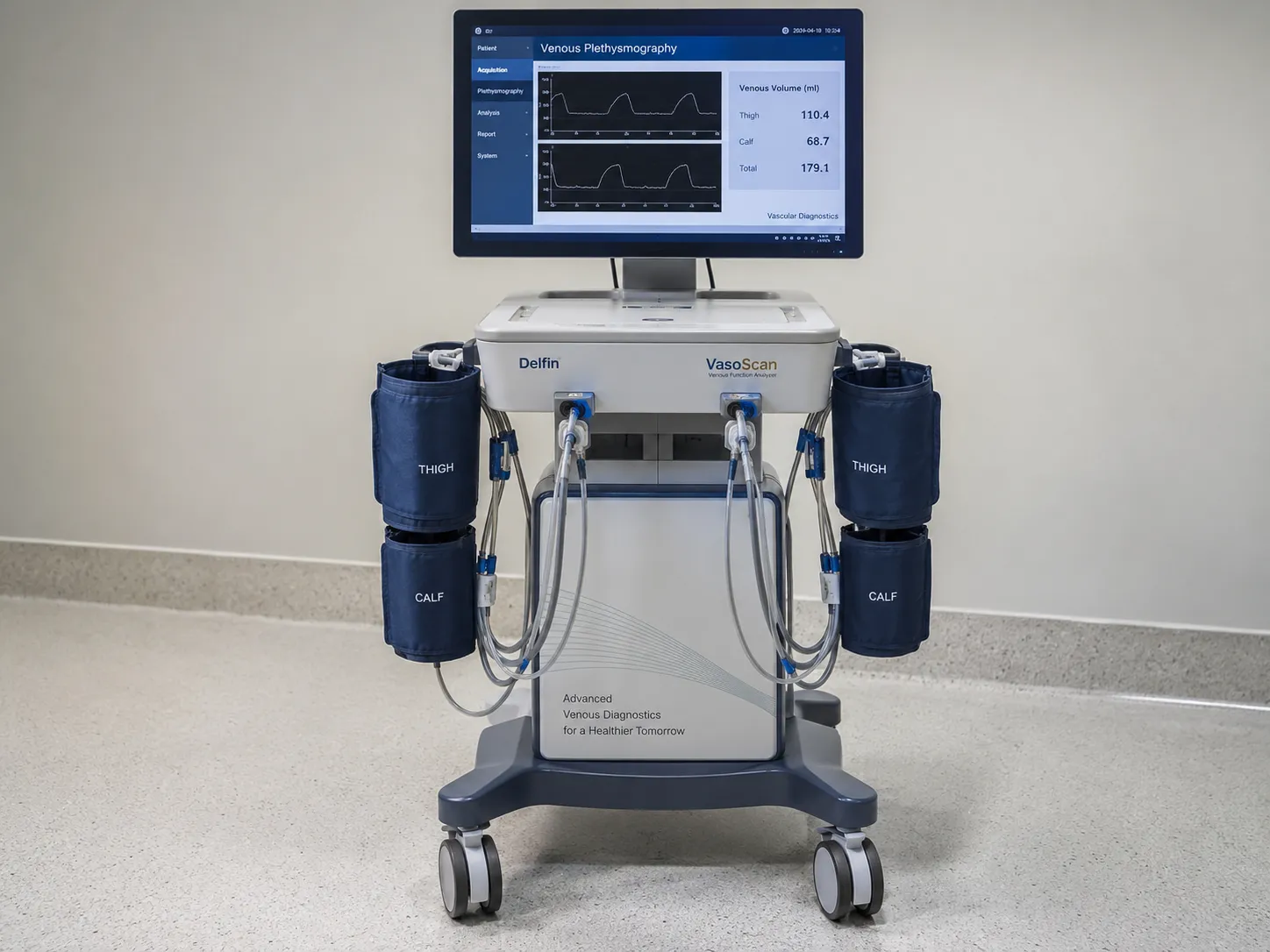
To make a leaky valve reveal itself, the sonographer provokes flow and then watches it reverse. A manual calf or thigh squeeze — and its release — drives blood up the vein and then lets any incompetent valve leak it back down; the Valsalva manoeuvre raises abdominal pressure to test the sapheno-femoral junction; and automated cuff inflation-deflation devices give a standardised, repeatable squeeze that removes some operator variation. The reflux time is measured on the release. A system whose Doppler responds cleanly to these rapid augmentation-and-release events, with fast spectral capture, makes reflux timing far more reliable.
The duplex system a reflux service needs
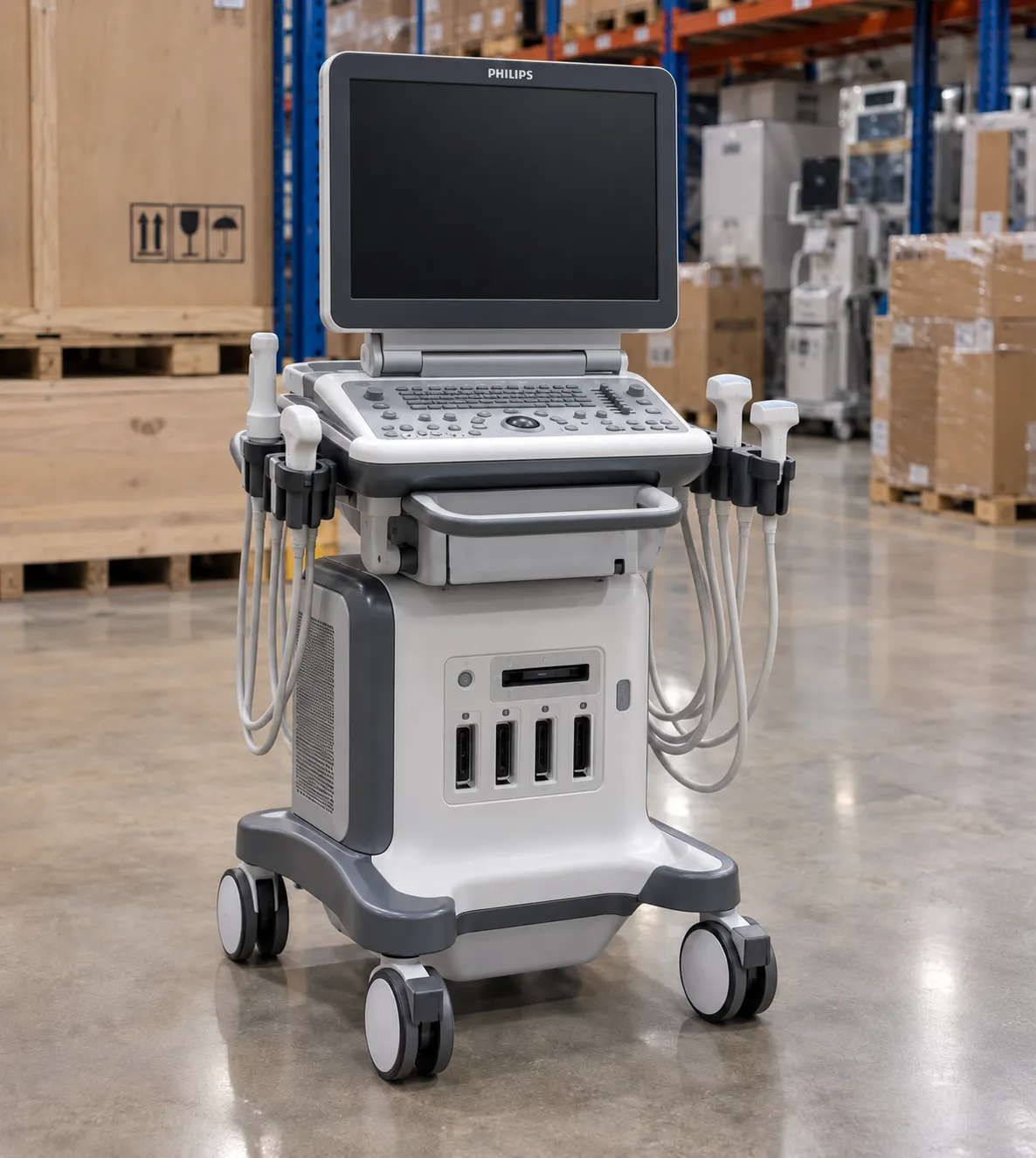
Reflux testing runs on duplex ultrasound, so a high-frequency linear-array transducer, broadly in the 5–12 MHz range, is the mainstay for the superficial leg veins, with a lower-frequency curvilinear probe for deeper or larger limbs. The Doppler must be tuned for slow venous flow — low pulse-repetition frequency and wall filter — and the spectral trace must capture the brief reverse-flow burst accurately for timing. Colour Doppler helps locate reflux quickly; spectral Doppler confirms and times it. Confirm the venous and reflux presets, the transducers included, nd the probe-port count when you specify a machine.
Where reflux testing sits in the pathway
Venous reflux testing is the mapping step before varicose-vein treatment. It tells the surgeon or interventional team which vein is the source, where the incompetent junction is, and whether the deep system is competent enough for superficial treatment to be safe. It is done in vascular labs, dedicated vein clinics and increasingly in day-case and outpatient settings, and it underpins the choice between endovenous ablation, foam sclerotherapy and surgery. NHS pathways for varicose veins route symptomatic patients to duplex assessment, and the care context is set out at nhs.uk. Unlike a general venous duplex for suspected clot, this study exists to plan an intervention.
Standards, marking and safety
The equipment is diagnostic ultrasound, built to the general standard IEC 60601-1 with the ultrasonic particular standard IEC 60601-2-37 governing acoustic output and safety, and it must carry UKCA or CE marking. Any automated cuff used for standardised provocation is an accessory that should also be marked and maintained. Oversight of the reflux-testing device and its field-safety notices lies with the Medicines and Healthcare products Regulatory Agency at mhra.gov.uk. This reflux-testing guide is grounded in supplier documentation, the IEC 60601 series and UK regulatory guidance, and is written with UK procurement and clinical-engineering staff in mind.
Probe care and consumables
Linear and curvilinear probes touch intact skin and need cleaning and low-level disinfection between patients using only the manufacturer's approved agents, since the wrong chemical cracks the lens and voids the warranty. Coupling gel is a steady consumable, nd single-use sachets help control cross-contamination. If you use an automated pressure cuff for provocation, its bladders and tubing are maintainable parts with their own life. Confirm the compatible-disinfectant list before standardising your wipes, and keep a documented cleaning protocol with the machine.
Reporting the reflux map
A reflux study produces a map, not just an image, so reporting is central. The system should let the sonographer record reflux times at each level and produce a clear diagram of which segments are incompetent, exporting it via DICOM to your PACS and vein-service reporting so the treating clinician can plan from it. Structured venous reporting that captures junction competence, saphenous diameters, and reflux times saves re-scanning and makes the treatment plan defensible. Check the reporting workflow and export formats, because a reflux map that will not leave the machine cleanly slows the whole pathway.
Ergonomics and the standing study
Because reflux testing is done with the patient upright, the physical set-up matters more than in a lying scan. The sonographer often works low, reaching around a standing leg, repeatedly through a list, and that is a musculoskeletal risk worth taking seriously. A machine with an adjustable control panel and monitor, a light, well-balanced probe, nd sensible standing-scan presets reduces the strain of a full vein list. Trial the system doing an actual standing reflux study with the sonographers who will run the clinic, because a machine that scans awkwardly upright will slow every case.
Beyond the purchase price
The console is only part of the cost of a reflux-testing capability. Transducers are expensive and fragile, so weigh probe warranty and replacement heavily; budget too for any automated cuff and its consumables, the service contract, software upgrades, gel and cleaning materials. A well-supported refurbished duplex system can stretch capital if it comes with warranty, current software and a service history. Compare whole-life cost and throughput rather than headline price, and use MediGear to weigh suppliers on equal terms.
Vein diameter and planning the intervention
Reflux timing is only half of what a varicose-vein plan needs; vein diameter matters too. The same duplex study measures the diameter of the great and small saphenous veins along their length, because size influences whether endovenous thermal ablation, foam sclerotherapy o, or surgery is the sensible route, and a very large or tortuous vein may steer the decision. Accurate calliper measurement on a clean transverse image is therefore part of the reflux study, and the reporting should capture diameters at defined points alongside the reflux times. A system that makes precise diameter measurement quick and stores it in the structure report ssaves thetreating team a second scan and firms up the treatment plan.
Specifying a reflux-testing system: buyer's checklist
-
A high-frequency linear transducer for superficial leg veins, plus a curvilinear probe for deeper limbs.
-
Slow-flow Doppler with fast, accurate spectral capture for timing reflux on valve release.
-
Dedicated venous and reflux presets, and a setup that supports safe standing scans.
-
Compatibility with an automated provocation cuff if you want standardised, repeatable squeezes.
-
Current UKCA or CE marking on the reflux-testing scanner, with evidence of IEC 60601-2-37 conformance supplied alongside it.
-
Structured venous reporting that records reflux times and exports a reflux map via DICOM.
-
Probe warranty cover, plus the whole-life running cost of the reflux-testing service — taking in service and maintenance, software upgrades and any cuff consumables.
Choosing well for reflux testing
Venous reflux testing is the standing, timed duplex study that maps failed valves before varicose-vein treatment — distinct from a general venous scan in its position, provocation and reflux-time focus. Specify for the reflux protocol: slow-flow Doppler, accurate spectral timing, standing-scan eergonomics nd a reporting workflow that produces a usable map. If you are equipping a vein service, MediGear can help you compare verified suppliers and duplex options side by side.
Disclaimer
This article is for informational purposes only. It is published by MediGear (medigear.uk) for general information and procurement guidance, and is not clinical, diagnostic, treatment, technical, engineering, legal or regulatory advice, nor a product endorsement, guarantee or substitute for professional assessment. MediGear does not provide medical consultations. Buyers should consult their clinical, biomedical, estates and regulatory contacts, and the manufacturer's documentation, and independently verify all specifications, certifications, compatibility and suitability before purchase. Specifications, certifications and availability are correct at the time of publication and may change without notice. MediGear is a medical-equipment distributor and does not sell medicines or pharmaceutical products.