The ankle-brachial index is a simple ratio that compares the blood pressure at the ankle with the blood pressure at the arm, and it is the standard first-line test for peripheral arterial disease. Divide the higher ankle systolic pressure by the higher arm systolic pressure, and you get a single number: around 1.0 is normal, below 0.9 points to arterial narrowing, and a very high value can signal stiff, incompressible vessels.
For a buyer,r the key thing is that the ankle-brachial index is a method, not a machine. It is a measurement performed with a blood-pressure cuff and a way of detecting flow — classically a handheld Doppler — and what you are actually procuring is the kit and, increasingly, the automation that makes the test fast, consistent and easy to document.
How the test is performed step by step
The manual reference method is deliberate. The patient rests flat for several minutes, then an appropriately sized cuff and a Doppler probe are used to record the systolic pressure at both arms and at the dorsalis pedis and posterior tibial arteries of each ankle. The cuff is inflated until the Doppler signal disappears and slowly released; the pressure at which flow returns is the systolic reading. The highest ankle pressure for each leg is divided by the highest arm pressure to give that leg's index. Rest, cuff size and consistent technique all shape the result, which is why the test rewards trained, repeatable practice.
Interpreting the numbers
The ratio is read against recognised bands rather than a single cut-off. A value between roughly 0.9 and 1.3 is generally taken as normal; below 0.9 suggests peripheral arterial disease, with lower values indicating more severe narrowing; and a value above about 1.3 or 1.4 suggests the vessels are calcified and incompressible, common in diabetes and renal disease, where the reading is unreliable and further assessment is needed. Interpretation is a clinical matter, and clinicians follow guidance such as that from the National Institute for Health and Care Excellence at nice.org.uk; the procurement point is that your equipment must let staff capture the pressures accurately enough to place a patient in the right band.
Doppler method versus automated ABI systems
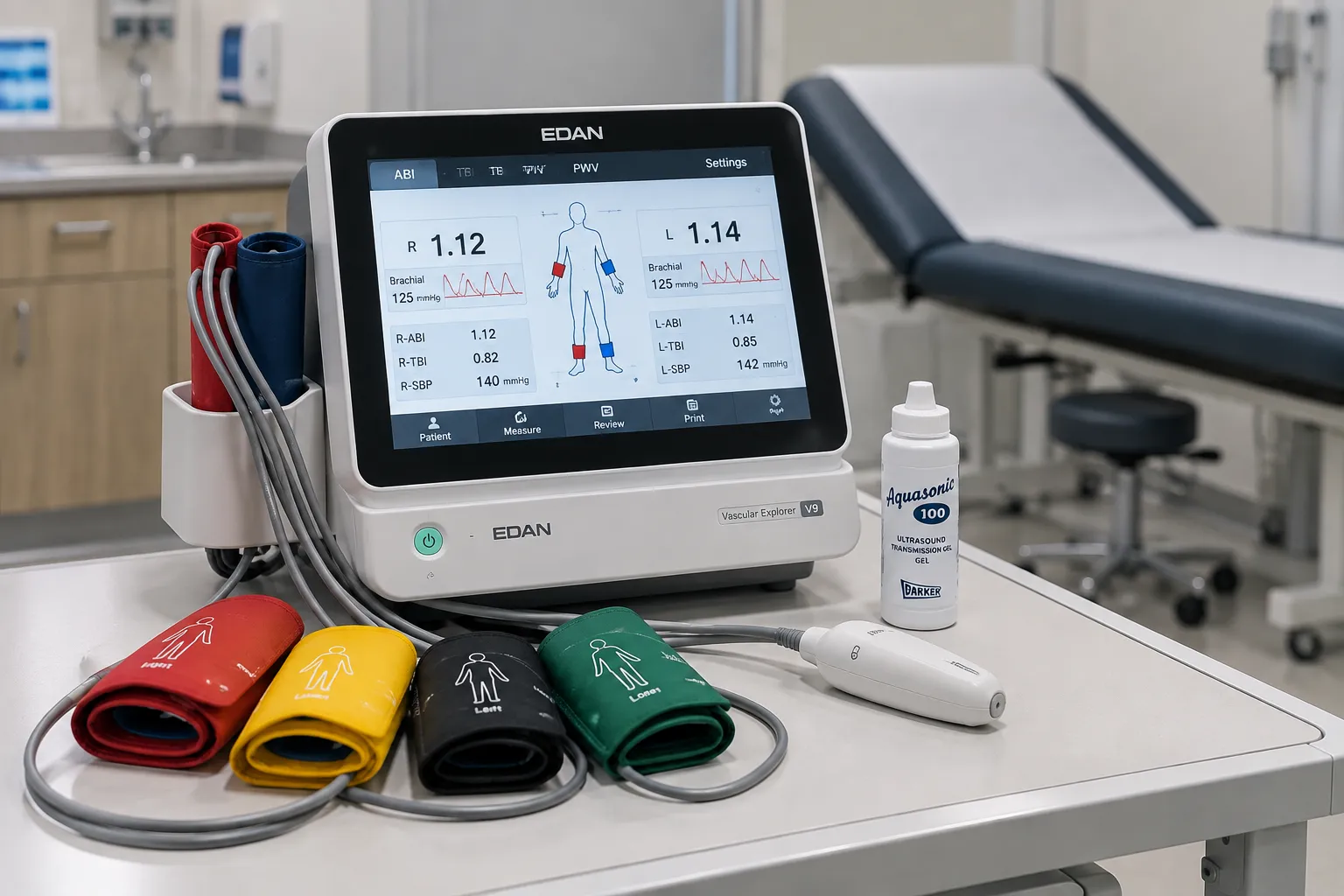
How the test is diagnosed now has shifted. The Doppler method remains the reference and needs only a sphygmomanometer, cuffs and a handheld vascular Doppler, giving full control at low cost but taking time and skill. Automated ankle-brachial index systems place cuffs on all four limbs, inflate them together, and compute the index electronically, often using oscillometric or plethysmographic sensing instead of a Doppler probe. They cut the test to a few minutes and remove operator variation, at a higher purchase price. Which suits you depends on volume: a busy diabetic-foot or vascular clinic may justify automation, while an occasional user may do better with the Doppler method.
The cuffs are the heart of the kit.
Whichever method you choose, cuff quality and range decide the accuracy. You need a correct range of cuff sizes — small, standard and large adult, and often a thigh cuff — because a cuff that is too small over-reads and a cuff too large under-reads, corrupting the ratio. For automated systems,s the four-limb cuff set is a recurring consumable and a real cost over the device life. Confirm the sizes supplied, the cost of replacements, and whether cuffs are reusable, le wipe-clean, or single-patient, before you commit.
Standards behind the measurement
An automated ankle brachial index system is, at heart, a non-invasive blood-pressure device, so the relevant particular standard is IEC 80601-2-30, which governs automated non-invasive sphygmomanometers, sitting under the general medical electrical standard IEC 60601-1. If the test is taken with a handheld Doppler instead, that probe is diagnostic ultrasound equipment built to IEC 60601-2-37. Any device must carry UKCA or CE marking, and device regulation and safety notices sit with the Medicines and Healthcare products Regulatory Agency at mhra.gov.uk. This guide draws on manufacturer documentation, UK clinical guidance and the relevant IEC standards, and is written for UK procurement teams rather than patients.
Where ABI testing happens
The test runs well beyond the vascular lab. GP practices and community nursing teams use it in leg-ulcer assessment to check that compression bandaging is safe before it is applied; diabetic-foot services use it to screen for silent arterial disease; and vascular clinics use it as the gateway to imaging. Because it is portable and inexpensive in its Doppler form, the ankle-brachial index has become a routine primary-care and community measurement, which is why the choice between a portable Doppler kit and a clinic-based automated system depends heavily on where your staff actually work.
Calibration, verification and upkeep
An automated system computes a clinical number from a pressure sensor, so that sensor must be verified and calibrated on the manufacturer's schedule — typically an annual check by your biomedical engineering team or the supplier — and the calibration certificate kept for audit. A manual aneroid sphygmomanometer also drifts and needs periodic verification against a reference. Budget for this ongoing calibration as part of the running cost, because an uncalibrated device quietly produces the wrong index and undermines every decision that follows.
Reporting, records and connectivity
An ankle-brachial index result is a documented number that follows the patient, so how it leaves the device matters. Automated systems often print a report with the four-limb pressures, both indices and the waveform, and better units export to the patient record or a vascular reporting system. For manual testing, the operator records the pressures and the calculated ratio in the notes. If your service screens at volume, a system that stores and exports results saves transcription errors and makes serial comparison straightforward, so check the output formats before you buy.
Common pitfalls that skew the result
The ankle-brachial index is only as good as the technique. Too little rest before the test, a wrongly sized cuff, an anxious patient, or a rushed inflation all shift the number. Calcified, incompressible arteries produce a falsely high index that can mask real disease, which is why a high reading prompts a toe-pressure or waveform assessment rather than reassurance. Automation removes some operator variation but cannot fix a poorly applied cuff or an unrested patient. Training and a written protocol matter as much as the hardware, and any kit you buy should support — not shortcut — good practice.
Beyond the purchase price
Costing an ankle-brachial index capability means looking past the box. A Doppler-method kit is cheap to buy but consumes staff time on every test; an automated system costs more upfront but is faster and more consistent at volume. Either way, budget for replacement cuffs, coupling gel, printer paper, annual calibration, and eventual battery replacement. When you weigh a low-cost Doppler kit against a clinic system, compare whole-life cost and throughput, and use MediGear to compare suppliers on equal terms rather than headline price.
Specifying ABI equipment: buyer's checklist
-
A full range of correctly sized cuffs — small, standard, large adult and thigh — with replacement cost confirmed.
-
Method fit: a handheld Doppler kit for portable, low-volume use, or an automated four-limb system for busy clinics.
-
Conformance to IEC 80601-2-30 for automated systems, or IEC 60601-2-37 for the Doppler probe, with current UKCA or CE marking.
-
A defined calibration and verification schedule and the cost of keeping it up.
-
Report output — printed and electronic — that exports both indices and the limb pressures into your records.
-
Coupling gel, printer paper and battery costs across the device life.
-
Waveform or toe-pressure capability if you assess patients with likely calcified vessels.
Choosing the right ABI setup
The ankle-brachial index remains the accessible front door to diagnosing peripheral arterial disease, and how you equip for it should follow how and how often your staff test. Buy the Doppler method for portable, low-volume, low-cost work; buy an automated system for speed and consistency at scale; and in both cases, mind the cuffs, the calibration, and the reporting. If you are equipping a practice, community team,m or vascular clinic, MediGear can help you compare options and suppliers side by side.
Disclaimer
This article is for informational purposes only. It is published by MediGear (medigear.uk) for general information and procurement guidance, and is not clinical, diagnostic, treatment, technical, engineering, legal or regulatory advice, nor a product endorsement, guarantee or substitute for professional assessment. MediGear does not provide medical consultations. Buyers should consult their clinical, biomedical, estates and regulatory contacts, and the manufacturer's documentation, and independently verify all specifications, certifications, compatibility and suitability before purchase. Specifications, certifications and availability are correct at the time of publication and may change without notice. MediGear is a medical-equipment distributor and does not sell medicines or pharmaceutical products.