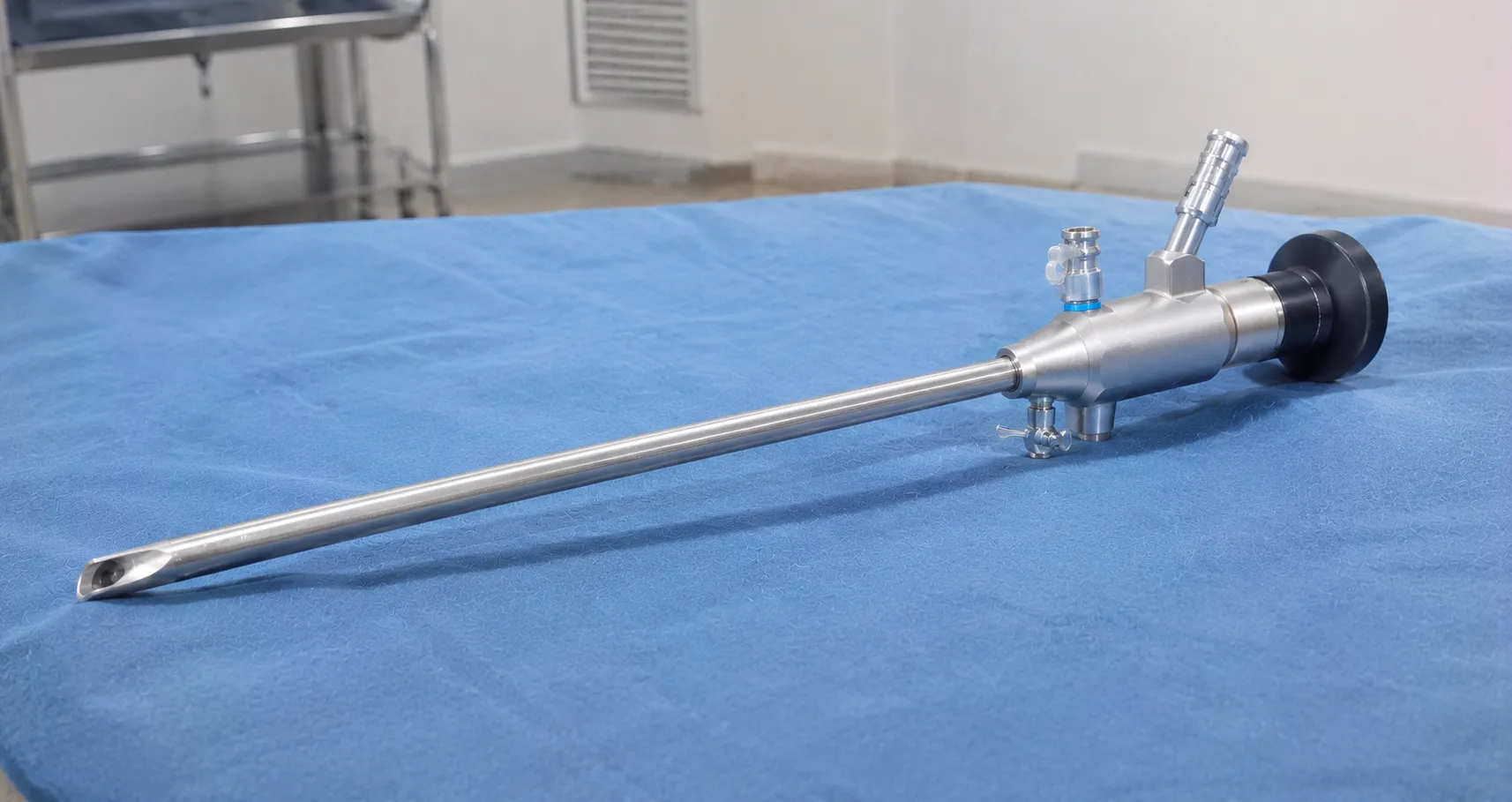
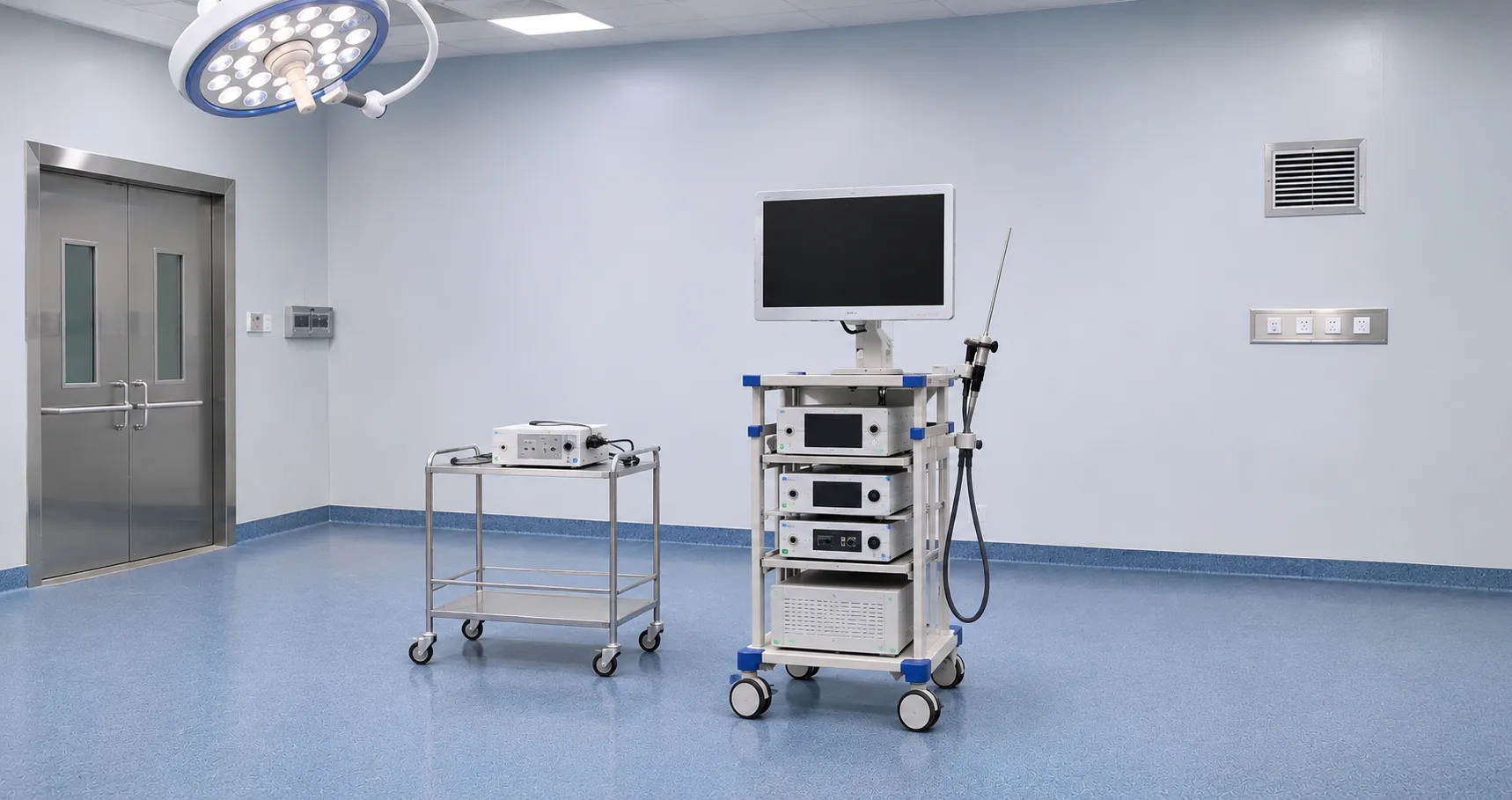
An arthroscope system is a rigid endoscopic instrument set that lets a surgeon see inside a joint through a small portal, projecting a magnified image of cartilage, ligaments and synovium onto a monitor. The core of the system is a rigid rod-lens telescope, a light source and cable, a camera head and processor, and a fluid-management pump that distends the joint so the anatomy can be examined and treated. Sold together, these parts form the visualisation chain that every arthroscopic procedure depends on.
For a procurement lead the question is rarely “which scope” in isolation. It is how the scope, camera, light source, pump and instruments work as a matched stack, and how that stack will be cleaned, sterilised, serviced and paid for over its working life. Get the chain right and the theatre runs; get one link wrong and the whole list slows.
How the measurement and imaging principle works
A rigid arthroscope uses a Hopkins rod-lens design: glass rods separated by thin air gaps carry the image along the shaft with high light transmission and resolution, far brighter than the older thin-lens telescopes they replaced. Light travels the other way, from a cold light source through fibre-optic bundles in the cable and around the telescope, illuminating the joint without carrying heat into it. The camera head clamps to the eyepiece and converts the optical image into a video signal the processor renders on screen.
The joint itself must be distended for any of this to be useful. A fluid pump circulates sterile irrigation, usually saline, to open the potential space, wash away debris and blood, and keep the field clear. Pressure and flow are controlled so the surgeon sees a clean, stable image rather than a collapsing, bloody one. Image quality is therefore a product of optics, illumination and irrigation together, not the telescope alone.
Scope variants and how they compare
Viewing angle
Arthroscopes are specified by their angle of view. A 30-degree forward-oblique scope is the general workhorse for the knee and shoulder; rotating it sweeps the field and reaches around structures. A 0-degree scope looks straight ahead and suits simple diagnostic passes. A 70-degree scope sees far to the side and helps in the hip and in tight recesses a 30-degree scope cannot reach.
Diameter and joint size
Diameter follows the joint. A 4 mm telescope is standard for the knee, shoulder and hip. Small-joint arthroscopes of roughly 1.9 to 2.7 mm are made for the wrist, elbow, ankle and other small joints, where a 4 mm scope simply will not fit. Matching diameter to caseload avoids buying optics that never leave the tray.
Autoclavable versus fluid-tight
Most modern rigid arthroscopes are fully autoclavable and sealed against fluid ingress. Confirm both, because a scope that cannot take steam or that fogs from a failed seal becomes a recurring repair line rather than a working instrument.
Key specifications a buyer must check
Look beyond angle and diameter. Check the working length, the optical field of view and depth of field, and the light-transmission quality of the rod-lens train. On the camera, resolution matters: high-definition is now the baseline and 4K is common, so confirm the camera, processor, cables and monitor all support the same resolution end to end — a 4K camera on a high-definition monitor wastes the investment. Verify the light source type; LED sources run cooler and last far longer than xenon lamps and remove lamp-replacement costs. Confirm the pump gives independent pressure and flow control and integrates with the console you are buying.
Standards, regulation and documentation
An arthroscope system is a medical device and must carry valid UKCA or CE marking with instructions for use that state the intended purpose and the validated reprocessing method. Electrical safety for the camera console, light source and pump is governed by the IEC 60601-1 family, with IEC 60601-1-2 covering electromagnetic compatibility so the stack does not interfere with, or suffer interference from, other theatre equipment. Ask the supplier for the declaration of conformity and confirm the device is registered for the Great Britain market. The MHRA is the UK regulator and the route for reporting device safety incidents, with wider guidance on GOV.UK. Keep the instructions for use on file; they define the only validated way to clean and sterilise that particular scope.
Decontamination, calibration and maintenance
Rigid arthroscopes are reused and must be decontaminated to a validated cycle: manual or automated cleaning to remove all soil, inspection, then sterilisation, usually by steam autoclave for autoclavable optics. Fibre-optic light cables and camera heads have their own reprocessing rules — some camera heads are soaked or sterilised, others use sterile drapes — so follow each item’s instructions rather than assuming one method covers the set. There is no clinical calibration of the optics as such, but cameras need white balance before each case and benefit from periodic image checks. Build in routine inspection for chipped rod lenses, delaminated fibres and worn seals, because a scope degrades gradually and image loss is easy to miss until it is severe.
Use across care settings
Large orthopaedic theatres run high-volume knee and shoulder lists and justify duplicate scope stacks so a scope out for repair never cancels a list. A day-surgery unit doing mainly diagnostic and minor procedures may run a single well-specified 30-degree stack. Hand and foot units need the small-joint scopes. Veterinary orthopaedic practices use arthroscopy too, on similar principles but different anatomy. Define the setting and caseload first, then size the number of scopes, cameras and instrument sets to the list rather than to a brochure.
Consumables, spares and total cost of ownership
The scope is a durable asset; the running cost sits elsewhere. Budget for irrigation fluid and tubing sets, shaver and burr blades if you run a motorised system, disposable cannulas and any single-use accessories, plus sterile drapes and camera covers. Rigid optics are the most repair-prone item in the chain, so a realistic repair budget or a service contract matters. Ask about warranty length on the telescope, camera and light source separately, lamp life or LED life, loan-scope cover during repairs, and the price and lead time of spare cables and light guides. Our team can help you cost a full stack against your list volume — register as a buyer or contact us to compare configurations.
Procurement checklist
-
Match viewing angle (0, 30 or 70 degrees) and diameter to the joints your surgeons actually operate on.
-
Confirm the camera, processor, cable and monitor all support the same resolution end to end.
-
Check the scope is fully autoclavable and sealed against fluid ingress.
-
Verify the light source is LED where possible and cost any lamp replacement if it is xenon.
-
Confirm the pump offers independent pressure and flow control and integrates with the console.
-
Request UKCA or CE documentation, IEC 60601 compliance and the validated reprocessing instructions.
-
Agree warranty terms, loan-scope cover during repair, and spare cable and light-guide pricing.
Conclusion
An arthroscope purchase is really the purchase of a matched visualisation chain: scope, camera, light source, pump and instruments that must work together and be reprocessed reliably between cases. Fix the viewing angles and diameters to your caseload, keep resolution consistent along the chain, confirm the regulatory paperwork, and cost the consumables and repairs honestly. MediGear can assemble suitable options so you buy a stack your theatre team trusts, not a set of parts that fight each other.
Disclaimer
This article is for informational purposes only. It is published by MediGear (medigear.uk) for general information and procurement guidance, and is not clinical, diagnostic, treatment, technical, engineering, legal or regulatory advice, nor a product endorsement, guarantee or substitute for professional assessment. MediGear does not provide medical consultations. Buyers should consult their clinical, biomedical, estates and regulatory contacts, and the manufacturer's documentation, and independently verify all specifications, certifications, compatibility and suitability before purchase. Specifications, certifications and availability are correct at the time of publication and may change without notice. MediGear is a medical-equipment distributor and does not sell medicines or pharmaceutical products.