

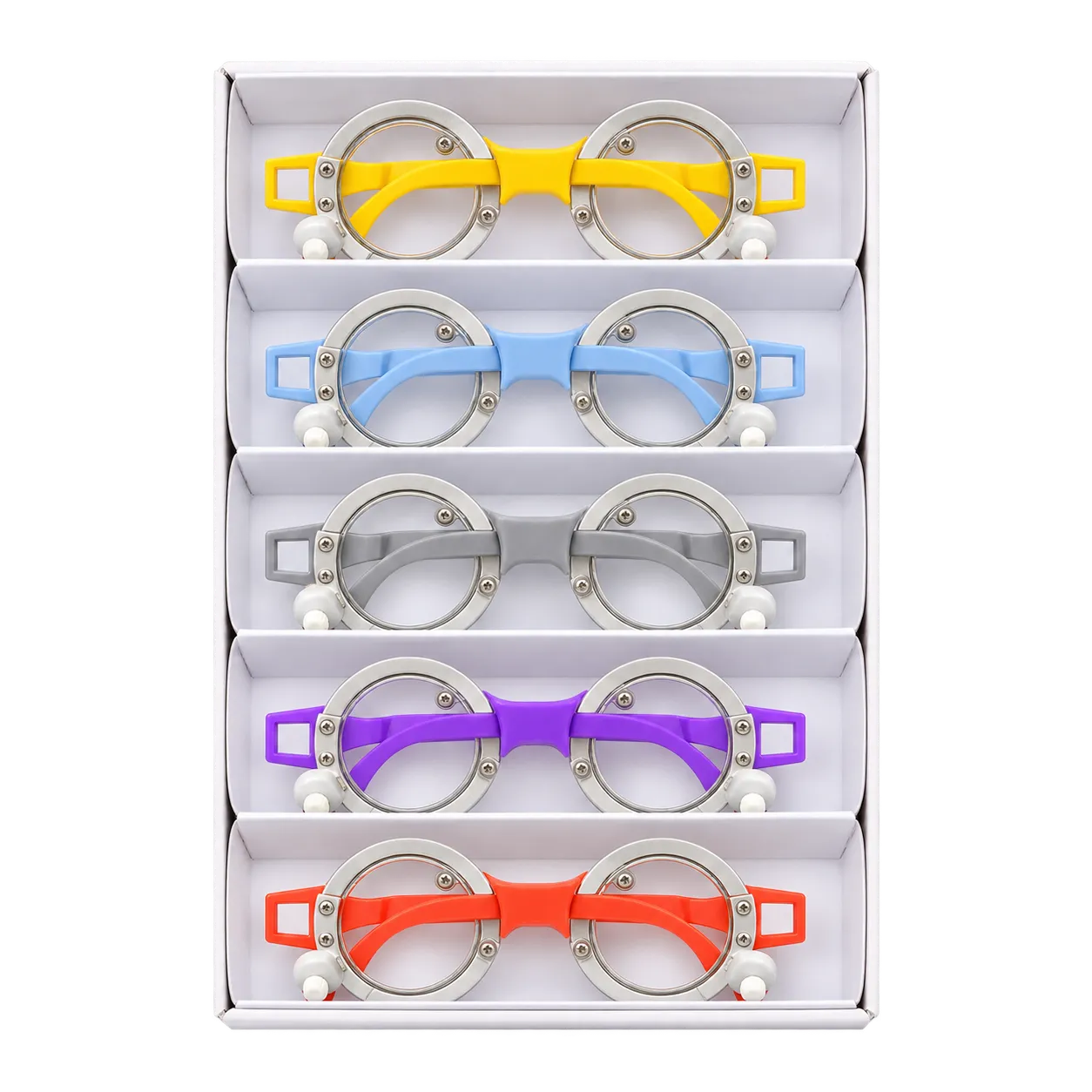


Vision screening is the natural home. Screening programmes refract many people quickly against a standard protocol, and a set of fixed frames removes the per-patient setup that adjustable frames require.
Occupational health assessments suit the same pattern, with repeated standardised testing where speed matters and prescriptions are usually moderate.
High-volume clinics gain from the removal of a recurring error, since a fixed frame cannot be left at the previous patient's spacing.
Teaching clinics can use a boxed set to demonstrate the effect of decentration directly, by showing what happens when a patient is fitted to the nearer size.
Second sets suit practices that already own an adjustable frame, giving a quick option for straightforward cases and reserving the adjustable one for complex or high prescriptions.
Domiciliary work can carry two or three sizes rather than a full set, since the frames are light and need no setting up on arrival.
High prescriptions are better refracted in an adjustable frame, where centration can be set exactly rather than approximated.
Paediatric refraction falls outside this set entirely, since the smallest size is 58 mm.