
Low vision clinics are the setting where a full aperture matters most. Patients with macular degeneration and other central field loss often view eccentrically, and a trial frame with 36.5 mm lenses lets them adopt their preferred viewing position while the practitioner refines the correction. Published work on new low-vision patients found that refraction improved acuity by two lines or more in about one in nine, which makes a careful trial frame refraction worth the time.
Hospital eye services use trial frame refraction for patients who cannot sit comfortably at a phoropter, including wheelchair users, patients with limited neck movement and those recovering from surgery. A wide clear zone helps them keep a usable view while seated in an unusual posture.
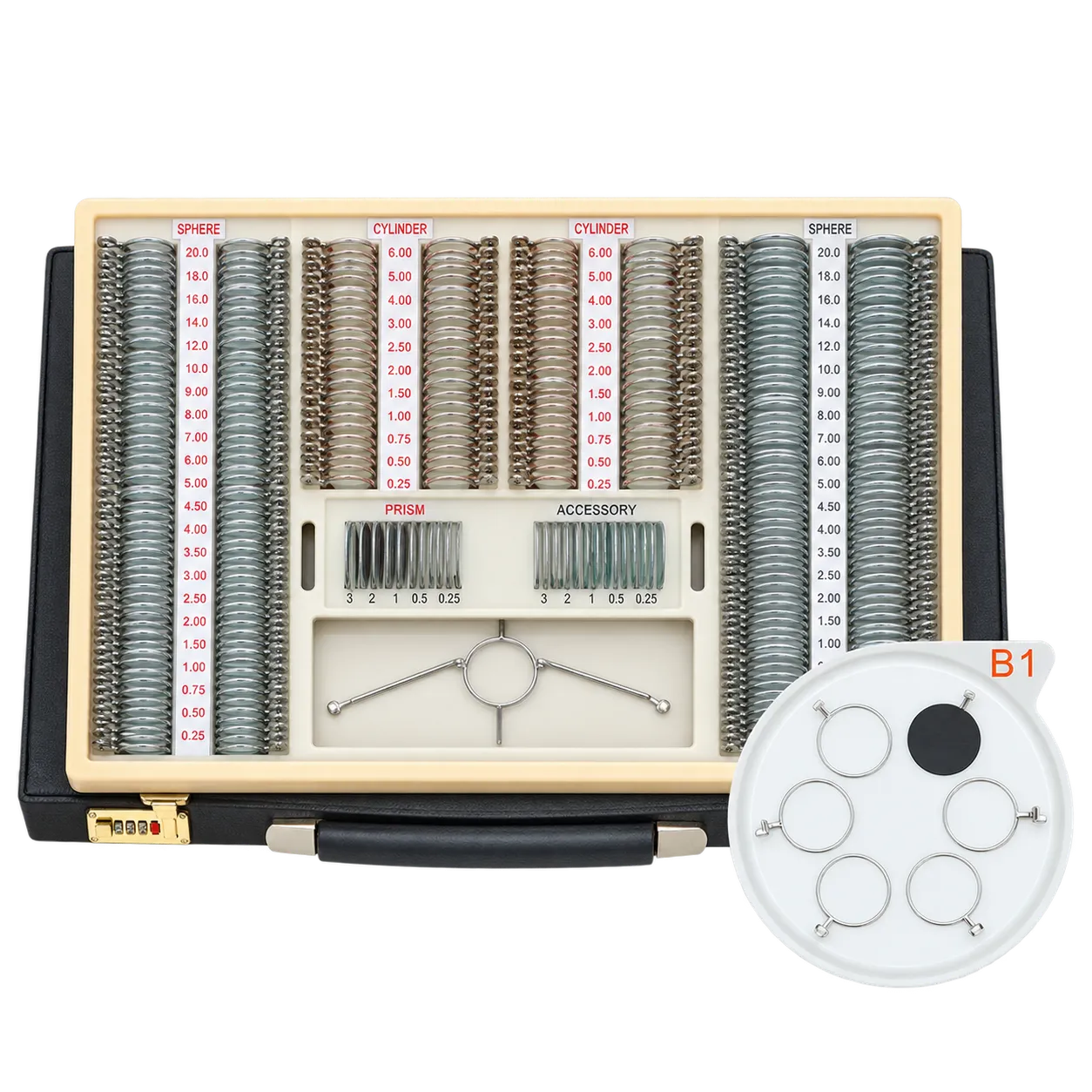
Community optometry practices use a full-aperture set for final checks in a trial frame, and for letting a patient walk around, read a page and look at a distant sign in the proposed correction before it is dispensed. Paired sphere and cylinder powers let both eyes carry identical lenses during binocular balancing.
Orthoptic and binocular vision clinics draw on the whole-value prism ladder from 1 to 10 and the paired white Maddox rods. Engraved prism base marks keep orientation readable through repeated handling.
Teaching clinics can use the set to show students how aperture and posture affect a patient's responses.
Two situations suit it less well: domiciliary rounds on foot, given the listed 7.5 kg, and practitioners who rely on ±0.12 D lenses. Institutional buyers commonly ask for evidence of conformity. The conformity documentation those procurement routes require is issued by the manufacturer and provided by the seller.