
Introduction
Most babies breathe on their own at birth. Still, a small number need help, sometimes urgently and without warning, so neonatal resuscitation equipment must be ready and working at every delivery. The equipment is designed around a newborn's specific needs: keeping the baby warm, supporting the first breaths gently and at controlled pressure, clearing the airway, and delivering the right amount of oxygen. Because there is no time to gather equipment when a baby needs help, readiness and reliability define this area.
Equipping for neonatal resuscitation spans the resuscitation unit that brings warmth and breathing support together, the T-piece resuscitators and bags used to support breathing, the neonatal airway and suction equipment, oxygen blending, and the monitoring that guides the team. This neonatal resuscitation equipment buyer guide sets out what each area needs, why readiness is central, and the standards and traceability questions to settle early. It is written for neonatal and maternity teams, resuscitation leads and procurement across the UK, Europe, the US, the Gulf and South Africa.
What a neonatal resuscitation service needs — the short version
-
A neonatal resuscitation unit that combines a radiant warmer with breathing support.
-
T-piece resuscitators, bags and masks to support the newborn's breathing.
-
Neonatal airway, suction, oxygen blending and monitoring, always ready to use.
Start with the resuscitation unit.
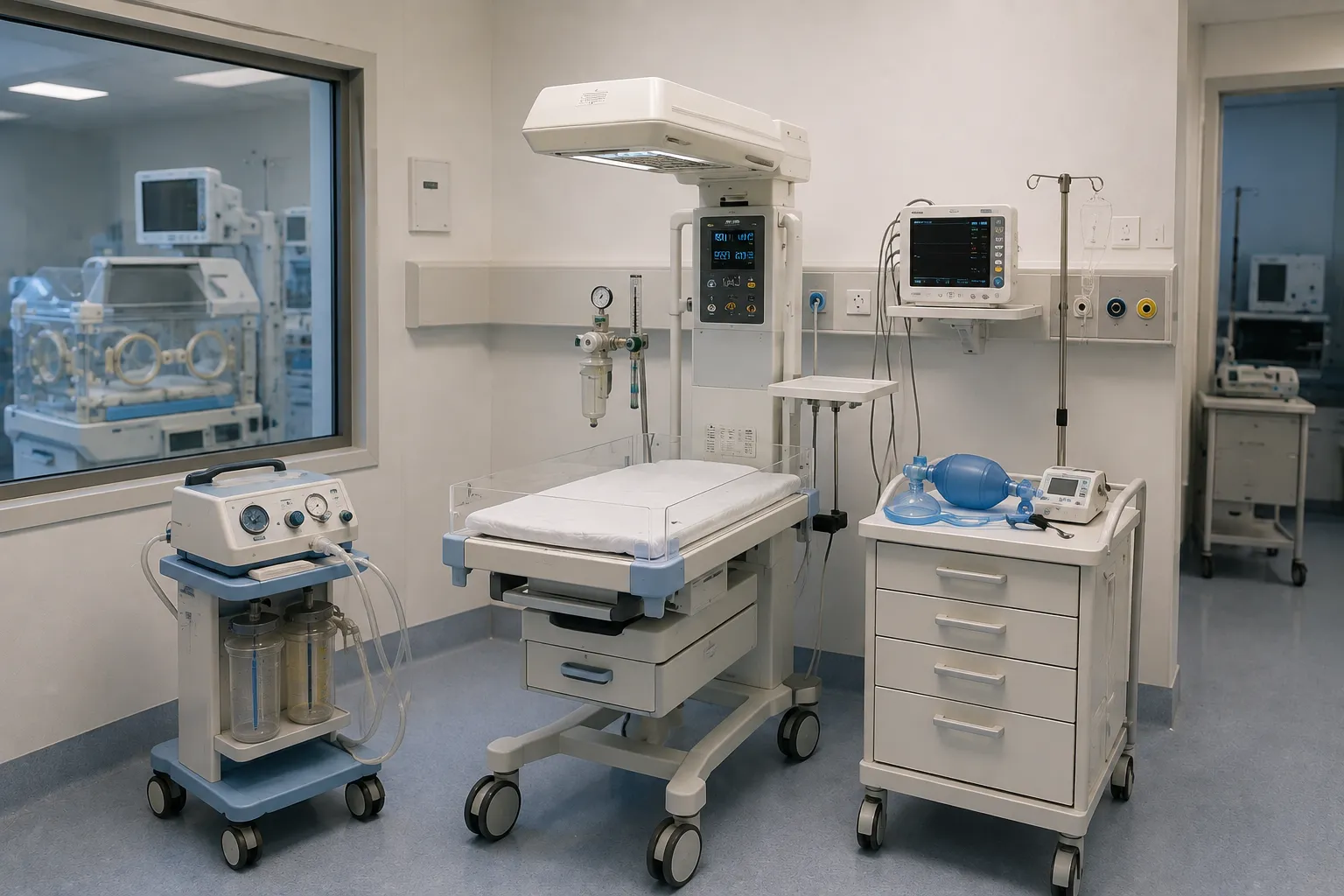
The centrepiece is the neonatal resuscitation unit, which brings the essentials together in one place at the point of birth. A radiant warmer keeps the baby warm, since newborns lose heat quickly and cold is dangerous, while an integrated T-piece resuscitator supports breathing with controlled pressure. Suction, oxygen, a timer and space to work are built in, so the team has everything to hand in the first critical minutes. This unit is specified first because it defines how resuscitation is delivered.
Around the unit sit the airway and breathing equipment that must be present and checked before every birth. T-piece resuscitators or self-inflating bags with correctly sized masks support the newborn's breathing; neonatal laryngoscopes and airway equipment are ready for babies who need more; and an air and oxygen blend, guided by pulse oximetry, allows carefully controlled oxygen. Because a resuscitation cannot wait, all of this is kept ready, checked and restocked so it works the moment it is needed.
What neonatal resuscitation needs
-
Neonatal resuscitation unit. A radiant warmer with integrated breathing support.
-
T-piece resuscitator. Controlled-pressure support for the newborn's first breaths.
-
Bags and masks. Self-inflating bags and correctly sized neonatal masks.
-
Neonatal airway. Laryngoscopes and airway equipment sized for newborns.
-
Suction. Equipment to clear the airway quickly and gently.
-
Air and oxygen blending. Controlled oxygen delivery guided by monitoring.
-
Pulse oximetry—neonatal monitoring to guide oxygen and assess response.
-
Warming and drying. Measures to keep the newborn warm throughout.
The equipment checklist
|
Equipment |
Role at birth |
Key selection point |
|
Resuscitation unit |
Warmth and breathing support |
Integration; readiness; layout |
|
T-piece resuscitator |
Controlled-pressure breaths |
Pressure control; reliability |
|
Bags and masks |
Backup breathing support |
Sizing; seal; availability |
|
Neonatal airway |
Advanced airway support |
Sizing; readiness |
|
Oxygen blending |
Controlled oxygen |
Accuracy; oximetry link |
|
Pulse oximeter |
Guiding the team |
Neonatal probe; fast reading |
At the moment of birth
Neonatal resuscitation is defined by its timing: help may be needed within seconds of birth, so everything must be ready before the baby arrives. Keeping the newborn warm comes first, because heat loss is rapid and harmful, and gentle, controlled support of the first breaths follows. The resuscitation unit brings these together so the team is not searching for equipment in a moment that allows no delay. This is why checking and preparing the equipment before every birth is as important as the equipment itself.
Airway, oxygen and monitoring
Supporting a newborn's breathing calls for equipment matched to their size and physiology. Correctly sized masks, bags or T-piece resuscitators, and neonatal airway equipment must all be present and ready, because adult equipment is not a substitute. Oxygen is given carefully rather than freely, guided by pulse oximetry, since both too little and too much can harm a newborn. The Resuscitation Council UK provides resuscitation guidance in the UK, and equipment is planned to support current practice.
Compliance and documentation
Neonatal resuscitation equipment must be genuine, current and fully documented, and readiness depends on regular checks. In the UK, the MHRA regulates medical devices, and NICE publishes clinical guidance. Requirements vary by country and market, so confirm current obligations with the relevant authorities before you buy.
Support keeps neonatal resuscitation ready.
-
Installation, commissioning and familiarisation for resuscitation units.
-
Preventive maintenance and safety checks that keep equipment ready to use.
-
Reliable supply of masks, airway equipment, suction and consumables.
-
Rapid technical response, because resuscitation equipment cannot be out of action.
-
Clear documentation and traceability for equipment and safety checks.
More from Business
-
Buyers — source compliant, fully documented equipment.
-
Suppliers — list your equipment and reach buyers worldwide.
-
Advertise — promote your products and services to a clinical audience.
-
Business overview — explore everything MediGear offers healthcare organisations.
Disclaimer
This article is for general information only. It does not constitute clinical, procurement, legal or regulatory advice. Equipment requirements for neonatal resuscitation vary by service, setting, facility, country and market, and change over time. Resuscitation requires trained staff and current protocols. Always confirm current requirements with the relevant authorities, and consult qualified clinical, neonatal, biomedical engineering, procurement and regulatory professionals for decisions specific to your organisation. medigear.uk accepts no liability for actions taken based on this content.
"Ready at every birth." A neonatal resuscitation service equipped and prepared.
We supply medical equipment to healthcare organisations across the UK, Europe, the US, the Gulf and South Africa. Everything is genuine, documented and supported, so newborn resuscitation is ready whenever it is needed.
Frequently Asked Questions
Neonatal resuscitation needs a resuscitation unit that combines a radiant warmer with integrated breathing support, T-piece resuscitators and self-inflating bags with correctly sized masks, and neonatal airway and suction equipment. It also needs air and oxygen blending for controlled oxygen, neonatal pulse oximetry to guide the team, and warming and drying measures — all kept ready and checked before every birth.
A neonatal resuscitation unit brings the essentials together at the point of birth. A radiant warmer keeps the baby warm, an integrated T-piece resuscitator supports breathing at controlled pressure, and suction, oxygen, a timer and workspace are built in. This means the team has everything to hand in the first critical minutes, which is why the unit is central to how resuscitation is delivered.
Newborns lose heat quickly, and becoming cold is dangerous, so keeping the baby warm is a priority. Radiant warmers on the resuscitation unit, together with drying and warming measures, maintain the baby's temperature while the team works. Warmth is managed alongside breathing support from the very first moments, which is why it is built into the resuscitation unit.
For a newborn, both too little and too much oxygen can be harmful, so oxygen is given carefully rather than freely. Air and oxygen blending allows a controlled mix, and pulse oximetry guides the team on how much is needed. Equipment is planned to support this careful approach, in line with current resuscitation guidance from the Resuscitation Council UK.
Yes. Equipment should be genuine, current and traceable, and readiness depends on regular checks before every birth. In the UK, the MHRA regulates devices, and NICE provides clinical guidance. Requirements vary by country and market, so confirm current obligations with the relevant authorities before purchasing.
Yes. MediGear supplies medical equipment to healthcare organisations across the UK, Europe, the US, the Gulf and South Africa. As a distributor,, we provide genuine, documente,d and supported equipment, from resuscitation units and T-piece resuscitators to neonatal airway, suction, oxygen blendin,g and monitoring. Requirements differ by service and market, so we work with your team to match equipment to your service and its regulatory setting.