
Introduction
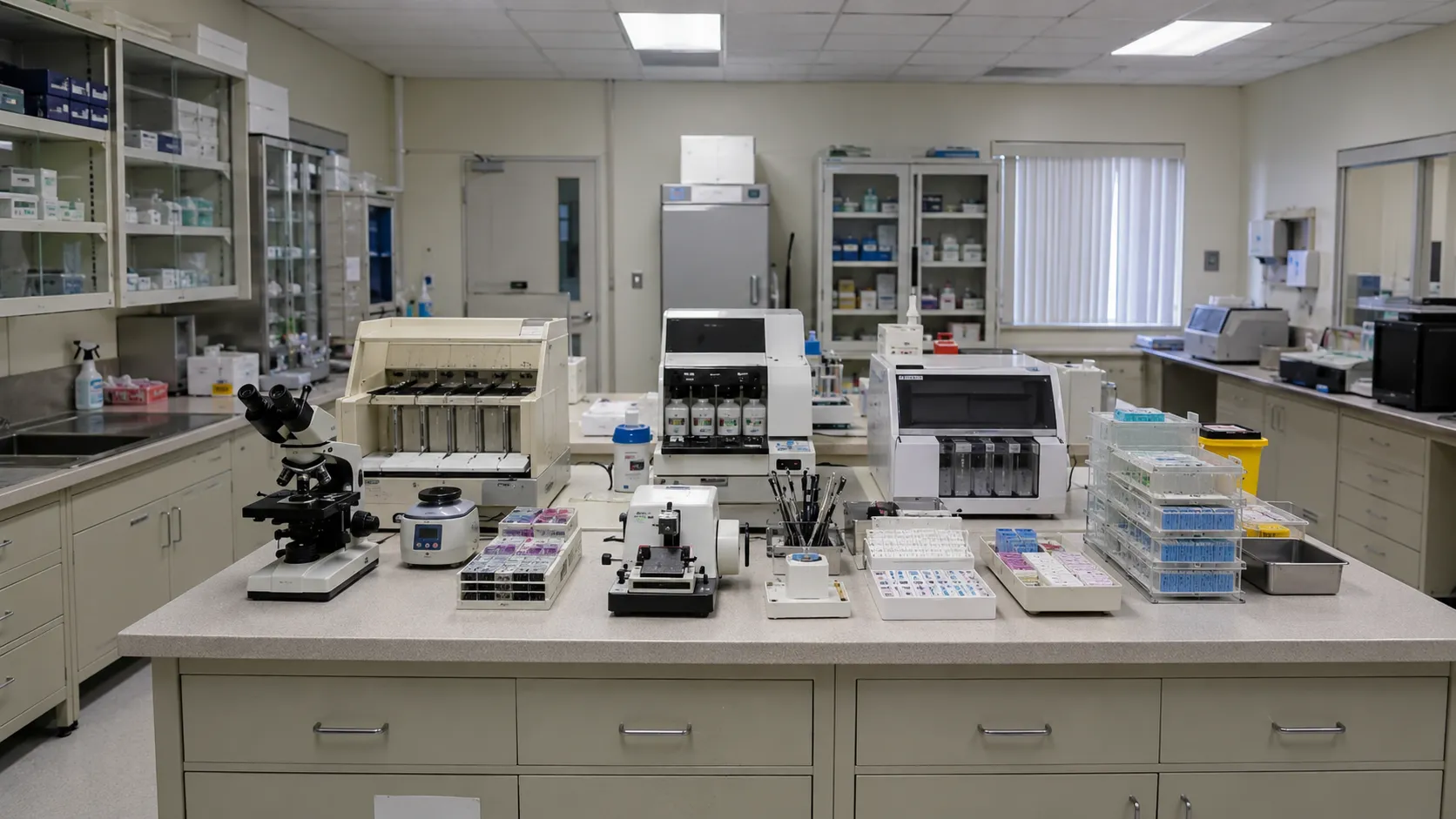
The hospital pathology laboratory is the engine room of diagnosis, running the huge volume of tests clinicians across the hospital depend on—from routine blood chemistry and full blood counts to tissue analysis in histology. It brings several disciplines together in one core service, often working around the clock, so its defining requirements are throughput, reliability and a smooth flow of samples from arrival to result. Increasingly, automation links analysers together to handle volume efficiently, and everything connects to the laboratory information system.
Equipping a hospital pathology laboratory spans the core analysers for clinical chemistry and haematology, the track automation and sample-handling that move work through the lab, the histology and specimen processing for tissue, and the integration that ties it all to the patient record. This hospital pathology lab equipment buyer guide sets out what each area needs, why throughput and integration are central, and the accreditation and traceability questions to settle early. It is written for laboratory managers, biomedical scientists, pathologists and procurement across the UK, Europe, the US, the Gulf and South Africa.
What a hospital pathology lab needs — the short version
-
Core analysers for clinical chemistry and haematology at volume.
-
Track automation and sample handling to move work through the lab efficiently.
-
Histology and specimen processing, with integration to the laboratory information system.
Start with the core analysers and throughput.
A pathology laboratory lives on throughput, so its core analysers are specified first. Clinical chemistry analysers measure substances in blood that reveal how organs are working, and haematology analysers count and characterise blood cells; together,m they handle a large share of the everyday workload. Because the hospital depends on a steady flow of reliable results, these analysers are chosen for their capacity, dependability and the breadth of tests they support, matched to the laboratory's volume and the demands placed on it.
As volumes grow, moving samples between analysers by hand becomes a bottleneck, so track automation increasingly links the core analysers into a connected line. Samples travel automatically from one stage to the next, improving speed, consistency, and safety, while sample-handling equipment such as centrifuges prepares specimens for testing. Histology and specimen processing handle tissue samples on a separate path. Matching the degree of automation and the range of disciplines to the hospital's needs is the practical core of equipping the laboratory.
What a hospital pathology lab needs
-
Clinical chemistry analyser. High-throughput measurement of blood chemistry.
-
Haematology analyser. Counting and characterising blood cells.
-
Track automation. Linked automation moving samples between stages.
-
Sample handling: centrifuges and preparation equipment.
-
Histology and processing. Equipment for processing and examining tissue.
-
Cold chain and storage. Refrigeration for samples and reagents.
-
Laboratory integration. Connection to the laboratory information system.
The equipment checklist
|
Equipment |
Role in the lab |
Key selection point |
|
Chemistry analyser |
Blood chemistry |
Throughput; menu; LIS link |
|
Haematology analyser |
Blood cell analysis |
Throughput; parameters |
|
Track automation |
Moving work through |
Integration; scalability |
|
Sample handling |
Preparing specimens |
Capacity; reliability |
|
Histology processing |
Tissue analysis |
Quality; workflow |
|
Integration |
Joining to systems |
Compatibility; data flow |
Automation and sample flow
What increasingly defines a modern pathology laboratory is how work flows through it. As test volumes rise, track automation links analysers into a connected line. Hence, samples move automatically from centrifugation through testing to storage, reducing manual handling, speeding results and improving consistency and safety. The right level of automation depends on the laboratory's volume, so it is planned around throughput rather than adopted for its own sake. Getting sample flow right is what lets a busy laboratory deliver reliable results at the pace the hospital needs.
Integration and accreditation
A pathology laboratory does not work in isolation; its value depends on results reaching clinicians reliably and on the laboratory meeting strict quality standards. Integration with the laboratory information system carries results cleanly to the patient record and reduces transcription errors, so analysers are chosen with connectivity in mind. Accreditation runs through the whole service, shaping how equipment is chosen, maintained and documented. In the UK, UKAS oversees laboratory accreditation, and this framework underpins the laboratory's work.
Compliance and documentation
Hospital pathology equipment must be genuine, current and fully documented, and diagnostic work carries accreditation obligations. In the UK, the MHRA regulates medical devices, and NICE publishes clinical guidance. Requirements vary by country and market, so confirm current obligations with the relevant authorities before you buy.
Support keeps a hospital pathology lab running
-
Installation, commissioning and method setup for analysers and automation.
-
Preventive maintenance and calibration that protect result quality and accreditation.
-
Reliable supply of reagents, controls and consumables across the test menu.
-
Rapid technical response, because a downed analyser delays results across the hospital.
-
Clear documentation and traceability for instruments, reagents and samples.
More from Business
-
Buyers — source compliant, fully documented equipment.
-
Suppliers — list your equipment and reach buyers worldwide.
-
Advertise — promote your products and services to a clinical audience.
-
Business overview — explore everything MediGear offers healthcare organisations.
Disclaimer
This article is for general information only. It does not constitute clinical, procurement, legal or regulatory advice. Equipment requirements for a hospital pathology laboratory vary by service, workload, disciplines, country and market, and change over time. Laboratory accreditation is separately governed and requires specialist input. Always confirm current requirements with the relevant authorities, and consult qualified laboratory, biomedical engineering, procurement and regulatory professionals for decisions specific to your organisation. medigear.uk accepts no liability for actions taken based on this content.
"The engine room of diagnosis." A hospital pathology lab equipped to run at scale.
We supply medical equipment to healthcare organisations across the UK, Europe, the US, the Gulf and South Africa. Everything is genuine, documented and supported, so your pathology laboratory runs its workload reliably.
Frequently Asked Questions
A hospital pathology laboratory needs core analysers for clinical chemistry and haematology to handle its everyday volume, track automation and sample-handling equipment to move work through efficiently, and histology and specimen-processing equipment for tissue. It also needs cold-chain storage for samples and reagents, and integration with the laboratory information system so results reach the patient record cleanly.
The pathology laboratory runs a huge volume of tests that clinicians across the hospital depend on, often around the clock, so throughput and reliability are its defining requirements. Core chemistry and haematology analysers are chosen for their capacity, dependability, and breadth of tests, matched to the laboratory's volume, because the whole hospital relies on a steady flow of reliable results.
As test volumes rise, moving samples between analysers by hand becomes a bottleneck. Track automation links the core analysers into a connected line so samples travel automatically from centrifugation through testing to storage. This improves speed, consistency and safety. The right level of automation depends on the laboratory's volume, so it is planned around throughput rather than adopted for its own sake.
A hospital pathology laboratory brings several disciplines — such as clinical chemistry, haematology and histology — together in one core service that runs the hospital's routine testing at scale, often around the clock. Specialist laboratories such as microbiology or genetics focus on a single discipline and its techniques—the pathology laboratory emphasises high-volume, integrated, reliable everyday testing.
Yes. Diagnostic equipment, reagents, and samples should be genuine, current, and traceable, and the laboratory should meet accreditation standards. In the UK, the MHRA regulates devices; NICE provides clinical guidance; CE; and UKAS oversees d laboratory accreditation. Requirements vary by country and market, so confirm current obligations with the relevant authorities before purchasing.
Yes. MediGear supplies medical equipment to healthcare organisations across the UK, Europe, the US, the Gulf and South Africa. As a distributor, we provide genuine, documented, and supported hospital pathology lab equipment, from chemistry and haematology analysers to track automation, sample handling, and histology processing. Requirements differ by service and market, so we work with your team to match equipment to your laboratory and its regulatory setting.