
Introduction
Hepatology focuses on the liver and its diseases, from fatty liver and hepatitis to cirrhosis and its complications. It sits alongside gastroenterology but has its own equipment emphasis, because much of the work is about measuring how scarred a liver has become and managing the consequences of advanced disease. Non-invasive assessment of fibrosis has transformed the speciality, while patients with decompensated liver disease need procedures to manage fluid and bleeding.
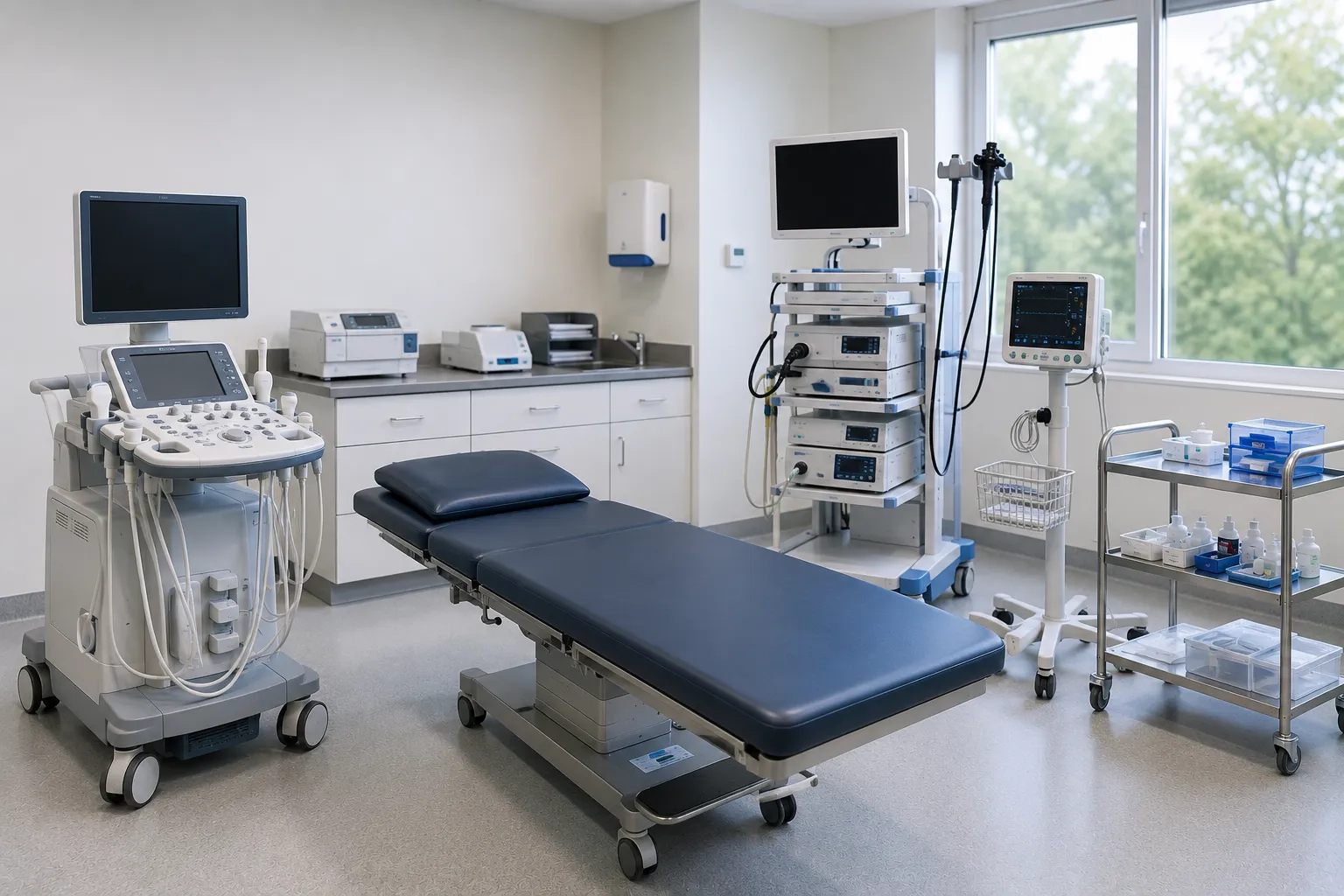
Equipping a hepatology service means covering liver-focused diagnostics — elastography and ultrasound — the biopsy provision that confirms difficult diagnoses, and the procedures used to manage ascites and variceal bleeding in advanced disease. This hepatology equipment buyer guide sets out what a service needs, the order in which to build it, and the compliance questions to settle early. It is written for hepatologists, liver-service teams and procurement across the UK, Europe, the US, the Gulf and South Africa.
What a hepatology service needs — the short version
-
Non-invasive fibrosis assessment — transient elastography and ultrasound with elastography.
-
Liver biopsy provision for cases that need tissue diagnosis.
-
Ascites and variceal management for the complications of advanced liver disease.
Start with non-invasive liver assessment.t
The biggest change in modern hepatology is the ability to assess liver scarring without a biopsy. Transient elastography measures liver stiffness as a marker of fibrosis quickly and painlessly, and ultrasound systems with elastography add both imaging and stiffness assessment in one platform. For many services, es these non-invasive tools are the workhorses of the clinic, used to diagnose, stage and monitor liver disease over time.
Because non-invasive assessment now drives so much of the pathway, it tends to be the first equipment decision, chosen for the patient population and the clinic's volumes. Ultrasound also supports many liver procedures by guiding needles safely, so a good system earns its place several times over. Biopsy and procedural equipment are then specified around this diagnostic core, for the cases where imaging and stiffness measurement are not enough on their own.
What hepatology needs
-
Transient elastography. A dedicated device measuring liver stiffness as a marker of fibrosis.
-
Ultrasound with elastography. Liver imaging combined with stiffness assessment and needle guidance.
-
Liver biopsy provis—Percutaneousous or, with radiology, transjugular biopsy equipment and consumables.
-
Paracentesis and ascites drainage. Equipment for safe sampling and drainage of ascitic fluid.
-
Variceal management. Endoscopic banding and related provision for variceal bleeding.
-
Monitoring for decompensation. Physiological monitoring for unwell patients with advanced disease.
-
Infusion and day-case provision. Infusion and day-unit facilities for treatments and procedures.
The equipment checklist
|
Equipment |
Role in the service |
Key selection point |
|
Transient elastography |
Fibrosis assessment |
Probe range; reliability; patient throughput |
|
Ultrasound with elastography |
Imaging and guidance |
Image quality; elastography; probe range |
|
Liver biopsy provision |
Tissue diagnosis |
Percutaneous vs transjugular; guidance |
|
Paracentesis and drainage |
Ascites management |
Safety; consumable range; guidance |
|
Variceal management |
Bleeding control |
Endoscopic banding; readiness |
|
Monitoring |
Decompensation care |
Parameter range; reliability |
|
Infusion and day-case |
Treatment delivery |
Comfort; pump accuracy; monitoring |
Assessing fibrosis without a biopsy
For decades, a liver biopsy was the main way to judge how scarred a liver had become; today, non-invasive tests do much of that work. Transient elastography measures the speed of a mechanical wave through the liver as a proxy for stiffness, and ultrasound-based elastography offers similar information alongside conventional imaging. These tools let a service diagnose, stage and monitor liver disease repeatedly and comfortably, reserving biopsy for cases where the picture remains unclear. Choosing the right platform for a service's population is one of the most consequential equipment decisions in hepatology.
Managing advanced liver disease
When liver disease decompensates, patients develop complications that need procedures: fluid accumulates in the abdomen and must be sampled and drained through paracentesis, and enlarged veins can bleed and require endoscopic banding. A hepatology service therefore keeps equipment for ascites management and variceal treatment ready, alongside monitoring for patients who can become unwell quickly. Some interventions, such as portal-pressure procedures, are shared with interventional radiology, so equipping a liver service often means planning across departments rather than in isolation.
Compliance and documentation
Hepatology equipment must be genuine, current and fully documented. In the UK, the MHRA regulates devices, with clinical guidance from NICE. The World Health Organisation provides wider context on medical devices internationally. Requirements vary by country and market, so confirm current obligations with the relevant authorities before you buy.
Support keeps a hepatology service running.
-
Installation, commissioning and familiarisation for elastography and ultrasound systems.
-
Preventive maintenance and calibration for diagnostic and monitoring equipment.
-
Reliable supply of consumables — biopsy, paracentesis and banding disposables.
-
Responsive technical support to keep clinics and day-case procedures running.
-
Clear documentation and device records to support governance and audit.
More from Business
-
Buyers — source compliant, fully documented equipment.
-
Suppliers — list your equipment and reach buyers worldwide.
-
Advertise — promote your products and services to a clinical audience.
-
Business overview — explore everything MediGear offers healthcare organisations.
Disclaimer
This article is for general information only. It does not constitute clinical, procurement, legal or regulatory advice. Equipment requirements for hepatology vary by service, facility, country and market, and change over time. Always confirm current requirements with the relevant authorities, and consult qualified clinical, biomedical engineering, procurement and regulatory professionals for decisions specific to your organisation. medigear.uk accepts no liability for actions taken based on this content.
"Measure the liver, manage the disease" A service equipped for both.
We supply medical equipment to healthcare organisations across the UK, Europe, the US, the Gulf and South Africa. Everything is genuine, documented and supported, so your hepatology service can assess and manage liver disease with confidence.
Frequently Asked Questions
A hepatology service centres on non-invasive liver assessment — transient elastography and ultrasound with elastography — to diagnose, stage and monitor fibrosis. It needs liver biopsy provision for cases requiring tissue diagnosis, and equipment for managing advanced disease: paracentesis and ascites drainage, endoscopic variceal banding, and monitoring for decompensated patients. Infusion and day-case facilities support treatments and procedures. The exact mix depends on the service's role and population.
Transient elastography is a quick, painless test that measures liver stiffness as a marker of fibrosis by tracking a mechanical wave through the liver. Along with ultrasound-based elastography, it lets a service assess and monitor liver scarring without a biopsy in most cases. These non-invasive tools have transformed hepatology and are often the busiest equipment in a liver clinic.
Gastroenterology is built around endoscopy of the digestive tract, with heavy investment in scopes and decontamination. Hepatology focuses on the liver, emphasising non-invasive fibrosis assessment such as elastography, liver biopsy, and managing advanced-disease complications like ascites and variceal bleeding. The specialities overlap and share some endoscopic procedures, but their core equipment priorities differ.
When liver disease decompensates, fluid accumulates in the abdomen and must be sampled and drained through paracentesis, and enlarged veins can bleed and need endoscopic banding. Services keep ascites and variceal equipment ready, with monitoring for patients who can deteriorate quickly. Some procedures, such as portal-pressure work, are shared with interventional radiology, so planning often spans departments.
Devices should be genuine, current and traceable. In the UK, the MHRA regulates devices; NICE provides clinical guidancE, and the World Health Organisation provides wider international context on medical devices. Requirements vary by country and market, so confirm current obligations with the relevant authorities before purchasing.
Yes. MediGear supplies medical equipment to healthcare organisations across the UK, Europe, the US, the Gulf and South Africa. As a distributor, we provide genuine, documented, and supported equipment, from elastography and ultrasound to biopsy, paracentesis, and variceal provision. Requirements differ by service and market, so we work with your team to match equipment to your caseload and regulatory setting.