
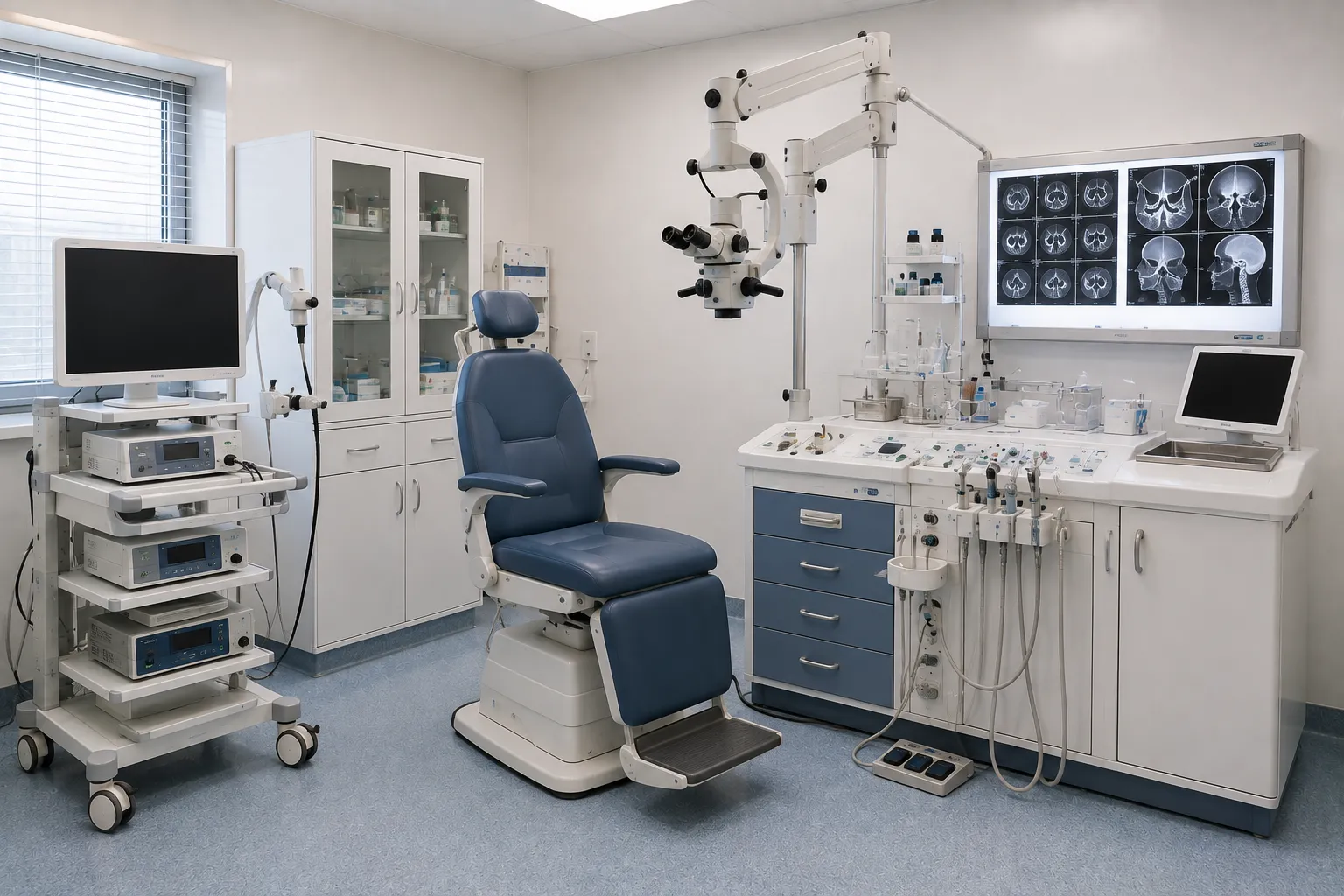
Introduction
Ear, nose and throat surgery covers three anatomically distinct regions, each demanding its own visualisation and instruments. Endoscopic sinus surgery works through the nose with rigid endoscopes and powered instruments; otology operates through the operating microscope with fine drills; and airway and laryngeal work uses its own scopes, sometimes shared with the anaesthetist. Few specialities ask a single service to equip for such different environments in one theatre.
Equipping an ENT service means covering endoscopic visualisation and powered instruments for the nose, microscope and drill systems for the ear, laryngeal and airway equipment for the throat, and nerve monitoring that protects critical structures throughout. This ENT surgery equipment buyer guide sets out what a service needs, the order in which to build it, and the compliance questions to settle early. It is written for ENT surgeons, theatre teams, biomedical engineering and procurement across the UK, Europe, the US, the Gulf and South Africa.
What ENT surgery needs — the short version
-
Endoscopic sinus kit — rigid endoscopes, a stack and a powered microdebrider, with image guidance where used.
-
Otology equipment — an operating microscope and fine, high-speed drills.
-
Airway and laryngeal instruments, with nerve monitoring to protect facial and laryngeal nerves.
Start with visualisation for each regio.n
ENT is specialityyty of seeing into tight spaces, so visualisation is the first deciso — and it differs by region. Sinus and nasal surgery relies on rigid endoscopes and a camera stack to work endoscopically through the nostril; otology relies on the operating microscope to work through the ear canal at high magnification. Many services need both, because the same team operates across the anatomy.
Once visualisation is settled, the powered and hand instruments follow. Endoscopic sinus surgery adds a microdebrider that cuts and removes tissue through a small opening, sometimes with image guidance that maps instruments against a scan for safety near the eye and skull base. Otology adds a high-speed micro-drill for bone work. Because visualisation platforms shape the instruments around them, they are specified fir,st and the rest of the service is built to match.
What ENT surgery needs
-
Rigid endoscopes. A range of angled nasal and sinus endoscopes for endoscopic access.
-
Camera stack. Camera, light source, monitor and recording for endoscopic surgery.
-
Powered microdebrider. A shaver system for precise cutting and removal of sinus tissue.
-
Image guidance. Navigation that maps instruments against imaging near the eye and skull base, where used.
-
Operating microscope. High-magnification visualisation for otology and middle-ear surgery.
-
Otologic drill system. High-speed micro-drills and burrs for delicate bone work.
-
Laryngeal and airway instruments. Laryngoscopes, suspension systems and microlaryngeal sets.
-
Nerve monitor—facialial and laryngeal nerve monitoring to protect critical structures.
-
Tonsil and general sets. Coblation or diathermy tonsillectomy and general ENT instrument sets.
The equipment checklist
|
Equipment |
Role in the theatre |
Key selection point |
|
Rigid endoscopes |
Nasal and sinus access |
Angle range; optics; durability |
|
Camera stack |
Endoscopic visualisation |
Image quality; recording; integration |
|
Microdebrider |
Sinus tissue removal |
Precision; blade range; control |
|
Image guidance |
Navigation near critical structures |
Accuracy; registration; workflow |
|
Operating microscope |
Otology visualisation |
Optics; illumination; ergonomics |
|
Otologic drill |
Middle-ear bone work |
Speed; control; burr range |
|
Nerve monitor |
Nerve protection |
Sensitivity; channels; reliability |
Endoscopic sinus surgery and image guidance
Functional endoscopic sinus surgery has become the standard approach to much nasal and sinus disease, working entirely through the nostril with rigid endoscopes and a microdebrider. Because the sinuses sit close to the eye and the base of the skull, some cases benefit from image guidance, which tracks the instrument tip against a scan so the surgeon can confirm position in difficult anatomy or revision surgery. A service decides how far to invest in navigation based on its case complexity, alongside the endoscope range and stack quality that underpin every case.
Protecting nerves in ear and throat surgery
Some of the most important structures in ENT surgery are nerves that must be preserved — the facial nerve in ear and parotid surgery, the recurrent laryngeal nerve in thyroid and neck work. Intraoperative nerve monitoring gives the surgeon audible feedback when an instrument is near a nerve, helping avoid injury during delicate dissection. It is a small part of the equipment list but a significant one for safety, and it sits naturally alongside the microscope and drill systems that otology and head-and-neck work rely on.
Compliance and documentation
ENT equipment must be genuine, current and fully documented. In the UKy the MH regulates devicesRA, with clinical guidance from NICE. The ISO maintains international standards for medical devices. Endoscope decontamination and device traceability are important throughout, and requirements vary by country and market. Confirm current obligations with the relevant authorities before you buy.
Support keeps an ENT service running.
-
Installation, commissioning and familiarisation for stacks, microscopes and drill systems.
-
Preventive maintenance and calibration for cameras, microdebriders, drills and monitors.
-
Reliable supply of consumables — blades, burrs, endoscope accessories and nerve-monitoring disposables.
-
Endoscope repair and loan support to keep lists running when scopes are out of service.
-
Clear documentation and device traceability to support decontamination governance and audit.
More from Business
-
Buyers — source compliant, fully documented equipment.
-
Suppliers — list your equipment and reach buyers worldwide.
-
Advertise — promote your products and services to a clinical audience.
-
Business overview — explore everything MediGear offers healthcare organisations.
Disclaimer
This article is for general information only. It does not constitute clinical, procurement, legal or regulatory advice. Equipment requirements for ENT surgery vary by service, facility, country and market, and change over time. Always confirm current requirements with the relevant authorities, and consult qualified clinical, biomedical engineering, decontamination, procurement and regulatory professionals for decisions specific to your organisation. medigear.uk accepts no liability for actions takenbased onf this content.
"Ear, nose and throat, fully equipped" One service, three regions.
We supply medical equipment to healthcare organisations across the UK, Europe, the US, the Gulf and South Africa. Everything is genuine, documented and supported, so your ENT service works precisely across every region it treats.
Frequently Asked Questions
ENT surgery is equipped for three regions. Nasal and sinus work needs rigid endoscopes, a camera stack and a powered microdebrider, sometimes with image guidance. Otology needs an operating microscope and high-speed micro-drills. Airway and laryngeal work needs laryngoscopes, suspension systems and microlaryngeal instruments. Across the speciality, nerve monitoring protects the facial and laryngeal nerves, and tonsil and general ENT sets complete a typical service.
Functional endoscopic sinus surgery works through the nostril using rigid angled endoscopes and a camera stack for visualisation, with a powered microdebrider to cut and remove tissue precisely. Because the sinuses sit near the eye and skull base, some cases use image guidance, which tracks the instrument against a scan. The endoscope range, stack quality and, where needed, navigation define the sinus service.
ENT surgery works close to critical nerves — the facial nerve in ear and parotid surgery and the recurrent laryngeal nerve in thyroid and neck surgery. Intraoperative nerve monitoring gives the surgeon audible feedback when an instrument approaches a nerve, helping avoid injury during delicate dissection. It is inexpensive relative to the overall list but significant for patient safety.
Otology works through the ear canal under an operating microscope rather than through an endoscope, and it uses high-speed micro-drills for fine bone work in the middle ear and mastoid. Sinus surgery, by contrast, is endoscopic and uses a microdebrider. Many ENT services need both visualisation platforms because the same team operates across the ear, nose and throat.
Yes. Endoscopes and reusable instruments require proper decontamination and traceability, which are important parts of running an ENT service. In the UK, the MHRA regulates devices, with clinical guidance from NICE and international device standards from ISO. Requirements vary by country and market, so confirm current obligations with the relevant authorities before purchasing.
Yes. MediGear supplies medical equipment to healthcare organisations across the UK, Europe, the US, the Gulf and South Africa. As a distributor,we provide genuine, ddocumented, and supported equipment, from endoscopes and stacks to microscopes, drills, mmicrodebriders, and nerve monitoring. Requirements differ by service and market, so we work with your team to match equipment to your caseload and regulatory setting.