
Briya AIRE steatotic liver detection lifts patient count 360%
Briya’s AIRE platform identified 4,036 additional patients with steatotic liver disease in existing ultrasound reports, increasing one study group from 1,122 to 5,158.
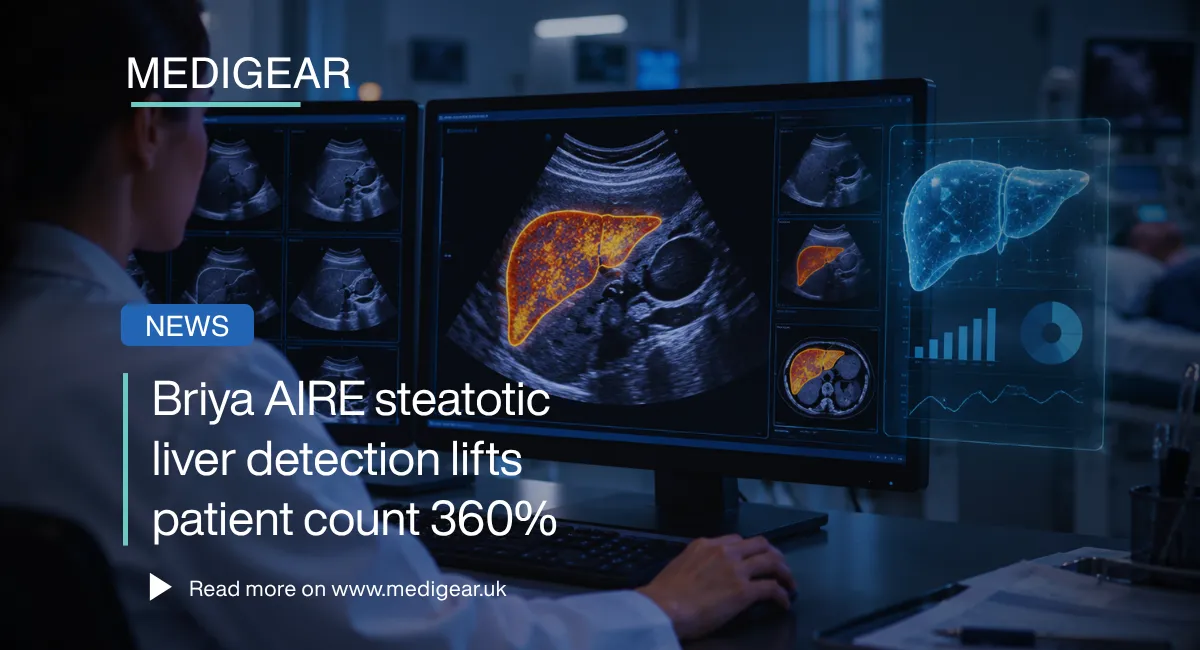
Briya has used its AIRE platform to find 4,036 more patients with a steatotic liver in existing ultrasound reports, Medical Device Network reported. Briya AIRE's steatotic liver detection expanded one study group from 1,122 to 5,158 patients, a 360% increase.
How the analysis worked
The company, which has offices in New York and Tel Aviv, applied its artificial intelligence (AI) and natural language processing (NLP) platform to 28,795 abdominal ultrasound reports. They covered 20,422 unique patients between 2020 and 2024. The target condition was metabolic dysfunction associated steatotic liver disease (MASLD).
Radiologists usually dictate these reports as free text in a loose narrative. Structured reports follow a fixed template instead. AIRE reads the free text and pulls out the findings. Briya says earlier identification could allow intervention before the disease becomes irreversible.
The gap in structured records
Only 22% of the additional patients had a diagnosis recorded in a structured electronic healthcare record (EHR), the company said. The other 78% were identified only through NLP review of unstructured report text. Briya describes this as “a major gap” for work that relies on structured records or diagnostic codes alone.
Fibrosis risk in the larger group
With the full group in place, researchers assessed progression risk using existing laboratory data and ultrasound reports. They found 4,368 patients with a Fibrosis 4 Index (FIB 4) score above the conventional risk threshold. The score estimates liver scarring.
What the researchers said
Gadi Lalazar, who led the study and heads the liver unit at Shaare Zedek Medical Centre in Israel, said Briya AIRE “fundamentally changed how we were able to identify patients for this study”. He said many patients may not have known about their condition because the finding was “buried in an ultrasound report performed for some other reason”. Finding them sooner gives physicians a chance to begin treatment before the disease reaches more serious stages, he added.
Dr Or Shaked, director of medical research solutions at Briya, said the platform's research agents pulled data from free text fields. They merged it with existing structured records and assembled the study group. He said the aim is to help researchers “focus on answering scientific questions that can ultimately influence care”.
Briya says the results show that unstructured radiology reports give researchers access to “larger, more representative patient populations” without extra data collection. The company plans to present the findings at an upcoming medical meeting.
Market context
The Briya AIRE steatotic liver detection work sits in a fast growing field. GlobalData expects the AI market across healthcare to grow at a compound annual growth rate (CAGR) of about 37%. It projects a value of $57.4bn in 2029.
Why it matters
The study shows that ultrasound reports already on file can hold diagnoses never coded in patient records. Imaging departments that store these reports hold data that software can mine to detect liver disease earlier. Coverage on Medigear.uk tracks Briya AIRE steatotic liver detection and the wider AI imaging market.
Source: Medical Device Network
Sourcing medical equipment?
Tell us the model and destination — our sourcing team will respond within one business day.

Zimmer Monogram Robot Submitted to FDA for Autonomous Use
The Zimmer Monogram robot is now with US regulators. Zimmer Biomet has filed a 510(k) submission for…

Abbott Encantor Trial Starts for Balloon Expandable Aortic Valve
The Abbott Encantor trial has begun. Abbott said on Thursday that it has started the VOYAGER CE clin…
J&J Ottava Surgical Robot Heads to First US Hospital
Johnson & Johnson (J&J) said on Thursday that a Houston hospital will be the first to instal…
Medical device news, once a week.
Approvals, trials, recalls and market moves — the essentials for procurement and clinical teams.