
Introduction
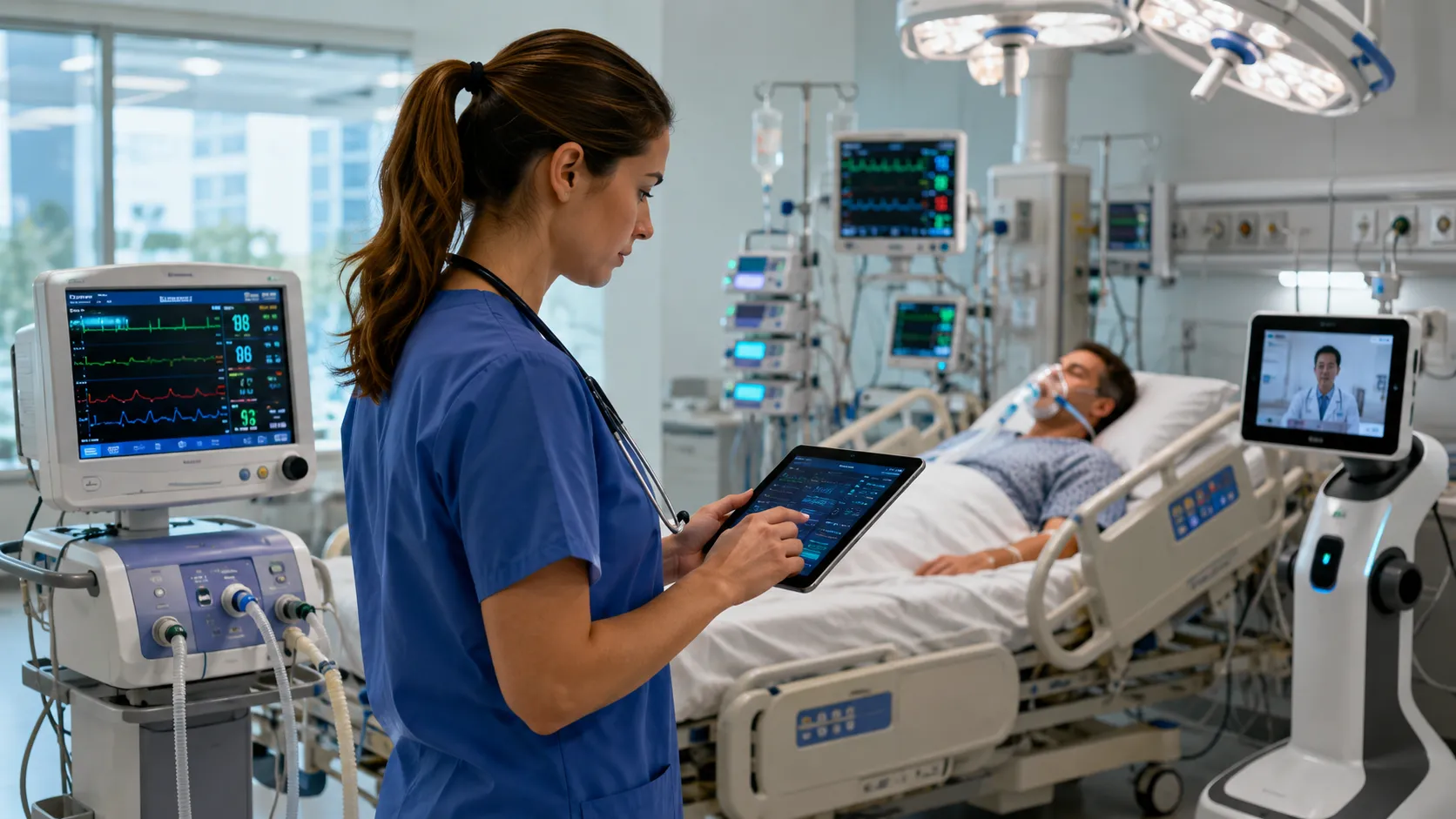
Hospital equipment has always evolved, but the pace of technological change in healthcare has accelerated dramatically. Artificial intelligence is making diagnostics more accurate. Connectivity links devices into integrated clinical systems. Robotics is expanding what surgery can achieve. Miniaturisation is bringing diagnostic and monitoring capability that once required a room-sized machine into a pocket-sized device. These are not distant possibilities — they are already changing what hospitals buy, how they use it, and what they pay for.
This guide explains the main technologies reshaping hospital equipment today, what the practical changes look like in each clinical area, and what the shift means for procurement teams and suppliers across the UK, Europe, the US, the Gulf and South Africa.
The technologies driving change.
Six technology families are reshaping hospital equipment in 2026, each affecting multiple clinical areas simultaneously.
-
Artificial intelligence (AI) software is being integrated into imaging, pathology, monitoring, and clinical decision support, changing what devices detect and how quickly they deliver results.
-
Connectivity and interoperability — medical devices are increasingly networked, feeding data into electronic records, central monitoring stations and remote oversight systems.
-
Robotics and automation — robotic surgical systems, automated laboratory platforms, and medication dispensing robots — are expanding speed, precision, and safety in clinical settings.
-
Miniaturisation and portability—diagnostic and monitoring capabilities that required large, expensive, fixed equipment—are now available in portable, handheld and wearable form at a fraction of the cost.
-
Digital health integration — hospital equipment increasingly integrates with digital health platforms, including electronic health records, telemedicine systems, and patient-facing apps.
-
Additive manufacturing — 3D printing is producing custom surgical guides, implants and prosthetics tailored to individual patients, changing how some surgical equipment is sourced and made.
Where technology is changing equipment by clinical area
The impact of technology varies by clinical area, but very few departments are untouched.
-
Diagnostic imaging. AI assistants flag lesions on X-ray and CT scans in real time, reducing missed findings and radiologist workload. Handheld ultrasound devices bring imaging to the bedside. Cloud-based PACS and teleradiology enable remote image reporting.
-
Laboratory medicine. Total laboratory automation connects analysers in continuous tracks, cutting turnaround time and manual handling. Molecular diagnostics and rapid PCR platforms bring high-accuracy results to near-patient settings. AI assists in pathology slide analysis.
-
Patient monitoring. Wearable sensors and continuous monitoring patches replace intermittent bedside checks for stable patients. Integrated alarm systems reduce alarm fatigue. Networked monitors automatically feed early-warning scores into the patient record.
-
Surgery and theatres. Robotic surgical platforms extend the reach and precision of minimally invasive surgery. Integrated digital theatres connect cameras, displays, navigation and records. 3D printing produces patient-specific surgical guides and implants.
-
Critical care. Smart ventilators adjust support automatically in response to the patient's breathing effort. Connected infusion systems with drug libraries reduce medication errors. Continuous data feeds support remote intensivist oversight across multiple ICUs.
-
Point-of-care. Rapid molecular platforms deliver PCR-quality results in minutes at the bedside. Miniaturised blood gas and chemistry analysers bring the laboratory to the patient. AI-assisted diagnostics are increasingly embedded in point-of-care readers.
Technology adoption by region
Technology adoption in hospital equipment is not uniform — it tracks healthcare investment, infrastructure maturity and regulatory pace.
|
Region |
Adoption pace |
Key drivers |
|
North America |
Fast |
Strong investment, early adoption culture, and FDA fast-track pathways |
|
Europe |
Steady |
High standards, EU MDR transition creating some slowdown |
|
Asia-Pacific |
Rapid in leading markets |
High growth investment, government digitalisation programmes |
|
Gulf (GCC) |
Accelerating |
New hospital build-outs adopting the latest technology from the start |
|
Africa |
Leapfrogging in places |
Portable and AI-assisted solutions suit infrastructure constraints |
Gulf and some African markets often leapfrog older technology generations — new hospitals built from scratch adopt the latest connected and portable equipment without the legacy infrastructure constraints that slow adoption in mature markets.
What to watch in technology-driven hospital equipment
-
AI as a medical device — software that makes clinical decisions is increasingly regulated as a medical device in its own right, with CE marking, FDA clearance and equivalent approvals required.
-
Cybersecurity as a clinical risk — connected devices introduce cybersecurity vulnerabilities that regulators now treat as patient safety issues, requiring manufacturers and hospitals to manage actively.
-
Total cost of ownership shifts — technology-forward equipment often carries a higher upfront cost but lower long-term costs due to reduced consumables, improved reliability, and remote diagnostics.
-
Training and change management — new technology fails without proper training and adoption support. Budget for implementation and training alongside the device purchase.
-
Regulatory lag — technology often outpaces regulation. Confirm that any new device has the required market approval for your country before purchasing.
Buying technology-forward equipment?
We help hospitals source technology-forward equipment that is properly approved, supported and priced for your market. Tell us the clinical area and the technology you are interested in — we will help you find the right device.
No pressure, no obligation. → Talk to the team
What does the technology change mean for procurement
Procurement teams face new challenges as equipment becomes more connected and software-dependent. A device that was purely hardware now has firmware updates, cybersecurity requirements and data integration specifications. Procurement criteria need to include these dimensions alongside the traditional clinical, financial and compliance checks.
The pace of technology change also affects lifecycle planning. A CT scanner purchased today will be clinically useful for 15 years. Still, its software and AI capabilities may be outdated within 5 years. Understanding the upgrade path and the manufacturer's software support commitment is increasingly part of the capital investment decision.
What does technological change mean for buyers and suppliers?
-
Buyers. Ask about software update cycles, cybersecurity policies and integration with your electronic health record before purchasing any connected device. Technology-forward equipment requires a different procurement process than traditional hardware.
-
Suppliers. The market is moving faster than procurement cycles in many organisations. Buyers need help understanding new technologies and their clinical and operational implications — that is a genuine service opportunity.
-
Everyone. AI, connectivity and miniaturisation are not optional futures — they are already in the market and shaping which devices get procured. Staying current with technology trends is now a core competency for anyone in the medical equipment field.
More from Business
-
Buyers — source technology-forward hospital equipment from a worldwide supply base.
-
Suppliers — list your technology-forward devices and reach hospital buyers worldwide.
-
Advertise — promote your products and services to a clinical audience.
-
Business overview — explore everything MediGear offers healthcare organisations.
Disclaimer
This article is for general information only and does not constitute clinical, procurement, regulatory or technology advice. Medical device technology, regulatory requirements and market availability change rapidly. Always verify that any device is approved for your market and consult qualified clinical, biomedical engineering and procurement professionals for decisions specific to your facility. medigear.UK accepts no liability for actions taken based on this content.
**Market figures are indicative ranges drawn from multiple published market research sources and vary across definitions and methodologies. ****
Sourcing technology-forward equipment?
We supply technology-forward medical equipment to hospitals and procurement teams across the UK, Europe, the US, the Gulf and South Africa. Tell us what you need and where — we will help you source it correctly.
Frequently Asked Questions
Technology is changing hospital equipment across multiple dimensions simultaneously — AI is improving diagnostic accuracy, connectivity is linking devices into integrated clinical systems, robotics is expanding surgical precision, miniaturisation is bringing diagnostic capability to the bedside and home, and digital health integration is connecting equipment to patient records and telemedicine platforms. These changes are affecting procurement, training, cybersecurity and total cost of ownership.
AI is being integrated into imaging systems to flag lesions and anomalies, into laboratory platforms for pathology slide analysis, into patient monitoring for early warning and deterioration detection, and into point-of-care diagnostic readers. AI software that makes or influences clinical decisions is regulated as a medical device in most markets, requiring CE marking, FDA clearance or equivalent approval before use.
Smart hospital devices are medical devices with integrated connectivity, software intelligence and data-sharing capability. They include networked patient monitors that feed data to central stations and electronic records, smart infusion pumps with drug libraries and error-reduction software, connected ventilators that adapt to patient breathing effort, and imaging systems with AI-assisted reporting. Smart devices generate data that can be used for clinical care, quality improvement and remote oversight.
Yes. Regulators, including the FDA, MHR, and EU authorities, now treat cybersecurity vulnerabilities in medical devices as patient safety issues. Manufacturers are required to design devices with cybersecurity controls, issue software updates to address vulnerabilities, and provide documentation of their cybersecurity approach. Hospitals must manage the security of networked devices as part of their clinical risk framework, including network segmentation, patch management and incident response.
Technology-forward equipment often has a higher purchase price than conventional alternatives. Still, the total cost of ownership may be lower due to reduced consumables, improved reliability, fewer service calls, and remote diagnostics, which reduce downtime. However, software licensing fees, cybersecurity management costs and the need for more frequent updates and upgrades can add to ongoing costs. Total cost of ownership analysis should include all of these dimensions.
Operating theatres are seeing robotic surgical platforms for minimally invasive procedures, integrated digital theatre systems connecting cameras, displays, navigation and clinical records, 3D printing for patient-specific guides and implants, advanced energy devices with real-time feedback, and image-guided surgery using intraoperative CT or fluoroscopy. These technologies are improving outcomes and reducing complication rates across many procedures.