
Introduction
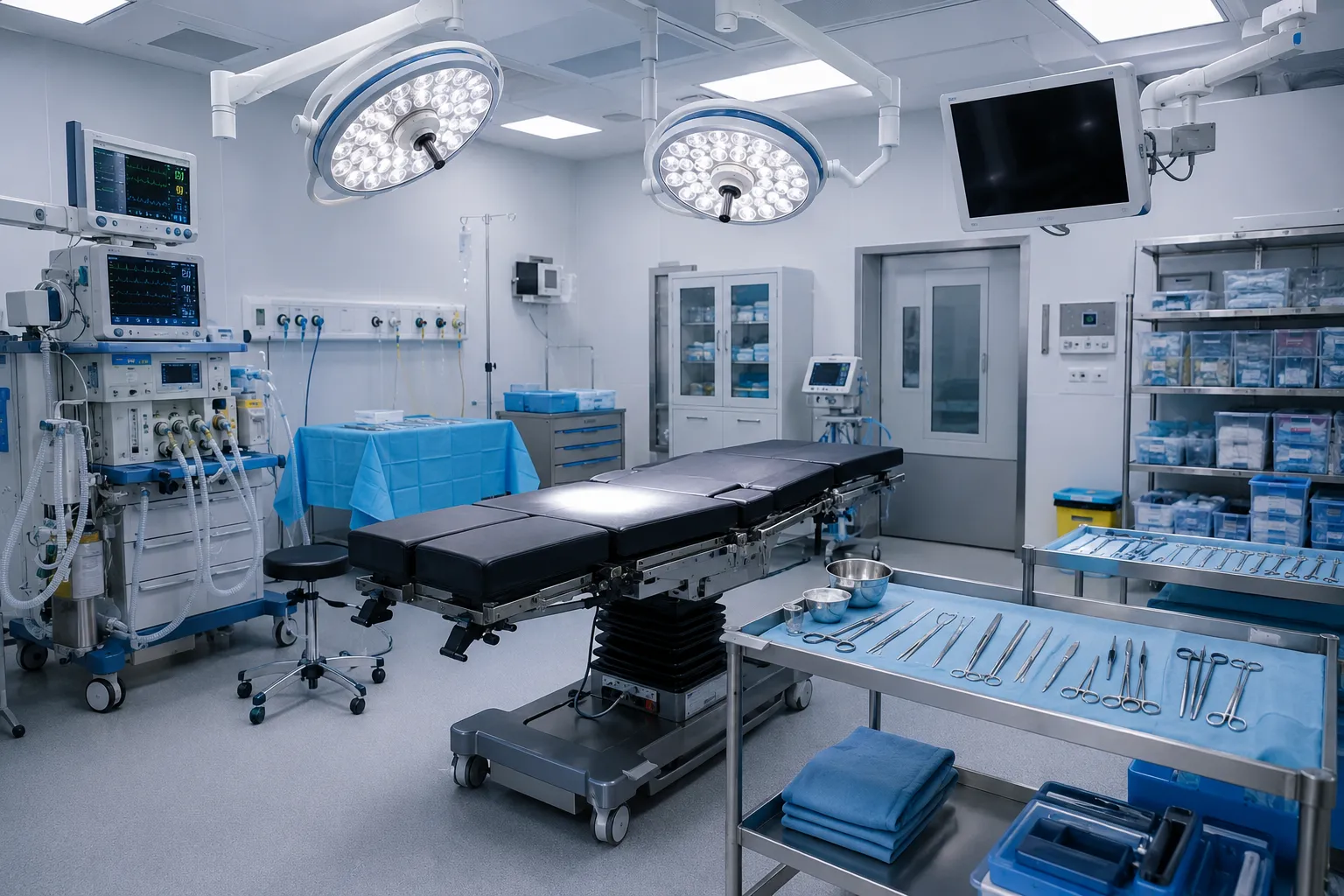
Setting up an operating theatre — an operating room, in US terms — is part equipment project, part engineering project. Beyond the surgical kit itself, a theatre depends on clean-air ventilation, reliable power and medical gas, sterile-services support, and a layout that protects the sterile field. Get the combination right, and the room runs safely for decades; get a piece wrong, and it affects every list that follows.
This guide sets out the full operating theatre equipment list by category, the surrounding infrastructure and design, the planning sequence, and the compliance points — for a new theatre, an upgrade, or added surgical capacity, wherever your hospital operates.
The short version — what every theatre is built around
At its core, a theatre brings together three things — a place to operate, a way to keep the patient safe under anaesthesia, and a sterile, well-lit field to work in.
-
Table & lights — an operating table and surgical lighting that position and illuminate the surgical field precisely.
-
Anaesthesia & monitoring — an anaesthesia machine with ventilation and full patient monitoring throughout the procedure.
-
Sterility & clean air — sterile instruments, sterilisation support and clean-air ventilation to protect the field.
Operating theatre equipment by category
-
Operating table. An electro-hydraulic table with positioning for different specialities, plus accessories — arm boards, stirrups, supports — and a backup power option.
-
Surgical lighting. Ceiling-mounted LED surgical lights with shadow control and adjustable intensity, plus a satellite light and ideally an integrated camera mount.
-
Anaesthesia & monitoring. An anaesthesia machine with ventilator and gas delivery, scavenging, and full multiparameter monitoring. See our guide to patient monitoring equipment.
-
Electrosurgery. An electrosurgical (diathermy) generator with monopolar and bipolar modes, plus vessel-sealing where needed, and the right return electrodes.
-
Suction & smoke evacuation. Surgical suction for fluids and dedicated surgical-smoke evacuation to protect the team from plume.
-
Instruments & sterilisation. Procedure-specific instrument sets, plus access to sterile services — autoclaves and a CSSD — and tracking of sterile stock.
-
Imaging. Mobile imaging, such as a C-arm for fluoroscopy, and endoscopy/laparoscopy towers for minimally invasive surgery.
-
Theatre furniture & clean air. Instrument trolleys, Mayo stands, scrub sinks, diathermy/suction pendants, and the HVAC and laminar-flow ventilation that keep the field sterile.
Operating theatre equipment checklist
|
Category |
Equipment |
Notes |
|
Table |
Operating table + positioning accessories |
Specialty-specific attachments |
|
Lighting |
Main + satellite surgical lights; camera mount |
LED, shadow control |
|
Anaesthesia |
Anaesthesia machine; ventilator; gas scavenging |
With multiparameter monitor |
|
Monitoring |
Multiparameter monitor; capnography |
Per theatre |
|
Electrosurgery |
Diathermy generator; vessel sealer |
Monopolar + bipolar |
|
Suction |
Surgical suction; smoke evacuation |
Fluid + plume |
|
Instruments |
Instrument sets; sterile services (CSSD/autoclave) |
Tracked sterile stock |
|
Imaging |
C-arm; endoscopy/laparoscopy tower |
As the speciality requires |
|
Furniture |
Trolleys; Mayo stands; scrub sinks; pendants |
Easy-clean |
|
Infrastructure |
HVAC / laminar flow; medical gas; UPS power; emergency kit |
Theatre-wide |
Exact requirements vary by surgical speciality — orthopaedic, cardiac and ophthalmic theatres each add specialised kit on top of this core.
Building a new theatre?
We'll help you equip it end-to-end. Tell us your speciality, budget, and market — we'll build the equipment list, balance new and refurbished units, and ensure everything's compliant and supported.
No pressure, no obligation. → Talk to the team
What else does setting up a theatre involve
-
Clean-air ventilation. Theatre HVAC controls air changes, pressure, temperature and humidity; ultraclean/laminar flow is used for high-risk surgery. It's often the costliest and longest-lead-time element.
-
Layout and zoning. Sterile, clean and disposal zones, scrub areas, anaesthetic room and recovery all shape workflow and infection control.
-
Sterile services. A theatre relies on a sterile-supply pipeline — decontamination, sterilisation and tracked instrument sets — sized to your case load.
-
Power and gas. Uninterruptible power, isolated electrical supplies and piped medical gas and vacuum are safety-critical infrastructure.
-
Staffing and workflow. Equipment is only as good as the team and the list management around it — plan training and turnover alongside procurement.
Setting up a theatre, step by step
-
Define the surgical specialities and case mix that the theatre must support.
-
Confirm infrastructure — ventilation, medical gas, power and layout — and start works early.
-
Build the equipment list by category, tailored to the specialities and case load.
-
Decide new vs refurbished per item to balance budget, lifespan and warranty.
-
Confirm market approval, arrange installation, training and servicing, then commission and validate.
Ventilation plant, operating tables and imaging carry the longest lead times — commit to those first and validate clean-air performance before the first list.
Budget and procurement
A theatre is a major capital project, so spend strategically. Many hospitals buy new anaesthesia and high-use core devices, and certified refurbished tables, lights, and imaging equipment to control costs without compromising safety. Cost the whole life of each item — installation, training, consumables, calibration, service contracts, and replacement. Because much theatre equipment is higher-risk, check the device risk class and the certification for your market, and plan capacity alongside your ICU and critical-care provision so surgical and recovery pathways line up.
Approval and standards by region
|
Region |
Regulator |
Requirement |
|
United Kingdom |
UKCA mark (CE accepted to 2028–2030) |
|
|
European Union |
CE marking under EU MDR 2017/745 |
|
|
United States |
510(k) clearance or PMA approval |
|
|
Gulf (GCC) |
SFDA & GCC bodies |
National registration / GCC conformity |
|
South Africa |
Medical device licensing |
For clinical and infection-control standards, bodies such as NICE and the World Health Organisation are useful references — the WHO Surgical Safety Checklist is a theatre staple. If you're equipping a theatre, our buyer hub sets out how to purchase with confidence.
More from Business
-
Buyers — source and import compliant equipment for your clinic, hospital or care service.
-
Suppliers — list and export your medical equipment to healthcare buyers worldwide.
-
Advertise — promote your products and services to a clinical audience.
-
Business overview — explore everything MediGear offers healthcare organisations.
Disclaimer
This article is for general information only and does not constitute clinical, medical, procurement, engineering or regulatory advice. Theatre design, equipment, ventilation standards and infection-control requirements vary by country, speciality, and facility, and change over time. The checklist is a general planning aid, not a specification — always work with qualified clinical, biomedical engineering, ventilation, infection control, and procurement professionals, and confirm that every device is approved for your market (for example, UKCA, CE under EU MDR, FDA, SFDA/GCC, or SAHPRA). medigear.uk accepts no liability for actions taken on the basis of this content.
Frequently Asked Questions
A theatre needs an operating table, surgical lights, an anaesthesia machine with patient monitoring, an electrosurgical (diathermy) unit, surgical suction and smoke evacuation, sterile instruments and sterilisation support, theatre furniture, and often imaging such as a C-arm or endoscopy tower. Clean-air ventilation, reliable power, medical gas, and emergency equipment underpin all of it.
They're the same thing — "operating theatre" is the common term in the UK and many Commonwealth countries, while "operating room" (OR) is used in the US. Both describe the sterile, controlled room where surgery is performed.
Theatres require specialised heating, ventilation and air conditioning (HVAC) that controls air changes, temperature, humidity and pressure to keep the field sterile. Some procedures, such as orthopaedic implants, use ultraclean or laminar-flow ventilation. This infrastructure is a major part of any theatre build and is often the longest lead-time element.
Yes, certified refurbished equipment is widely used for items such as operating tables, lights, and imaging equipment, and can deliver significant savings. For anaesthesia and life-supporting devices, insist on certified refurbishment, a warranty, reliable service support, and confirmation that the device is approved for your market.
It depends heavily on whether building and ventilation works are involved. Fitting out an existing compliant shell can take weeks once equipment is procured, whereas a new theatre with HVAC, medical gas, and structural works typically takes many months. Order long lead-time items, including tables and ventilation plant, early.
Every device must be approved for the market where it's used — UKCA or CE in the UK and EU, FDA clearance in the US, and SFDA or SAHPRA registration in the Gulf and South Africa. Theatres also follow national standards for ventilation, electrical safety and sterilisation, so plan for calibration, servicing and infection-control compliance from the start.
Equip your theatre, end to end.
From tables and lights to anaesthesia, diathermy and imaging, we help hospitals across the UK, Europe, the US, the Gulf and South Africa build operating theatres — compliant, supported and on budget.