
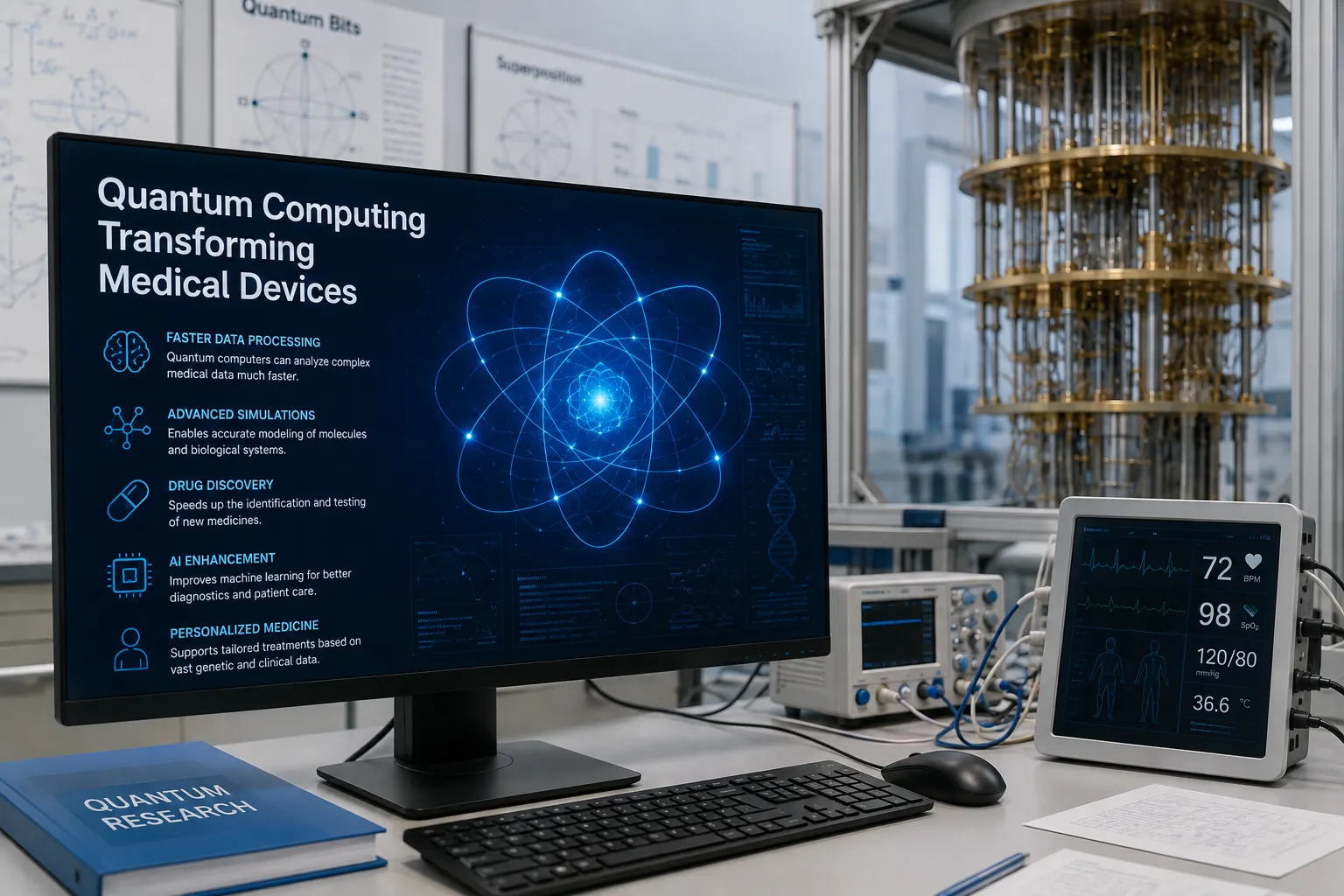
How quantum computing relates to medical devices
Quantum computing attracts dramatic headlines, which makes its real influence on medical devices easy to misjudge. It is not about a quantum machine appearing on a ward. Its likely effect is indirect and gradual. It appears in stronger computation behind imaging, faster design and discovery, new kinds of sensing, and the security of connected devices. This article explains how quantum computing will influence medical devices. It also explains why perspective matters as much as interest when a technology is still on the horizon. The effects are real, but mostly indirect.
A technology felt, not seen
Quantum computing attracts dramatic headlines, which makes it easy to misjudge. It is not about a quantum machine appearing on a ward. Its likely influence on medical devices is indirect and gradual: better computation behind imaging, faster design and discovery, and new kinds of sensing. The effect is felt, not seen. Understanding it as a background force, rather than a gadget, is the key to seeing where it actually matters. Hype and dismissal both miss the point. The truth sits in between. Clear thinking beats hype and dismissal alike.
This kind of emerging technology is exactly what horizon-scanning bodies watch, precisely because its effects are easy to over- or under-estimate. The World Health Organisation's foresight work on emerging technologies exists to anticipate such shifts before they arrive in full. For a hospital, the sensible stance is neither hype nor dismissal, but a clear view of the few areas where quantum computing may quietly change the devices it buys. Most of its effect will be felt long before it is ever seen. Seeing it early is the advantage.
"Quantum computing rarely arrives as a device you can point to. It improves the ones you already use."
Sharper imaging from stronger computation
Much of modern medical imaging depends on computing to turn raw signals into a clear picture. As computational power advances, the reconstruction and processing behind imaging can improve, potentially yielding clearer images, faster results or lower doses. Quantum computing sits at the far edge of this trend, as one of several forces pushing computation forward. The scanner stays; the computing behind it improves. Hardware holds while software climbs.
For a hospital, the practical effect is not a quantum scanner but better imaging equipment over time, supported by more capable processing. The device itself looks familiar; what changes is how well it can turn what it captures into something useful. This is a reminder that a device's value increasingly depends on the computation behind it, not only its hardware. Software is becoming half the machine. The box matters less each year.
Faster design and discovery
Behind every medical device is a long process of design, testing and, for many therapies, the discovery of new materials or molecules. Advanced computing can shorten parts of that process by simulating and modelling faster than before. Quantum computing is one of the technologies expected to contribute here, in time. The gains are upstream of the ward.
The influence on medical devices is therefore upstream, in how they are created rather than how they are used. Better simulation can mean devices and treatments that are developed and refined more quickly. A hospital will not see the quantum computer. But it may, over years, benefit from equipment and therapies that reached it sooner. The design work behind them simply moved faster. Progress arrives quietly. Hospitals feel it late, but they feel it. The benefit is real, if slow.
New kinds of sensing
Quantum science is not only about computing. Related advances in quantum sensing could, in time, lead to instruments that detect signals with extraordinary sensitivity. That has potential implications for diagnostic and measurement equipment, where detecting a faint signal clearly can change what is possible. Sensitivity opens new doors.
This is earlier and less certain than the computing story, and it deserves caution rather than excitement. But it points to a future in which some sensing equipment becomes more sensitive because of quantum effects. For a buyer, the message is not to wait for it. It is to understand that the frontier of measurement is moving. Keeping sight of where that could matter is enough for now. Watch it, but do not chase it. The frontier is moving, slowly.
Keeping perspective on a distant technology
Quantum computing is real and advancing, but its influence on everyday medical devices will be gradual and mostly invisible for some time. The risk is not ignoring it; it is being distracted by it. A hospital that chases quantum headlines may overlook the connected, intelligent and portable trends that are changing equipment right now. Those nearer trends deserve the attention first. Distraction is the real danger here.
So the honest framing is one of perspective. Quantum computing belongs on the horizon, watched with interest, while today's decisions are shaped by nearer, clearer trends. The tools that regulators bring to emerging technologies, such as the NICE Early Value Assessment for promising health technologies, show how new capabilities are best judged: carefully, on evidence, and in their proper time.
The security behind connected devices
There is one more way quantum computing touches medical devices, and it concerns security. As devices become connected, the data they share must be protected. Advances in quantum computing could, in time, challenge some of the encryption that keeps that data safe. They could also enable stronger protection. The picture cuts both ways. Protection and risk rise together.
This matters because connected equipment is only trustworthy if its data is secure. So part of quantum computing's influence is not clinical at all. It is about keeping the growing web of connected devices safe over the years ahead. For a hospital, it is another reason to value equipment that is well supported and kept up to date. Security ages faster than hardware. A supported device stays safer for longer.
What quantum computing really means for buyers
-
Better imaging over time — stronger computation behind familiar scanners, not a quantum machine.
-
Faster design and discovery — devices and therapies that may reach hospitals sooner.
-
New sensing, in time — more sensitive measurement, but earlier and less certain.
-
Perspective — watch it on the horizon, without being distracted from nearer trends.
The horizon, and the ground beneath it
Seen clearly, quantum computing will influence medical devices mostly from behind the scenes: in the computation that supports imaging, the design that creates equipment, and the sensing that may one day sharpen it. It is a horizon technology. It is worth understanding, but not worth chasing ahead of nearer, clearer trends. Interest, not urgency, is the right response. Perspective is the real skill. The horizon work that tracks such shifts, including the WHO horizon scan of emerging health technologies, exists to keep that perspective honest and to make foresight ordinary rather than rare.
Underneath even the most futuristic technology sits one unchanging truth. Whatever the computation behind it, a medical device is only worth having if it is genuine, approved and reliable, and if it does its job well today. The fundamentals of sound equipment outlast every wave of excitement. So the wise approach is to keep quantum computing in view without letting it distract from the basics, and to buy on what is proven now. Understanding beats reacting. Curious about what is coming, firm about what has always mattered.
More from Business
-
Buyers — source approved, well-documented equipment.
-
Suppliers — list your equipment and reach buyers worldwide.
-
Advertise — promote your products and services to a clinical audience.
-
Business overview — explore everything MediGear offers healthcare organisations.
Disclaimer
This article is for general information only and does not constitute clinical, procurement, regulatory or legal advice. The examples given are illustrative. Trends in medical equipment are general directions, not certainties, and their pace and relevance vary by market and setting. Requirements and standards change over time and should always be confirmed with the relevant authorities. Always consult qualified clinical, biomedical engineering and procurement professionals for decisions specific to your organisation. medigear.uk accepts no liability for actions taken on the basis of this content.
Buy for the future, built on the basics.
Genuine, approved, fully documented medical equipment — the dependable foundation every future trend still rests on, wherever you work.
Frequently Asked Questions
Quantum computing is likely to influence medical devices indirectly and gradually, rather than as a machine on the ward. Its main effects are behind the scenes: stronger computation that can improve imaging, faster design and discovery of devices and therapies, and, in time, new kinds of highly sensitive sensing. For hospitals, it means familiar equipment supported by more capable computation, not a sudden new class of device.
Most hospitals will not operate quantum computers themselves. The influence of quantum computing is expected to reach them through the equipment and therapies it helps create and support, not through a quantum machine on site. It is better understood as a background force improving imaging, design and sensing over time than as a device a hospital would buy and run directly.
Potentially, yes, over time. Much of modern imaging depends on computation to turn raw signals into a clear picture, and stronger computing can improve that reconstruction and processing. Quantum computing sits at the far edge of this trend, as one of several forces pushing computation forward. The practical result would be better imaging from familiar equipment, rather than a distinct quantum scanner.
Quantum sensing refers to instruments that use quantum effects to detect signals with extraordinary sensitivity. In healthcare, this could, in time, influence diagnostic and measurement equipment, where detecting a faint signal clearly can change what is possible. It is earlier and less certain than the computing story, so it deserves interest and caution rather than excitement, and is best watched on the horizon.
For most hospitals, the sensible approach is to watch quantum computing with interest rather than invest directly. Its influence on everyday devices will be gradual and mostly invisible for some time. The greater risk is being distracted by quantum headlines and overlooking the connected, intelligent and portable trends that are changing equipment right now, which deserve nearer attention.
It is relevant mainly as context. Understanding that computation increasingly determines a device's value, and that the frontier of design and sensing is moving, helps buyers think clearly about the future. But today's decisions should be shaped by nearer, clearer trends and by proven, reliable equipment, with quantum computing kept in view on the horizon rather than driving purchases now.