
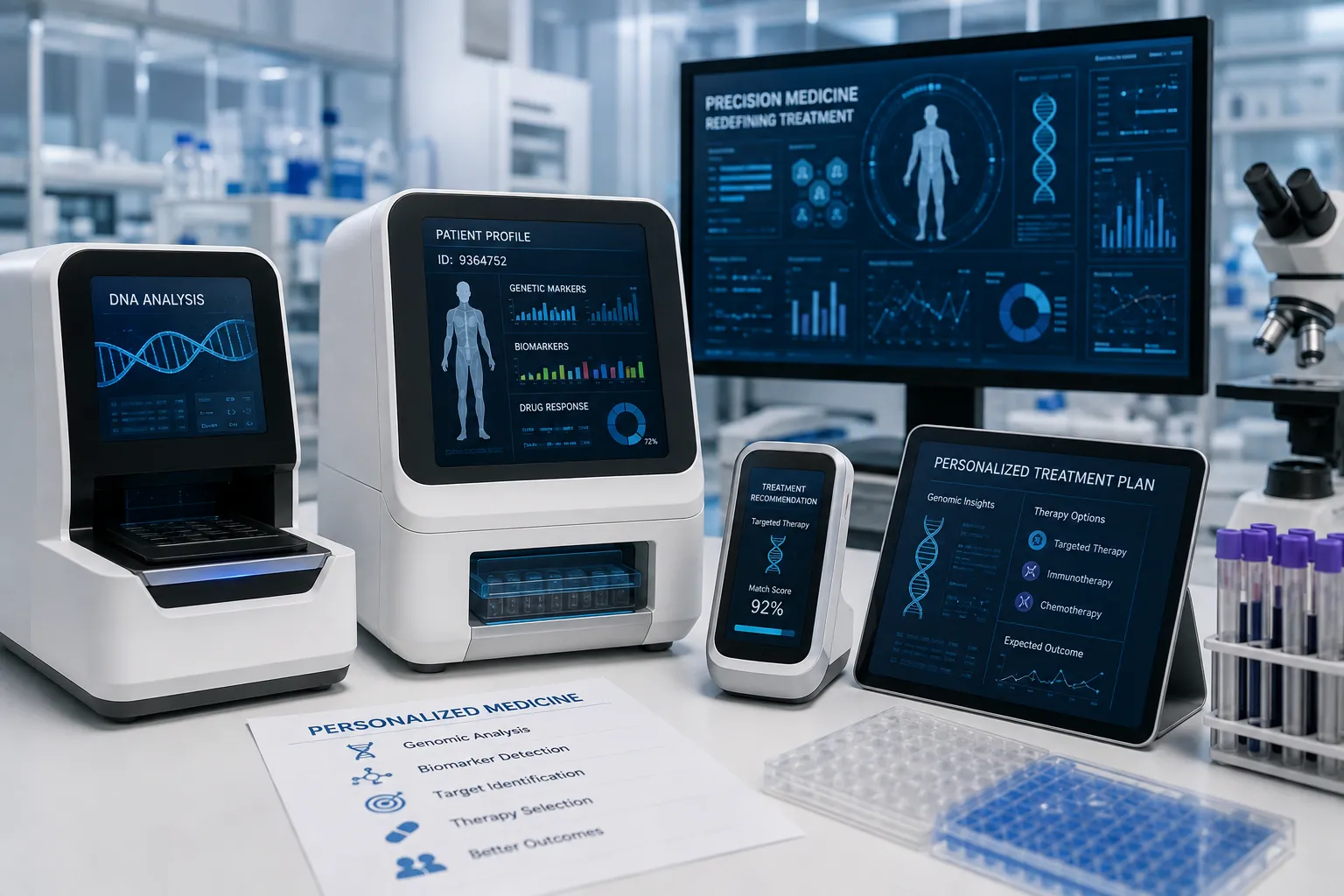
How personalised medicine changes equipment
Personalised medicine tailors treatment to the individual patient, using their biology, data and circumstances to guide care. As this approach grows, it changes the equipment behind it. Devices are increasingly designed to test precisely, deliver treatment in a targeted way, and handle the data that personalisation depends on. This article explains how personalised medicine is changing equipment design. It covers the shift towards precise diagnostics, targeted and flexible delivery, and connected, data-driven devices. It sets out what these mean for hospitals choosing equipment for the years ahead. The direction is already clear. The devices are being redrawn. Diagnostics change first.
From one-size-fits-all to tailored care
For much of medical history, equipment was built for the average case. A device did the same thing for every patient, and treatment was broadly standardised. Personalised medicine changes that starting point. It asks equipment to support care shaped around the individual, which places new demands on how devices test, deliver and connect. The treatment may be the headline, but the equipment behind it is being redesigned to match. The tailoring reaches the devices too. Design must follow the patient. The device serves the person.
This shift is worth understanding early, because the direction is clear even where the detail is still developing. Health bodies actively track this move towards precision, and the World Health Organisation's foresight work on emerging technologies exists to anticipate it. For a hospital, the useful question is not whether personalised medicine will affect its equipment, but which parts of the equipment picture it changes first. Diagnostics tend to feel it soonest. Delivery and data follow.
"Personalised medicine does not just tailor the treatment. It changes what the equipment behind it has to do."
Precise diagnostics come first
Personalised medicine begins with knowing the individual patient in detail, so precise diagnostics are central. Equipment that can test accurately, sometimes at the level of a patient's specific biology, becomes more important. This raises the value of advanced and point-of-care diagnostic equipment that can guide a tailored decision. Accuracy becomes the starting point. Everything else builds on it. Knowing the patient comes first.
For buyers, this means diagnostics move from a supporting role to a central one. The equipment that identifies who will benefit from which treatment is part of the treatment pathway itself. Choosing diagnostic equipment that is accurate, reliable and able to inform personalised decisions becomes a more strategic choice than before, not a routine one. The test now guides the treatment. That makes diagnostics central. They shape the pathway.
Targeted and flexible delivery
When treatment is tailored, delivery often has to be too. Equipment may need to deliver a specific dose, to a specific patient, in a specific way. That pushes device design towards precision, flexibility and control, rather than fixed, one-size delivery. The tool is increasingly shaped around the individual treatment. Fixed settings fit less well. Precision is the new default. Exact doses matter.
This connects to the wider trend of therapies made or adjusted for the individual. Delivery equipment that can be set precisely, and adapted to different needs, fits this world better than rigid, standardised kit. For a hospital, it means valuing flexibility and accuracy in delivery equipment, because personalised care rarely fits a single fixed setting. Flexibility earns its keep. One dose rarely fits all. Settings must adjust.
Data at the centre of the device
Personalisation depends on data: the information that describes a patient and guides their care. So equipment is increasingly designed to capture, share and use data well, not just to perform a mechanical task. A device that produces useful, connected data supports personalised care. One that keeps its data locked away does not. Data is now part of the device. Sharing is the point of it.
The question behind this is about connection and standards. Does the equipment share data on open, recognised ones, so it flows into the record and supports a fuller picture of the patient? Bodies such as the Medicines and Healthcare products Regulatory Agency set expectations for how such devices and their data are handled. Equipment designed around good, connected data fits personalised medicine far better than equipment that treats data as an afterthought. The record depends on it. Open standards make it flow cleanly.
Software that helps tailor care
Tailoring care to the individual involves interpreting complex information, and software increasingly helps with that. Intelligent tools can highlight patterns, sort data and support the choice of a personalised approach. This is the most discussed part of the trend, and the most misread. It is easy to assume the software makes the decision. It does not. The tool assists, it does not choose.
The settled direction is that these tools support the professional rather than replace them. They help skilled people tailor care, while the judgement stays human. Responsible routes exist to evaluate such tools as evidence grows, such as the NICE Early Value Assessment for promising health technologies. For a buyer, the honest questions are whether the software genuinely helps tailor care well, and whether its use can be governed and explained. The clinician still decides. Judgement stays human.
Flexible design for changing needs
Because personalised care varies from patient to patient, equipment that is flexible and adaptable fits it better than fixed, single-purpose kit. Modular, configurable and upgradeable design lets a device serve a range of needs and keep pace as personalisation grows. Rigid equipment can struggle as care becomes more individual. Adaptable design wins out. Single-purpose kit ages fast. Modular design lasts longer.
For buyers, this raises the value of adaptable, well-supported equipment that can be updated rather than replaced. A device that can flex with changing needs keeps earning its place. Personalised medicine rewards equipment designed to adapt, because the one thing it does not offer is a single, unchanging way of working. Change is the constant here. Equipment must move with it. Adaptability is key, since fixed kit falls behind.
What buyers should really be asking
-
Precise enough? Does diagnostic equipment support accurate, individual, treatment-guiding decisions?
-
Flexible in delivery? Can delivery equipment be set precisely and adapted to different needs?
-
Good with data? Does it capture and share data on open standards, into the record?
-
Adaptable? Can the equipment be configured and updated as personalised care grows?
What buyers should take from this
Personalised medicine is not just a new way to treat patients. It is a force that reshapes equipment design, from precise diagnostics and targeted delivery to connected data and flexible, adaptable devices. A hospital preparing for personalised care is really choosing equipment that can test precisely, deliver flexibly, handle data well and adapt over time. The patient shapes the choice. Design bends around them. The patient leads throughout. The horizon work that tracks such shifts, including the WHO horizon scan of emerging health technologies, exists to make that foresight ordinary rather than rare.
Underneath every trend sits one unchanging requirement. Precise, flexible, data-driven equipment is only worth having if it is genuine, approved and reliable, and if it does its core job well. The fundamentals of sound equipment outlast every shift in fashion. So the wise approach is to read where personalised medicine is taking device design, and to build on equipment that is dependable in the first place. Curious about what is coming, firm about what has always mattered.
More from Business
-
Buyers — source approved, well-documented equipment.
-
Suppliers — list your equipment and reach buyers worldwide.
-
Advertise — promote your products and services to a clinical audience.
-
Business overview — explore everything MediGear offers healthcare organisations.
Disclaimer
This article is for general information only and does not constitute clinical, procurement, regulatory or legal advice. The examples given are illustrative. Trends in medical equipment are general directions, not certainties, and their pace and relevance vary by market and setting. Requirements and standards change over time and should always be confirmed with the relevant authorities. Always consult qualified clinical, biomedical engineering and procurement professionals for decisions specific to your organisation. medigear.uk accepts no liability for actions taken on the basis of this content.
Buy for the future, built on the basics.
Genuine, approved, fully documented medical equipment — the dependable foundation every future trend still rests on, wherever you work.
Frequently Asked Questions
Personalised medicine tailors treatment to the individual, and this reshapes the equipment behind it. Devices are increasingly designed to test precisely, deliver treatment in a targeted, flexible way, handle data well, and adapt to changing needs. Diagnostics move to the centre of the pathway, delivery becomes more precise, and connected data becomes essential. Equipment design shifts from a one-size approach towards supporting care shaped around the individual.
Personalised medicine, also called precision medicine, tailors care to the individual patient using their biology, data and circumstances rather than a one-size-fits-all approach. It aims to give the right treatment to the right patient. Because it depends on knowing the individual in detail and delivering care precisely, it places new demands on diagnostic, delivery and data-handling equipment, changing how devices are designed.
Personalised medicine begins with knowing the individual patient in detail, so precise diagnostics come first. Equipment that tests accurately, and can guide a tailored decision, becomes part of the treatment pathway rather than a supporting step. This makes the choice of diagnostic equipment more strategic, because it helps identify who will benefit from which treatment, which is central to personalising care.
Yes. Personalisation depends on data that describes the patient and guides their care, so equipment is increasingly designed to capture, share and use data well. Devices that share data on open standards support a fuller picture of the patient and fit personalised care. Equipment that keeps its data locked away fits far less well, so connection and data handling are central to design, not afterthoughts.
No. The clear direction is that intelligent software supports professionals in tailoring care rather than replacing them. It can highlight patterns, sort complex data and support a personalised approach, while the judgement stays human. For buyers, the sensible questions are whether the software genuinely helps tailor care well and whether its use can be governed and explained.
Hospitals should ask whether diagnostic equipment supports precise, individual decisions, whether delivery equipment is flexible and accurate, whether devices handle and share data well on open standards, and whether equipment can adapt and update as personalised care grows. Choosing with these questions in mind, alongside reliability, builds a capability suited to care shaped around the individual patient.