
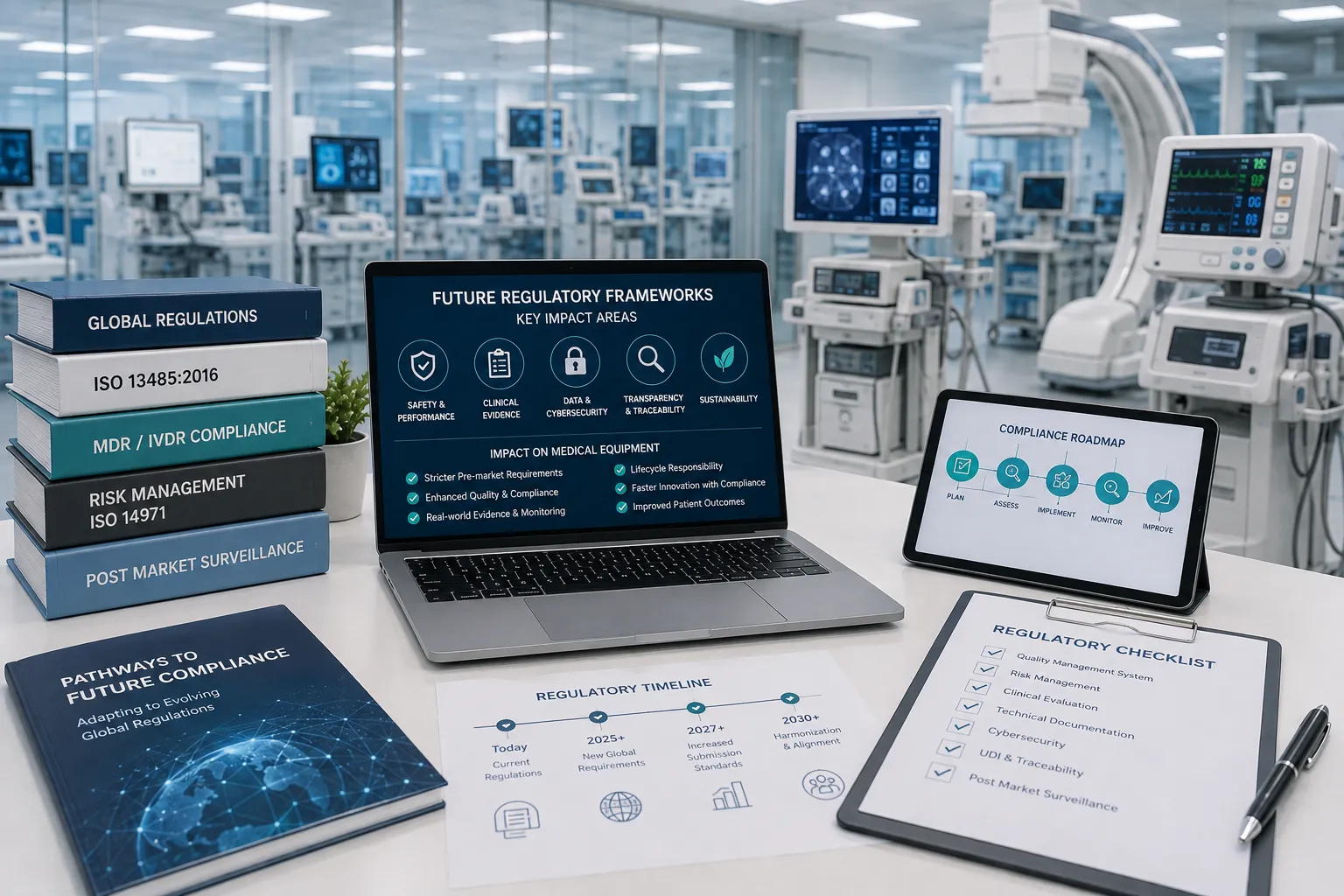
How will future regulation affect equipment?
As medical technology advances, the rules that govern it are evolving too. Regulation shapes what equipment can be sold and used, how it must be tested, and what evidence stands behind it. The direction is towards frameworks that keep pace with newer technology, especially software, data and connected devices, while keeping patient safety at the centre. This article explains how future regulatory frameworks will affect equipment. It sets out the main areas of change, and what they mean for hospitals and buyers, without offering legal advice. The direction is already clear. Safety stays at the centre.
Rules that keep pace with the technology
It is easy to see regulation as background detail. In fact, it shapes the equipment market directly, deciding what can be offered, how it is proven and what evidence supports it. As technology advances, regulation evolves to keep pace, particularly around software, data and connected devices that older rules did not fully anticipate. So the frameworks around equipment are changing alongside the equipment itself.
This matters to buyers as well as makers, because it affects what reaches the market and what to look for. Regulators such as the Medicines and Healthcare products Regulatory Agency set and update the standards equipment must meet. For a hospital, the useful question is not the fine detail of every rule, but the direction regulation is taking and what it means for the equipment it chooses. This article is general information, not legal advice. The trend is clear enough. Approved equipment is the safe path. Quality is rewarded.
"Regulation is not background detail. It shapes what equipment reaches the market and what stands behind it."
Regulating software and connected devices
One of the biggest areas of change is software, including software that acts as a medical device, and connected devices. As more equipment becomes software-driven and connected, regulation is developing to cover it properly. This is a significant shift, because software behaves differently from a traditional physical device and needs a suitable framework. Rules must adapt. Frameworks are developing. Software needs fit rules. New tech needs new rules.
For buyers, this raises the importance of choosing equipment from makers who take regulation seriously and keep pace with it. Frameworks for digital health are developing internationally, and the FDA's work on medical devices reflects this focus. Equipment backed by a maker who understands and meets evolving requirements is a safer choice than equipment from one who does not. Regulation and quality tend to go together. Serious makers keep pace. It shows in the product. Good makers comply fully. Quality shows through. Serious makers stand out.
Evidence and demonstrating value
Regulation increasingly emphasises evidence: showing that equipment does what it claims, safely and effectively. Future frameworks are likely to keep raising expectations for the evidence behind equipment, especially newer technologies. This is good for patients and for hospitals, because it supports trust in what equipment can do. Proof matters more now. Trust rests on evidence. Claims need backing.
For buyers, this makes the evidence behind equipment more important than ever. Equipment supported by solid evidence, from makers who invest in demonstrating value, fits the direction of travel. A stronger emphasis on evidence rewards makers who do things properly, and helps hospitals choose equipment they can trust. Evidence is becoming a central part of what equipment quality means. Proof supports trust. Claims need backing. Evidence builds confidence. Trust is earned.
Data, privacy and security
As equipment becomes more connected and data-driven, regulation around data, privacy and security grows in importance. Future frameworks are likely to pay close attention to how equipment handles data and keeps it secure. This is an essential part of trust in connected equipment, and it is developing quickly. Data must be secure. Privacy matters. Security is expected.
For buyers, this means asking how equipment manages data and security, not only how it performs clinically. Equipment designed with good data practices and security in mind fits evolving expectations, while equipment that treats these as afterthoughts may struggle. As connectivity spreads, data and security move from specialist concerns to central ones, shaping what good equipment looks like. Security is essential now. Data must be protected. Privacy is expected. Security is designed in.
Consistency across markets
Medical equipment is often sold across many countries, so how regulatory frameworks align across markets matters. Differences and alignment between regions shape what equipment is available and how it moves across borders. For a marketplace serving many countries, this is a practical reality, not just a technical one. Standards vary by region. Alignment aids trade. Recognised rules help. Standards ease movement.
For buyers, this means equipment that meets recognised international standards travels and fits more easily. Frameworks such as the European Union's medical device rules are part of this wider picture. Equipment made to strong, recognised standards is generally a safer, more portable choice, while equipment that meets only narrow local requirements may be more limited. Recognised standards support both safety and availability. Standards travel well. They aid access.
What regulation means for buyers
For a hospital, the practical effect of evolving regulation is that it shapes what equipment is available, what evidence stands behind it, and how much it can be trusted. Rather than tracking every rule, buyers can focus on choosing equipment that is properly approved, well evidenced and made by responsible makers. Regulation, at its best, works in the buyer's favour. It protects patients. It rewards quality. Buyers benefit too. Quality is encouraged.
So the sensible response is not anxiety about complexity, but a preference for equipment that clearly meets its requirements. Equipment that is genuine, approved and backed by makers who take regulation seriously is exactly what evolving frameworks are designed to encourage. For buyers, keeping to properly regulated, well-evidenced equipment is both the safe path and the one regulation rewards. Approval signals quality. It protects patients.
What buyers should really be asking
-
Properly approved? Is the equipment genuine, approved and backed by responsible makers?
-
Well evidenced? Is there solid evidence that it does what it claims, safely?
-
Sound on data? Does it handle data and security in line with evolving expectations?
-
Recognised standards? Does it meet strong, internationally recognised standards?
What buyers should take from this
How future regulatory frameworks affect equipment comes down to this: regulation shapes what reaches the market, what evidence stands behind it and how far it can be trusted, evolving especially around software, data and connected devices. A hospital does not need to track every rule, but can focus on equipment that is properly approved, well evidenced and made by responsible makers. The horizon work that informs this, such as the WHO foresight work on emerging technologies, exists to make such foresight ordinary rather than rare.
Underneath every change sits one unchanging requirement. Whatever the framework, equipment is only worth having if it is genuine, approved and reliable, and does its core job well. The fundamentals of sound equipment outlast every shift in fashion, and regulation at its best exists to protect exactly those fundamentals. So the wise approach is to follow where regulation is heading, while insisting on equipment that is dependable in the first place. This article is general information and not legal advice. Curious about what is changing, firm about what has always mattered.
More from Business
-
Buyers — source approved, well-documented equipment.
-
Suppliers — list your equipment and reach buyers worldwide.
-
Advertise — promote your products and services to a clinical audience.
-
Business overview — explore everything MediGear offers healthcare organisations.
Disclaimer
This article is for general information only and does not constitute clinical, procurement, regulatory or legal advice. The examples given are illustrative, and this article is general information rather than legal or regulatory advice. Trends in medical equipment are general directions, not certainties, and their pace and relevance vary by market and setting. Requirements and standards change over time and should always be confirmed with the relevant authorities. Always consult qualified clinical, biomedical engineering and procurement professionals for decisions specific to your organisation. medigear.uk accepts no liability for actions taken based on this content.
Buy for the future, built on the basics.
Genuine, approved, fully documented medical equipment — the dependable foundation every future trend still rests on, wherever you work.
Frequently Asked Questions
Regulation shapes what equipment can be sold and used, how it must be tested, and what evidence stands behind it. Future frameworks are evolving to keep pace with newer technology, especially software, data and connected devices, while keeping patient safety central. For hospitals, this affects what reaches the market and what to look for, so the practical response is to choose equipment that is properly approved, well evidenced and made by responsible makers.
As medical technology advances, particularly with software-driven and connected devices, older rules did not fully anticipate how it behaves. Regulation is evolving to cover these properly, because software and connected devices differ from traditional physical equipment and need suitable frameworks. The direction is towards rules that keep pace with the technology while keeping patient safety at the centre, which affects what equipment reaches the market.
Software as a medical device is software that performs a medical function in its own right, rather than simply running a physical machine. As more equipment becomes software-driven and connected, regulation is developing to cover it properly, since software behaves differently from a traditional device. For buyers, this raises the importance of choosing equipment from makers who understand and keep pace with these evolving requirements.
Regulation increasingly emphasises showing that equipment does what it claims, safely and effectively, and future frameworks are likely to keep raising expectations for evidence, especially for newer technologies. This is good for patients and hospitals because it supports trust. It also makes the evidence behind equipment more important when buying, rewarding makers who invest in demonstrating value and helping hospitals choose equipment they can trust.
As equipment becomes more connected and data-driven, regulation around data, privacy and security grows in importance, and future frameworks are likely to pay close attention to how equipment handles and protects data. This is an essential part of trust in connected equipment. For buyers, it means asking how equipment manages data and security, not only how it performs clinically, since these are becoming central to what good equipment looks like.
Rather than tracking every rule, buyers can focus on choosing equipment that is properly approved, well evidenced, sound on data and security, and made to recognised standards by responsible makers. Regulation at its best works in the buyer's favour, encouraging exactly this kind of equipment. Keeping to properly regulated, well-evidenced equipment is both the safe path and the one regulation rewards. This is general guidance, not legal advice.