
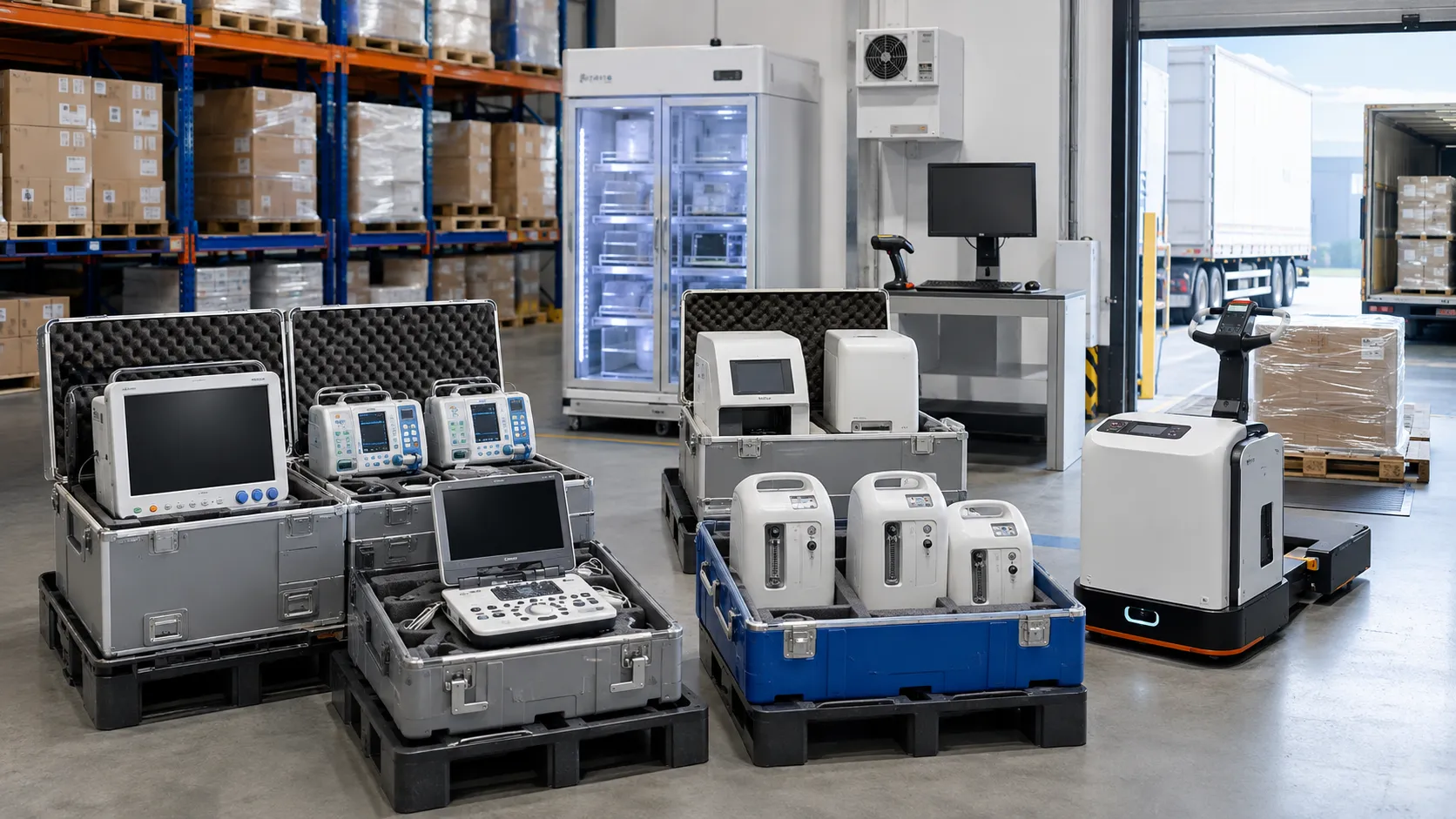
How medical equipment supply chains are changing
How medical equipment reaches hospitals is being rethought worldwide. Recent years have shown how much a hospital's ability to care depends not just on what equipment it buys, but on the supply chains that deliver it. The direction is towards supply chains that are more resilient to disruption, more traceable end to end, more diversified across suppliers and regions, and more sustainable in how they operate. This article sets out the main trends shaping the future of medical equipment supply chains, and what they mean for buyers. The direction is already clear. Supply now matters visibly to buyers everywhere in health services.
How equipment reaches hospitals matters
It is easy to picture medical equipment as a device on a shelf. In fact, that device is the end of a long chain of makers, suppliers, transport and logistics. When that chain works, it is invisible to the hospital. When it breaks, hospitals feel it quickly and painfully. So the future of supply chains is really the future of whether hospitals can count on getting what they need, when they need it, in good condition, over the long run. That is a central concern, not a background one.
This matters more than it used to because the disruptions of recent years exposed weaknesses that were easy to overlook. Bodies that work on global health recognise the importance of dependable supply and appropriate equipment, and the World Health Organisation's work on medical devices reflects it. For a buyer, the useful question is not only which equipment to choose, but how confident they can be that it will keep arriving as needed. Supply is part of value, not just background detail. Confidence matters here too, across the years of a hospital's work in care.
"A device is only as reliable as the supply chain that delivers it, keeps it running and replaces it in time."
Resilience in disruption
A major trend is building resilience into supply chains, so hospitals are less exposed when disruption happens. Equipment that can be sourced and supported through a chain designed for resilience is more dependable in a crisis. This has moved from a specialist concern to a mainstream part of thinking about equipment supply for buyers.
For buyers, this raises the value of supply arrangements that have been thought through for real-world conditions, not just for smooth times. Equipment from suppliers who take resilience seriously fits this direction. Cheapness on the surface can hide fragility beneath, which becomes expensive when the chain breaks under pressure. Resilience is now part of the true value of equipment supply. Fragility costs later. Robust chains save money and trouble over time in disruptions of any kind in the wider system.
Traceability end to end.
Supply chains are becoming more traceable, so hospitals can know where equipment has come from and how it has been handled. Traceability supports safety, quality and confidence in the equipment received throughout the whole supply chain. It also supports faster response when something goes wrong, because a problem can be traced back to its source quickly.
For buyers, this makes traceability part of what a supply chain should offer. Equipment that comes with clear, dependable traceability supports safer buying than equipment whose origins and handling are opaque. Standards and safety expectations for equipment are set by bodies such as the Medicines and Healthcare products Regulatory Agency, and traceability is part of how those expectations are met in practice. Origins should be clear. Handling should be known through the chain end to end for the safety of patients and staff alike.
Diversified suppliers and regions
A concentrated supply chain, dependent on a small number of suppliers or regions, is fragile. Diversification, across suppliers and geographies, spreads risk and gives hospitals more confidence in ongoing access to equipment. This is a lesson recent disruptions have taught clearly, and it is shaping how supply is planned for the future.
For buyers, this makes diversified supply part of a healthier equipment picture. Working with suppliers who themselves draw on diversified sources, rather than concentrated ones, reduces exposure to single points of failure in the wider chain. Diversification is not about spreading effort thinly, but about protecting a hospital's ability to keep working when parts of the wider system come under pressure. Concentration is a risk. Spread supports resilience against disruption at any point in the wider system of health across regions.
Sustainability in supply
Supply chains are also being asked to become more sustainable, from how equipment is made and packaged to how it is transported. Reducing waste, using resources more efficiently and lowering the environmental impact of supply are moving from optional to expected in modern practice. Sustainability is part of how good supply chains are now judged.
For buyers, this connects equipment choices to their wider impact. Equipment from suppliers who take sustainability seriously fits the direction of travel, and often reflects a broader discipline of doing things well across the operation. Sustainability in supply is not just an ethical question but a signal of how a supplier operates overall, which matters when a hospital is choosing partners for the long term. Discipline shows through. Long-term choices matter for hospitals and their partners over years of partnership between supplier and hospital.
Choosing suppliers, not just products.
All of this points to a shift in how buyers should think. Choosing equipment is increasingly also choosing suppliers and the supply chains behind them. The device is one part of the picture; the supplier's ability to keep delivering it, support it and stand behind it is the other part of the deal. Both matter, and neither is a substitute for the other.
For buyers, this makes supplier judgement a real part of buying well. Suppliers who take resilience, traceability, diversification and sustainability seriously offer more than suppliers who do not. Equipment is bought with a supplier attached, and that supplier's supply chain shapes the value of the equipment over its life. Choosing well means looking at both. Supplier and product go together. Neither is enough alone in equipment supply, when it matters most in care.
What buyers should really be asking
-
Resilient? Can the supply chain cope with disruption without leaving the hospital exposed?
-
Traceable? Is the equipment's origin and handling clearly documented end-to-end?
-
Diversified? Is the supply drawn from a healthy range of suppliers and regions?
-
Sustainable and well-run? Does the supplier take sustainability and quality seriously?
What buyers should take from this
The future of medical equipment supply chains worldwide is a move towards more resilient, traceable, diversified and sustainable ways of getting equipment to hospitals. A hospital buying well is really choosing suppliers as much as products, and looking at the supply chain behind the device as part of the value it will deliver. The horizon work that informs this, such as the WHO horizon scan of emerging health technologies, exists to make such foresight ordinary rather than rare.
Underneath every trend sits one unchanging requirement. However well-designed a supply chain is, the equipment at the end of it must still be genuine, approved and reliable, and do its core job well. The fundamentals of sound equipment outlast every shift in fashion. So the wise approach is to prize dependable supply and dependable equipment together. Curious about how supply chains are changing, firm about what has always mattered.
More from Business
-
Buyers — source approved, well-documented equipment.
-
Suppliers — list your equipment and reach buyers worldwide.
-
Advertise — promote your products and services to a clinical audience.
-
Business overview — explore everything MediGear offers healthcare organisations.
Disclaimer
This article is for general information only and does not constitute clinical, procurement, regulatory or legal advice. The examples given are illustrative. Trends in medical equipment are general directions, not certainties, and their pace and relevance vary by market and setting. Requirements and standards change over time and should always be confirmed with the relevant authorities. Always consult qualified clinical, biomedical engineering and procurement professionals for decisions specific to your organisation. medigear.uk accepts no liability for actions taken based on this content.
Buy for the future, built on the basics.
Genuine, approved, fully documented medical equipment — the dependable foundation every future trend still rests on, wherever you work.
Frequently Asked Questions
The future of medical equipment supply chains is a move towards greater resilience in disruption, clearer end-to-end traceability, diversified sourcing across suppliers and regions, and more sustainable operation. Recent disruptions have shown that how equipment reaches hospitals matters as much as what it is, so supply chains have moved from a background concern to a central one. Choosing equipment is increasingly also choosing suppliers and the chains behind them.
Recent years have shown that hospitals depend not just on the equipment they buy but on the supply chains that deliver it. Resilient supply chains help hospitals stay supported when disruption happens, so equipment from suppliers who take resilience seriously is more dependable in a crisis. Cheapness at the surface can hide fragility beneath, which becomes expensive when the chain breaks, so resilience is part of the true value of equipment supply.
Traceability means being able to know where equipment has come from and how it has been handled through the supply chain. It supports safety, quality and confidence in the equipment received, and it supports faster response when something goes wrong because a problem can be traced back to its source. Equipment that comes with clear, dependable traceability supports safer buying than equipment whose origins and handling are opaque.
A concentrated supply chain, dependent on a small number of suppliers or regions, is fragile. Diversification across suppliers and geographies spreads risk and gives hospitals more confidence in ongoing access to equipment. This is not about spreading effort thinly, but about protecting a hospital's ability to keep working when parts of the wider system come under pressure, which recent disruptions have shown to be a real concern.
Sustainability in supply chains means reducing waste, using resources more efficiently and lowering environmental impact across how equipment is made, packaged and transported. This is moving from optional to expected, and it often reflects a broader discipline of doing things well. Equipment from suppliers who take sustainability seriously fits the direction of travel and can signal how a supplier operates overall, which matters when choosing partners for the long term.
Hospitals should ask whether the supply chain is resilient enough to cope with disruption, whether the equipment's origin and handling are clearly traceable, whether the supply is drawn from a healthy range of suppliers and regions, and whether the supplier takes sustainability and quality seriously. Because choosing equipment is increasingly also choosing suppliers, judging the supplier and their supply chain is part of buying well, alongside judging the product itself.