
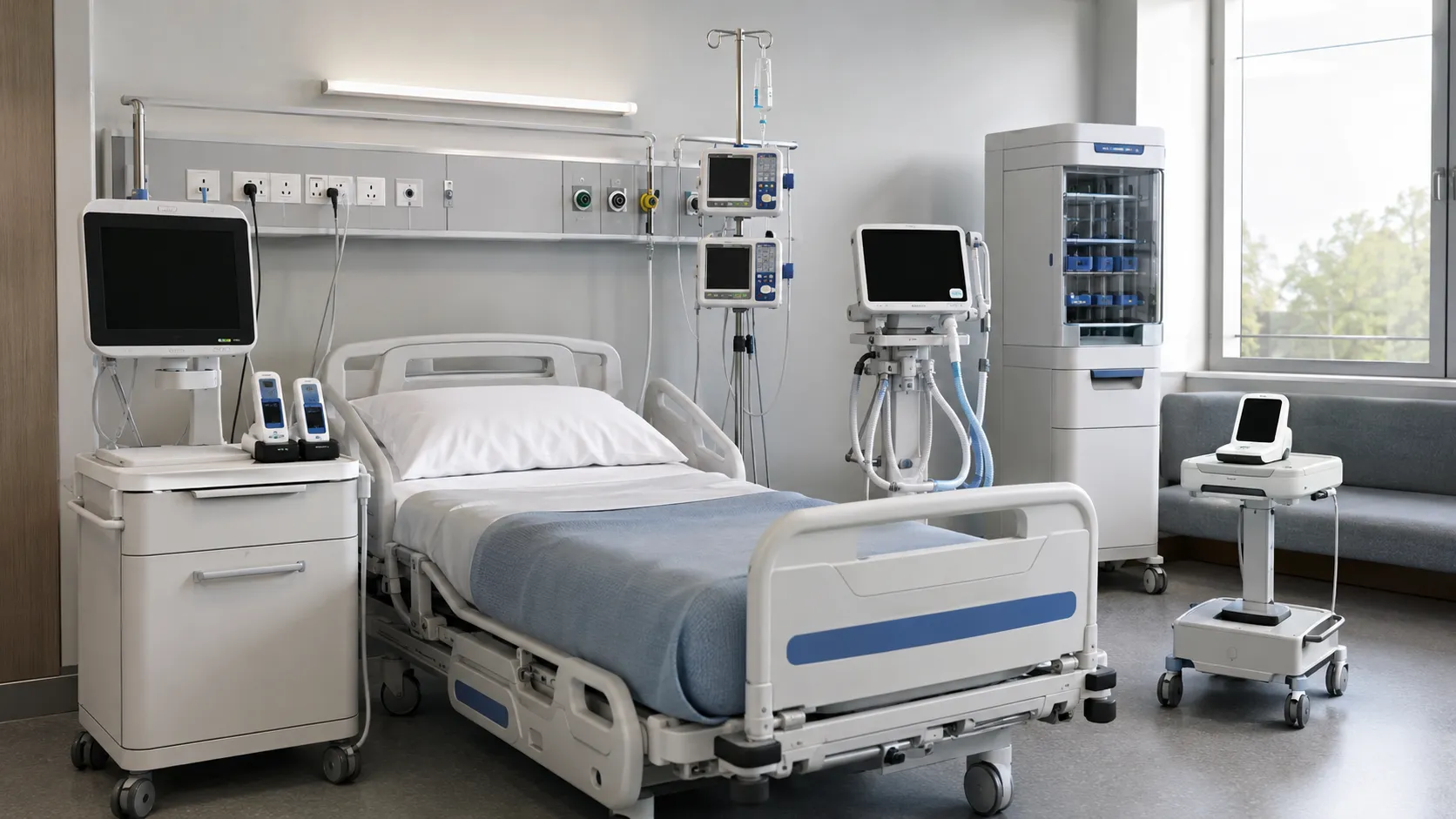
How connected devices fit into smart hospitals
A smart hospital links devices, systems and environments so that information flows across the whole building, not just within individual departments. Connected medical devices are one important layer of that picture, alongside asset tracking, environmental monitoring and integrated command centres. Together, these turn a hospital into a place where information supports the whole operation. This article sets out where connected medical devices fit in the wider smart hospital, and what buyers should consider. The direction is already clear. The whole building shares information. Departments join up. The picture is fuller across the building, and better decisions become possible across the operation of the building as a whole.
The whole hospital, joined up.
It is easy to think of connectivity as a feature of individual devices. In a smart hospital, connectivity is a whole-building idea. Medical devices, asset tracking, environmental systems and command centres share information so the hospital can be understood and run as a whole. This is a wider view than any single connected device, and it changes how a hospital thinks about the equipment it buys.
None of this replaces the clinical work at the heart of care, and none of it removes the need for reliable core equipment. Smart hospitals are about supporting that work with better information across the building. Bodies that scan the horizon for healthcare recognise this direction, and the World Health Organisation's foresight work on emerging technologies reflects it. For a hospital, the useful question is how connected devices fit into a wider joined-up picture. Devices join the whole. Standards make it work. Isolation limits value. Connection multiplies it across the hospital, wherever devices join up on standards and share their data cleanly across the network.
"A smart hospital is not a set of clever devices. It is a building that shares information about itself."
Medical devices as one layer
Connected medical devices form one important layer of a smart hospital. Monitors, infusion equipment, imaging and other devices that share their data support a fuller, joined-up view of the patient and the department. Devices whose data stay isolated hold a smart hospital back, while those that connect on open standards fit into it naturally.
For buyers, this makes connectivity part of what a medical device offers, not a bonus feature. Equipment that connects cleanly on recognised standards fits the wider smart hospital picture, while equipment that locks a hospital into one supplier or keeps its data to itself fits it less well. Standards-based connection is central to the value of connected devices. Open standards connect. Locked data isolates. Interoperability is essential. Silos hold back care and slow coordination between teams and departments across the hospital.
Asset tracking and equipment visibility
Beyond individual devices, smart hospitals often use asset tracking to know where equipment is and how it is being used. This visibility can support better use of equipment, faster access when it is needed and more informed planning. It turns equipment from a static inventory into something the hospital can see and understand in near real time.
For buyers, this widens the picture of how connected devices deliver value. Equipment that can be tracked and managed as part of a smart hospital's asset picture fits this direction. Devices that resist visibility make the wider hospital picture harder to build. Being knowable, as well as connectable, is becoming part of what good equipment looks like. Visibility supports care. Tracking supports planning. Assets become knowable. Use improves as a result of visibility and better planning across the day and week of care.
Environmental and building systems
Smart hospitals also connect to their environment, from clinical spaces to the building around them. Environmental information supports safety, comfort and efficient operation, and it becomes more valuable when it is joined up with the rest of the hospital. Medical devices sit within this environment and can benefit from it being understood.
For buyers, this connects equipment choices to the wider setting they work in. Equipment that fits and can share information with the environmental picture of a smart hospital adds more than equipment that stands apart. The wider building matters for medical equipment, and equipment that recognises this fits the smart hospital direction of travel far better. The setting matters. Fit shapes value. Environment plays its part. Devices sit within it, and benefit from it being understood in detail and in real time as things change.
Command centres and coordinated operation
One of the clearest expressions of a smart hospital is the command centre, where information from across the building is brought together to support coordinated operation. This is where connected devices, asset tracking and environmental information can support decisions about the whole hospital, from patient flow to resource use.
For buyers, this makes it worth choosing equipment that can support a bigger, coordinated view. Equipment that shares useful information into the wider system helps a command centre function, while equipment whose data stays isolated offers less. Software and connected systems are increasingly considered within digital health frameworks, such as the FDA Digital Health Centre of Excellence, reflecting how central this space has become. Coordination helps care. Shared data supports decisions. The bigger picture guides. Individual devices contribute to it in their own roles, each with its part to play in the whole. The result is coordinated care across the hospital, from clinical work to logistics and building services.
Standards, security and reliability
None of this works without standards, security and reliability. A smart hospital depends on devices and systems that connect on recognised standards, protect the information they share and work dependably. Weakness in any of these undermines the whole picture, so they are central concerns, not afterthoughts.
For buyers, this makes standards, security and reliability part of every connected device decision. Equipment that meets recognised standards, handles data securely and is dependable fits the smart hospital direction. Equipment that treats these as afterthoughts fits it far less well. The best smart hospitals are built on connected devices whose fundamentals are strong. Reliability underpins it. Security protects it. Fundamentals matter most. Standards support the whole picture end to end, across the building.
What buyers should really be asking
-
Standards-based? Do connected devices share information on open, recognised standards?
-
Trackable? Can equipment be seen and managed as part of the hospital's asset picture?
-
Environment-aware? Does the equipment fit within the wider smart hospital and its systems?
-
Secure and reliable? Are standards, security and dependability treated as central?
What buyers should take from this
The future of connected medical devices in smart hospitals is a whole-building picture where devices, asset tracking, environmental systems and command centres share information to support the operation as a whole. A hospital choosing well is really choosing equipment that fits this wider picture, on open standards and with security and reliability at its heart. The horizon work that informs this, such as the WHO horizon scan of emerging health technologies, exists to make such foresight ordinary rather than rare.
Underneath every trend sits one unchanging requirement. Connected medical devices are only worth having if they are genuine, approved and reliable, and share information dependably and securely. The fundamentals of sound equipment outlast every shift in fashion. So the wise approach is to build the smart hospital picture on connected devices with strong fundamentals. Curious about smart hospitals, firm about what has always mattered.
More from Business
-
Buyers — source approved, well-documented equipment.
-
Suppliers — list your equipment and reach buyers worldwide.
-
Advertise — promote your products and services to a clinical audience.
-
Business overview — explore everything MediGear offers healthcare organisations.
Disclaimer
This article is for general information only and does not constitute clinical, procurement, regulatory or legal advice. The examples given are illustrative. Trends in medical equipment are general directions, not certainties, and their pace and relevance vary by market and setting. Requirements and standards change over time and should always be confirmed with the relevant authorities. Always consult qualified clinical, biomedical engineering and procurement professionals for decisions specific to your organisation. medigear.uk accepts no liability for actions taken based on this content.
Buy for the future, built on the basics.
Genuine, approved, fully documented medical equipment — the dependable foundation every future trend still rests on, wherever you work.
Frequently Asked Questions
A smart hospital links devices, systems and environments so that information flows across the whole building, not just within individual departments. Connected medical devices are one important layer, alongside asset tracking, environmental monitoring and integrated command centres. Together, these turn a hospital into a place where information supports the whole operation, from patient care to planning and resource use, on a foundation of dependable core equipment.
Connected medical devices form one important layer of a smart hospital, from monitors and infusion equipment to imaging and other devices that share their data. This supports a fuller, joined-up view of the patient and the department. Devices whose data stay isolated hold a smart hospital back, while those that connect on open standards fit into it naturally, so standards-based connection is central to the value of connected devices.
Asset tracking uses connected systems to know where equipment is and how it is being used. This visibility can support better use of equipment, faster access when needed and more informed planning, turning equipment from a static inventory into something the hospital can see and understand in near real time. Equipment that can be tracked and managed as part of the smart hospital's asset picture adds value beyond its clinical function.
Smart hospitals also connect to their environment, from clinical spaces to the building around them. Environmental information supports safety, comfort and efficient operation, and it becomes more valuable when it is joined up with the rest of the hospital. Medical devices sit within this environment and benefit from it being understood, so equipment that fits and shares information with the environmental picture adds more than equipment that stands apart.
A hospital command centre brings information from across the building together to support coordinated operation. This is where connected devices, asset tracking and environmental information can support decisions about the whole hospital, from patient flow to resource use. Equipment that shares useful information into the wider system helps a command centre function, while equipment whose data stays isolated offers less to this coordinated view.
Standards, security and reliability matter most. A smart hospital depends on devices and systems that connect on recognised standards, protect the information they share and work dependably. Weakness in any of these undermines the whole picture, so they are central concerns rather than afterthoughts. Equipment that meets recognised standards, handles data securely and is dependable fits the smart hospital direction far better than equipment that treats these as afterthoughts.