
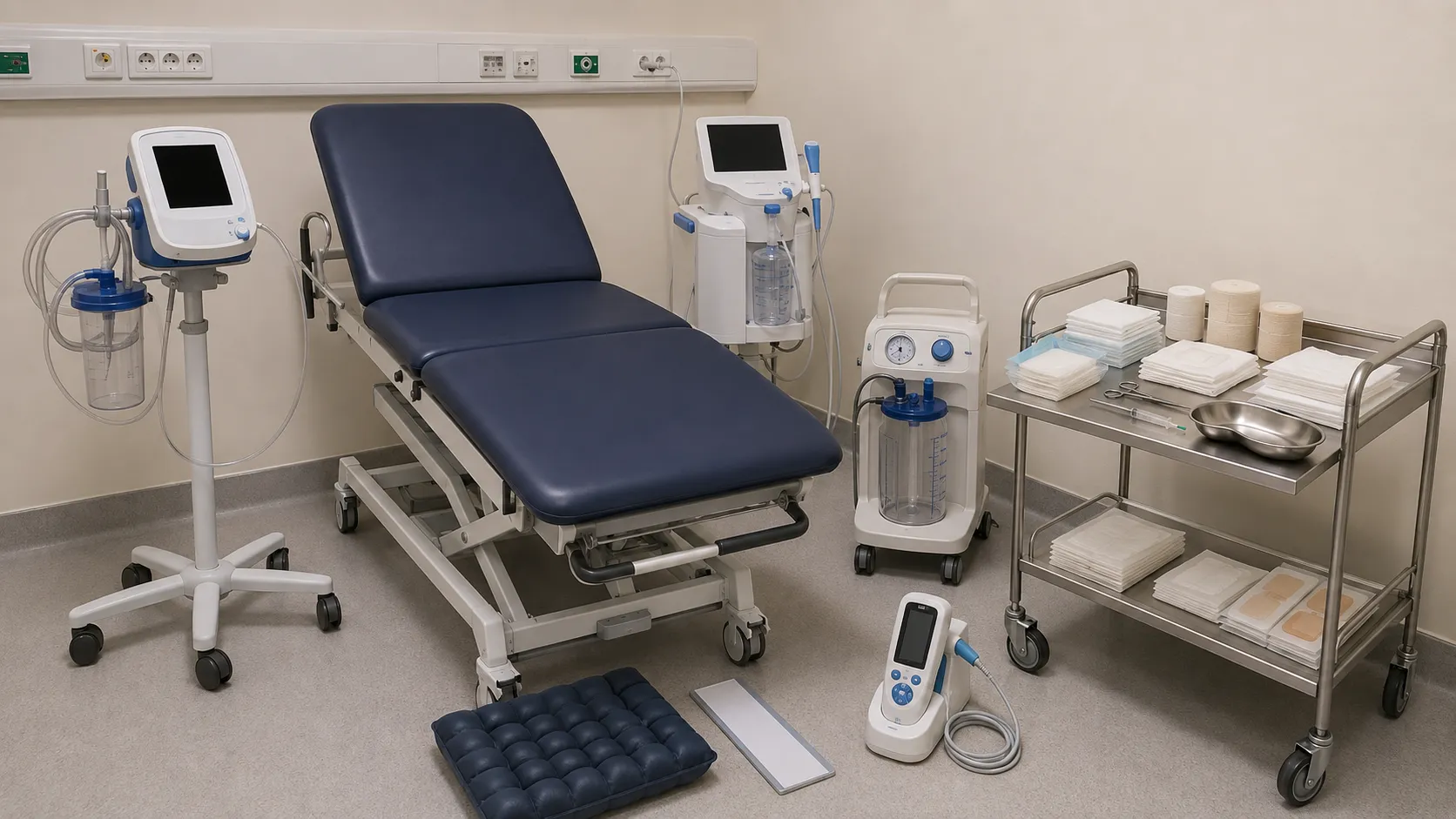
Introduction
Wound care has become a clinical speciality in its own right, and effective wound management depends on the right equipment at every stage. Hospital wound care equipment spans the negative-pressure and debridement systems that prepare and progress wounds, the assessment tools that measure and document, and the irrigation and advanced dressing systems that promote healing. Understanding those groups helps any wound service plan, compare options and budget sensibly.
This guide walks through the main types of wound care equipment used in hospitals worldwide, what each does, where it fits, and how to choose — with notes on approval across the UK, the EU, the US, the Gulf (GCC) states, and South Africa.
The short version — wound care equipment in three groups
Most wound care equipment falls into one of three groups — wound preparation and debridement, negative-pressure and active therapy, and assessment and documentation.
-
Preparation & debridement — irrigation, debridement devices and larval therapy that clean and prepare the wound.
-
Active therapy — negative-pressure wound therapy (NPWT) and other devices that actively promote healing.
-
Assessment & documentation — wound measurement, imaging and documentation tools that track progress.
Types of wound care equipment
-
Negative-pressure wound therapy. NPWT machines with disposable canisters and foam or gauze dressings that apply controlled suction to promote healing.
-
Wound irrigation systems. Pulsed and pressure wound irrigators that clean wounds by removing bacteria and debris.
-
Debridement devices. Ultrasonic, hydrosurgical and mechanical debridement tools that remove devitalised tissue.
-
Larval therapy. Medical-grade sterile larvae that debride chronic wounds by removing slough and necrotic tissue.
-
Wound assessment tools. Rulers, depth probes, wound cameras and digital planimetry that measure and document wounds.
-
Photobiomodulation. Low-level laser and LED therapy devices used to promote tissue healing in chronic wounds.
-
Compression therapy. Compression bandaging machines and hosiery systems for venous leg ulcers and lymphoedema.
-
Wound imaging & documentation. Digital cameras, structured-light and fluorescence imaging systems for wound assessment and reporting.
What each type does
|
Category |
Examples |
Used for |
|
NPWT |
Negative-pressure machines and kits |
Active suction wound healing |
|
Wound irrigation |
Pulsed irrigators, syringes |
Cleaning wounds |
|
Debridement |
Ultrasonic, hydrosurgical, mechanical |
Removing devitalised tissue |
|
Larval therapy |
Sterile larvae dressings |
Biological debridement |
|
Assessment tools |
Rulers, probes, cameras |
Measuring and documenting |
|
Photobiomodulation |
LLLT and LED therapy |
Stimulating tissue healing |
|
Compression therapy |
Compression bandaging, hosiery |
Venous ulcer and lymphoedema |
|
Wound imaging |
Digital and fluorescence cameras |
Recording and reporting |
Debridement methods compared
Wound debridement removes dead tissue to allow healing, and several methods are used for different wound types.
|
Method |
How it works |
Best for |
Consider |
|
Surgical/sharp |
Scalpel or scissors |
Quick removal of thick necrosis |
Skill; pain; bleeding |
|
Ultrasonic |
Ultrasound energy in fluid |
Selective, precise debridement |
Cost; equipment needed |
|
Hydrosurgical |
Water jet under pressure |
Large sloughy wounds |
Cost; fluid management |
|
Larval |
Biological larval activity |
Chronic sloughy wounds |
Patient acceptance |
Most wound services combine methods — sharp debridement for fast removal, NPWT or larval therapy for ongoing management, and autolytic dressings for maintenance.
Equipping a wound care service?
We'll help you choose the right kit. Tell us the wound types, your patient group and your market — we'll help you pick wound care equipment that fits your service and is approved for use where you'll use it.
No pressure, no obligation. → Talk to the team
Wound care equipment by setting
-
Hospital wound care services - the full range — NPWT, debridement, irrigation, assessment and compression for complex wounds.
-
Surgical wards - NPWT for post-operative and dehisced wounds, irrigation and assessment.
-
Community and district nursing - portable NPWT, irrigation and assessment tools for wound management at home.
-
Vascular and leg-ulcer clinics - compression therapy, assessment and imaging for venous and arterial leg wounds.
-
Burns services - specialist wound irrigation, dressing and assessment equipment for burn injuries.
Choosing wound care equipment
-
Define the wound types and patient volumes the service must treat.
-
Match NPWT, debridement and irrigation to the wound complexity.
-
Choose assessment tools that integrate with clinical documentation.
-
Confirm market approval and the device class for NPWT and active devices.
-
Plan consumables — canisters, dressings and irrigation fluid — into the running cost.
NPWT consumables and disposable kits dominate the running cost of wound services — weigh capital purchase against rental, confirm consumable supply chains, and plan device servicing before you invest.
Emerging wound care technology
-
Fluorescence imaging. Point-of-care fluorescence cameras detect bacterial bioburden before it is clinically visible.
-
Smart wound dressings. Sensor-embedded dressings monitor moisture, temperature and bacterial load continuously.
-
Portable NPWT. Smaller, lighter NPWT devices enable therapy in the community and at home.
-
AI-assisted assessment. Software analyses wound photographs for size, depth and tissue type automatically.
-
Bioactive materials. Growth-factor and matrix dressings provide biological signals to stimulate healing.
Approval by region
|
Region |
Regulator |
Requirement |
|
United Kingdom |
UKCA mark (CE accepted to 2028–2030) |
|
|
European Union |
CE marking under the EU MDR |
|
|
United States |
510(k) clearance or PMA approval |
|
|
Gulf (GCC) |
SFDA & GCC bodies |
National registration / GCC conformity |
|
South Africa |
Medical device licensing |
NPWT systems and active wound therapy devices are regulated as medical devices, often at a higher risk class. For clinical and quality guidance, the NICE and World Health Organisation resources are useful references. Our buyer hub sets out how to purchase with confidence.
More from Business
-
Buyers — source NPWT, debridement and wound care equipment for your hospital or clinic.
-
Suppliers — list your wound care and tissue viability equipment and reach buyers worldwide.
-
Advertise — promote your products and services to a clinical audience.
-
Business overview — explore everything MediGear offers healthcare organisations.
Disclaimer
This article is for general information only and does not constitute clinical, wound care, medical, procurement or regulatory advice. Wound care equipment, techniques, requirements and regulations vary by country, setting and need, and change over time. Always confirm that equipment suits the intended clinical use and is approved for your market (for example, UKCA, CE under the EU MDR, FDA, SFDA/GCC or SAHPRA), and consult qualified wound care, nursing, biomedical engineering and procurement professionals for decisions specific to your organisation. medigear.uk accepts no liability for actions taken based on this content.
The right wound care equipment for your service.
From negative-pressure wound therapy and debridement to wound irrigation, assessment and advanced dressing systems, we supply wound care equipment to hospitals and clinics across the UK, Europe, the US, the Gulf and South Africa.
Frequently Asked Questions
Wound care equipment covers negative-pressure wound therapy systems with disposable canisters and dressings, wound irrigation devices, debridement tools including ultrasonic, hydrosurgical and mechanical systems, larval therapy, wound assessment and documentation tools such as cameras and digital planimetry, photobiomodulation devices, compression therapy for venous wounds, and wound imaging systems.
Negative-pressure wound therapy uses a sealed foam or gauze dressing connected to a pump that applies controlled sub-atmospheric pressure to the wound. This removes exudate, reduces oedema, promotes granulation tissue and draws wound edges together. It is widely used for complex, surgical and chronic wounds, and both stationary hospital units and portable devices are available for community use.
Wound debridement removes devitalised, infected or necrotic tissue to allow healing. Equipment used includes sharp or surgical debridement with scalpels and scissors, ultrasonic debridement devices that use sound energy in a saline stream, hydrosurgical systems using a pressurised water jet, and medical-grade sterile larvae for biological debridement of sloughy chronic wounds.
NPWT pump units are available as certified refurbished or rental equipment. Confirm certified refurbishment, a warranty, servicing and consumable supply, and check the device is approved for your market. Disposable components — canisters, dressings and tubing — are single-use and cannot be refurbished. Assess whether purchase or rental is more cost-effective for lower-volume services.
NPWT and active wound care devices are regulated as medical devices and must be approved for the market — UKCA or CE under the EU MDR in the UK and EU, FDA clearance in the US, and SFDA or SAHPRA registration in the Gulf and South Africa. Consumables used with the device must also be compatible and approved for use together.
Wound assessment uses rulers and depth gauges for basic measurement, specialised wound cameras and structured-light devices for accurate area and volume measurement, and digital planimetry software that analyses wound photographs. Fluorescence imaging cameras detect bacterial burden in the wound bed. Together, these tools support clinical decision-making, tissue viability records and audit.