
Introduction
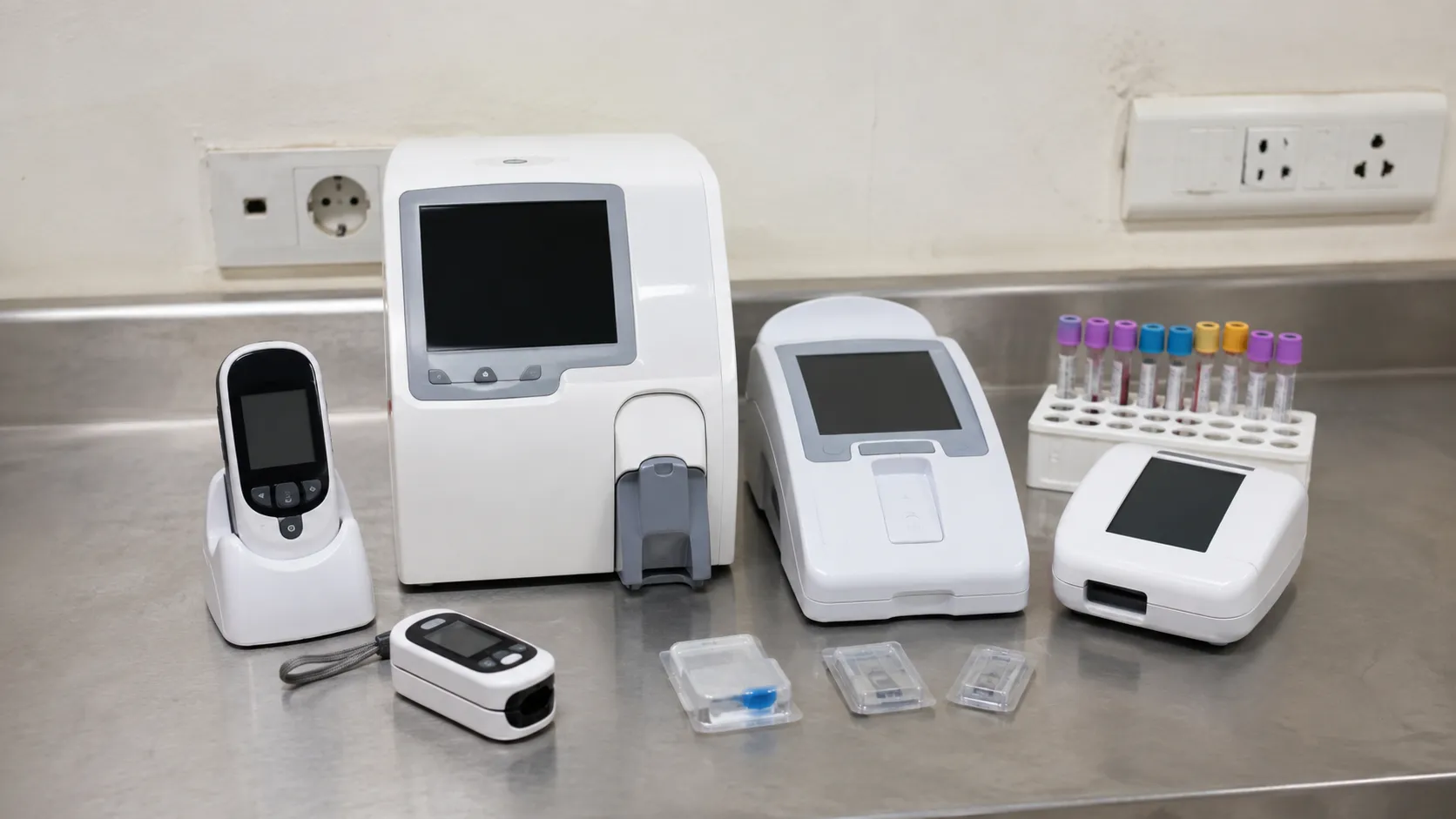
Point-of-care testing moves diagnosis from the central laboratory to the patient — the bedside, the clinic, the ambulance, or the community. It spans devices as simple as a glucose test strip and as complex as a portable blood gas or molecular test platform, and the common thread is that results are available in minutes rather than hours. Understanding those groups helps any service plan, compare options and budget sensibly.
This guide walks through the main types of point-of-care testing devices used worldwide, what each does, where it fits, and how to choose — with notes on approval across the UK, the EU, the US, the Gulf (GCC) states, and South Africa.
The short version — POCT devices in three groups
Most POCT devices fall into one of three groups — metabolic and critical care testing, rapid infection and immunoassay testing, and compact analysers that bring the laboratory to the bedside.
-
Metabolic & critical care — glucose meters, blood gas analysers and coagulation devices for urgent bedside results.
-
Rapid & immunoassay — lateral flow tests and rapid immunoassay readers for infection, inflammation and markers.
-
Compact analysers — portable chemistry, haematology and molecular platforms for near-patient testing.
Types of point-of-care testing devices
-
Blood glucose meters. Handheld meters and continuous glucose monitors for diabetes management and inpatient glucose control.
-
Blood gas & electrolyte analysers. Portable analysers for pH, blood gas, electrolytes and lactate at the bedside or in critical care.
-
Coagulation POCT. INR meters and viscoelastic testing for anticoagulation management and surgical coagulation monitoring.
-
Rapid antigen & LFT. Lateral flow tests for influenza, COVID-19, RSV, streptococcus and other pathogens, for immediate results.
-
Rapid immunoassay readers. Reader-based systems for quantitative cardiac markers, CRP, D-dimer and hormones at the point of care.
-
Urine analysis. Dipstick analysers and urine culture rapid tests for urinalysis in clinics and the community.
-
Portable haematology & chemistry. Compact multi-analyte analysers bringing haematology and biochemistry to remote or resource-limited settings.
-
Molecular POCT. Rapid PCR platforms for influenza, COVID-19, GAS and STIs, giving laboratory-quality molecular results in minutes.
What each type does
|
Category |
Examples |
Used for |
|
Glucose meters |
Handheld meters, CGM devices |
Glucose in diabetes and inpatients |
|
Blood gas analysers |
Portable blood gas, electrolyte |
pH, gases, electrolytes, lactate |
|
Coagulation POCT |
INR meters, viscoelastic |
Anticoagulation and surgical coag |
|
Rapid antigen/LFT |
Lateral flow tests |
Fast pathogen detection |
|
Immunoassay readers |
Quantitative POCT readers |
Cardiac markers, CRP, D-dimer |
|
Urine analysis |
Dipstick analysers |
Urinalysis in clinics |
|
Portable analysers |
Compact haematology/chemistry |
Near-patient lab testing |
|
Molecular POCT |
Rapid PCR platforms |
Molecular pathogen testing |
POCT and central laboratory compared
Point-of-care testing and the central laboratory each have distinct strengths in clinical care.
|
Approach |
Turnaround |
Best for |
Consider |
|
Central lab |
30 min to hours |
Complex, high-volume testing |
Delay; transport; staffed 24h |
|
POCT |
Minutes |
Urgent decisions, remote, community |
Cost per test; QC; training |
|
Lateral flow |
2-15 minutes |
Rapid screening |
Qualitative; sensitivity limits |
|
Molecular POCT |
15-60 minutes |
High-accuracy near-patient molecular |
Cost; platform limitations |
POCT complements but does not replace the central laboratory — it is best used for decisions that cannot wait, in settings where transport would delay care.
Equipping a point-of-care testing service?
We'll help you choose the right kit. Tell us the tests, your setting and your market — we'll help you pick POCT devices that fit your service and are approved for use where you'll use them.
No pressure, no obligation. → Talk to the team
POCT devices by setting
-
Emergency departments - blood gas, lactate, troponin and rapid infection testing for fast triage and diagnosis.
-
Critical care and theatres - blood gas, coagulation, glucose and viscoelastic testing at the bedside.
-
Primary care and community - glucose meters, urine strips, CRP, rapid antigen and pregnancy tests.
-
Ambulance and pre-hospital - portable blood gas, glucose and haemoglobin for care before hospital arrival.
-
Remote and resource-limited - compact multianalyte analysers and lateral flow tests where laboratory access is limited.
Choosing point-of-care testing devices
-
Define the tests, clinical decisions and settings the devices must support.
-
Match lateral flow, quantitative and molecular platforms to those needs.
-
Plan quality control, training and connectivity to laboratory information systems.
-
Confirm IVD regulatory approval and POCT governance requirements.
-
Plan consumables, calibrators and service support into the running cost.
Reagents, consumables and quality control dominate POCT running costs — weigh device purchase against reagent lock-in, confirm IVD approval, and plan governance and training before deployment.
Emerging point of care testing technology
-
Rapid molecular testing. Platforms delivering PCR-quality molecular results in under 15 minutes are expanding rapidly.
-
Multiplex lateral flow. Single tests detecting multiple pathogens simultaneously at the point of care.
-
Continuous monitoring. CGM and continuous lactate monitoring move real-time data to the bedside.
-
Connected POCT. Results uploaded automatically to the electronic record, removing manual transcription.
-
Miniaturised lab-on-chip. Microfluidic devices combine multiple tests on a single disposable card.
Approval by region
|
Region |
Regulator |
Requirement |
|
United Kingdom |
UKCA mark (CE accepted to 2028–2030) |
|
|
European Union |
CE marking (EU IVDR for diagnostics) |
|
|
United States |
510(k) clearance or PMA approval |
|
|
Gulf (GCC) |
SFDA & GCC bodies |
National registration / GCC conformity |
|
South Africa |
Medical device licensing |
Point-of-care testing devices are regulated as in-vitro diagnostics and follow IVD-specific approval pathways. For clinical and quality guidance, the NICE and World Health Organisation resources are useful references. Our buyer hub sets out how to purchase with confidence.
More from Business
-
Buyers — source blood gas analysers, rapid tests and POCT devices for your clinic or hospital.
-
Suppliers — list your point-of-care testing devices and reach buyers worldwide.
-
Advertise — promote your products and services to a clinical audience.
-
Business overview — explore everything MediGear offers healthcare organisations.
Disclaimer
This article is for general information only and does not constitute clinical, laboratory, medical, procurement or regulatory advice. POCT devices, requirements and regulations vary by country, setting and need, and change over time. Always confirm that devices suit the intended clinical use and are approved for your market (for example, UKCA, CE under the EU IVDR, FDA, SFDA/GCC or SAHPRA), follow POCT governance and quality-control requirements, and consult qualified laboratory, clinical and procurement professionals for decisions specific to your organisation. medigear.uk accepts no liability for actions taken based on this content.
The right point of care testing for your service.
From blood glucose meters, blood gas analysers and rapid infection tests to cardiac markers, CRP analysers and urine test strips, we supply point of care testing devices to hospitals and clinics across the UK, Europe, the US, the Gulf and South Africa.
Frequently Asked Questions
POCT devices include blood glucose meters and continuous glucose monitors, portable blood gas and electrolyte analysers, coagulation devices including INR meters and viscoelastic systems, lateral flow rapid antigen tests, quantitative immunoassay readers for cardiac markers, CRP and D-dimer, urine dipstick analysers, compact portable haematology and chemistry analysers, and rapid molecular PCR platforms.
A lateral flow test uses antibodies to detect antigens from a sample and gives a visual positive or negative result in minutes — fast and simple but less sensitive than PCR. A PCR test amplifies and detects genetic material, giving high sensitivity and specificity, and rapid POCT PCR platforms now deliver results in 15–60 minutes near the patient, combining molecular accuracy with rapid turnaround.
A blood gas analyser measures pH, oxygen and carbon dioxide levels, bicarbonate, electrolytes and lactate from a small arterial or venous blood sample, giving results in minutes. It is used in emergency, critical care and anaesthesia settings where decisions about ventilation, acid-base balance and resuscitation cannot wait for the central laboratory.
Some POCT instruments such as blood gas analysers and immunoassay readers are available as certified refurbished units. Confirm certified refurbishment, a warranty, calibration, consumable compatibility and quality-control support, and check the device is approved for your market. Lateral flow and molecular platforms are often bought new due to rapid technology updates and tight consumable integration.
POCT devices are regulated as in-vitro diagnostics and must be approved for the market — UKCA or CE under the EU IVDR in the UK and EU, FDA clearance in the US, and SFDA or SAHPRA registration in the Gulf and South Africa. POCT governance, operator training, quality control and connectivity to laboratory systems are also required in most markets.
POCT quality control uses liquid controls run at defined intervals to verify analyser performance, external quality assessment schemes comparing results across sites, and regular calibration and maintenance. Governance frameworks define operator training, device authorisation and result reporting, and many modern POCT systems include connectivity to middleware that tracks QC, results and operator compliance centrally.